


AUK Goes to Harvard
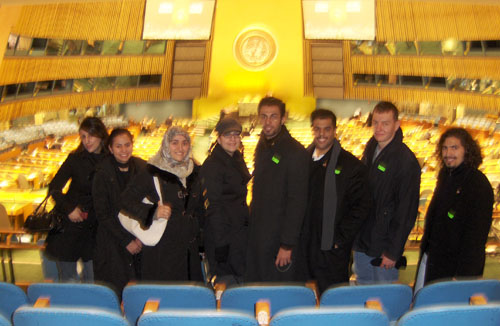
The Model United Nations of the American University of Kuwait (MUNAUK) @ The Harvard National Model United Nations Conference (HNMUN)
Under the generous patronage of the Deputy Prime Minister and Minister of Foreign Affairs, Sheikh Dr. Mohammad Sabah Al-Salim Al-Sabah, six students and two faculty advisors took off to Boston, Massachusetts in the United States of America on 11 February 2008 to participate in the 54th Harvard National Model United Nations Conference (HNMUN) from 14-17 February.
HNMUN is the oldest and most prestigious MUN conference and has participants from all over the world. This year, over 3,000 participants, from 170 different participating universities from over 35 countries took part representing 192 countries in 24 committees over four days. The American University of Kuwait was the first university from Kuwait to participate in the history of American Model United Nations conferences. AUK was one of three Arab delegations to take part this year; the other two being from Morocco and Iraq.
Model United Nations is a simulation of the functional dynamics of the well-known international organization, the United Nations. Each student represents the foreign policy of an assigned state and applies this towards various topics in certain committees.
For this conference, the Model United Nations at the American University of Kuwait team was assigned by the Harvard conference administration to represent the countries of Namibia and Grenada in four committees. The following students participated in the conference:
The students were accompanied by Faculty Advisor and Assistant to the President of AUK, Ms. Shareefa Al-Adwani, and Assistant Professor of History, Dr. Christopher Ohan.
Prior to the HNMUN conference, MUNAUK was eager to meet up with Kuwait's Ambassador to the United States Sheikh Salim Al-Jabir Al-Abdullah Al-Sabah in Washington, D.C., as well as with Kuwait's Ambassador to the United Nations Abdullah Al-Murad in New York.
Sheikh Salim, Kuwait's Ambassador to the United States, listened to the MUNAUK member's topics to be discussed at the conference and stressed that the key to successful diplomacy was extensive lobbying to garner the support of people. He also emphasized creating a comprehensive argument with feasible solutions for the topic at hand with regards to the assigned state's interest.
Ambassador Abdullah Al-Murad spoke to MUNAUK about Kuwait's role in the United Nations and its workings with other regional organizations, primarily the Gulf Cooperation Council (GCC), the Arab League and the Organization of Islamic Countries (OIC).
Both Ambassadors warmly received the MUNAUK members and advised the members on a number of items to remember, primarily, the key traits required of a successful diplomat: to be hard working, determined to succeed, willing to make sacrifices, and to have discipline.
Also, Kuwait's Cultural Attache Dr. Fatima Nazar, warmly welcomed MUNAUK at the Cultural Division of the Kuwaiti Embassy in Washington DC and engaged in fruitful discussions on our future career paths and Kuwaiti politics. Her encouragement and support of Kuwaiti students provided to be positive motivation for students seeking higher education as well as positions in diplomatic arenas.
In addition, MUNAUK also took tours of the United Nations building in New York as well as of the Capitol building and the Congressional gallery in Washington, D.C.
After several months of preparation including participating in the Bahrain Universities Model United Nations (BUMUN) December 2007, confidence was high and unwavering as the MUNAUK members stepped into the committees.
The double delegation of Yusuf Al-Rashed and Norah Al-Hilaly representing Grenada in the Organization of American States (OAS) saw them discuss the sensitive topic of drug trafficking and its relation with terrorism with both Yusuf and Norah engaging in behind the scenes negotiations with 34 other double delegations to pass several important clauses in the final resolution and an amendment.
In the African Union, composed of over 40 delegates, Dana Shamlawi represented Namibia and was very active in collaborating with other African States on some major issues, and was most notable for leading debate on the topic of empowering women in African societies. Her focus was on importance of women's education and the ample social and economic opportunities that come out of education, and was able to pass a clause on that notion.
In the United Nations Higher Commission for Refugees, Farah Al-Shamali represented Namibia and was very active in finding common ground with other delegates on the very sensitive issue of the plight of Iraqi refugees following the 2003 Iraq War, proposing that neighboring countries taking in these refugees must be aided by the international community. She passed several amendments on the issue.
The World Trade Organization had both Fahad Mohammad and Fahad Al-Tukhaim representing Namibia and Grenada respectively as they negotiated and debated with over 100 other delegates on the topic of Trade and development. Fahad Al-Tukhaim led the Caribbean interests with regards to development and trade, noting that it is impossible to continue on the path of development when Caribbean nations are prone to suffer from natural disasters. He was successful in passing a clause that ensured an insurance policy with regards to natural disasters on loans taken by Caribbean nations and successfully lobbied for the International Monetary Fund and World Bank to ease their agreements on those nations that are prone to natural disasters.
Fahad Mohammad, representing Namibia, was successful in writing up a working paper that became one of the pillars of the final WTO resolution, arguing that less developed nations require much economic diversity, more foreign direct investment in the fields of logistics, telecommunications, and communications and much more concerted technical and financial assistance in order to alleviate the poverty and unemployment in the third world. Collaborating with the EU and the US, their resolution passed with a vote of 56 for, 13 against and 6 abstaining. For his diplomatic skill, Fahad Mohammad was awarded the Best Delegate in the World Trade Organization becoming the first Kuwaiti to win the highest award.
All MUNAUK members emerged from those four days with stronger negotiating skills and increased diplomatic experience as well as a greater belief in their abilities to make a change for the future. Through compromise and collaboration, students had to put aside their preconceived notions and instead listened earnestly to others while still holding on to the assigned states principles and interests in order to come up with feasible resolutions, clauses and agreements.
Numerous goals set out by the MUNAUK members were achieved. First of all, MUNAUK was able to represent the youth of Kuwait positively. It was able to put the American University of Kuwait on the academic map as it competed against the most prestigious American and international universities. The trip was proof that once students are given the opportunity to practice what was learned and platform to pragmatically exercise education, they can accomplish grand things and challenge the best of the best.
It was an accomplishment to participate in the biggest and most prestigious MUN conference after only 15 months after MUNAUK's founding. It was satisfying to see three founding members of MUNAUK, Fahad Mohammed, Fahad Al-Tukhaim, and Ms. Shareefa Al-Adwani enjoy the fruit of their hard work so soon.
Under the generous patronage of the Deputy Prime Minister and Minister of Foreign Affairs, Sheikh Dr. Mohammad Sabah Al-Salim Al-Sabah, six students and two faculty advisors took off to Boston, Massachusetts in the United States of America on 11 February 2008 to participate in the 54th Harvard National Model United Nations Conference (HNMUN) from 14-17 February.
HNMUN is the oldest and most prestigious MUN conference and has participants from all over the world. This year, over 3,000 participants, from 170 different participating universities from over 35 countries took part representing 192 countries in 24 committees over four days. The American University of Kuwait was the first university from Kuwait to participate in the history of American Model United Nations conferences. AUK was one of three Arab delegations to take part this year; the other two being from Morocco and Iraq.
Model United Nations is a simulation of the functional dynamics of the well-known international organization, the United Nations. Each student represents the foreign policy of an assigned state and applies this towards various topics in certain committees.
For this conference, the Model United Nations at the American University of Kuwait team was assigned by the Harvard conference administration to represent the countries of Namibia and Grenada in four committees. The following students participated in the conference:
| Name | Country Representing | Committee |
| Fahad Mohammed (President of MUNAUK and Head Delegate) |
Namibia | World Trade Organization |
| Fahad Al-Tukhaim (Vice President of MUNAUK) |
Grenada | World Trade Organization |
| Yusuf Al-Rashed | Grenada | Organization of American States |
| Norah Al-Hilaly | Grenada | Organization of American States |
| Dana Shamlawi | Namibia | African Union |
| Farah Al-Shamali | Grenada | United Nations Higher Commissions for Refugees |
The students were accompanied by Faculty Advisor and Assistant to the President of AUK, Ms. Shareefa Al-Adwani, and Assistant Professor of History, Dr. Christopher Ohan.
Prior to the HNMUN conference, MUNAUK was eager to meet up with Kuwait's Ambassador to the United States Sheikh Salim Al-Jabir Al-Abdullah Al-Sabah in Washington, D.C., as well as with Kuwait's Ambassador to the United Nations Abdullah Al-Murad in New York.
Sheikh Salim, Kuwait's Ambassador to the United States, listened to the MUNAUK member's topics to be discussed at the conference and stressed that the key to successful diplomacy was extensive lobbying to garner the support of people. He also emphasized creating a comprehensive argument with feasible solutions for the topic at hand with regards to the assigned state's interest.
Ambassador Abdullah Al-Murad spoke to MUNAUK about Kuwait's role in the United Nations and its workings with other regional organizations, primarily the Gulf Cooperation Council (GCC), the Arab League and the Organization of Islamic Countries (OIC).
Both Ambassadors warmly received the MUNAUK members and advised the members on a number of items to remember, primarily, the key traits required of a successful diplomat: to be hard working, determined to succeed, willing to make sacrifices, and to have discipline.
Also, Kuwait's Cultural Attache Dr. Fatima Nazar, warmly welcomed MUNAUK at the Cultural Division of the Kuwaiti Embassy in Washington DC and engaged in fruitful discussions on our future career paths and Kuwaiti politics. Her encouragement and support of Kuwaiti students provided to be positive motivation for students seeking higher education as well as positions in diplomatic arenas.
In addition, MUNAUK also took tours of the United Nations building in New York as well as of the Capitol building and the Congressional gallery in Washington, D.C.
After several months of preparation including participating in the Bahrain Universities Model United Nations (BUMUN) December 2007, confidence was high and unwavering as the MUNAUK members stepped into the committees.
The double delegation of Yusuf Al-Rashed and Norah Al-Hilaly representing Grenada in the Organization of American States (OAS) saw them discuss the sensitive topic of drug trafficking and its relation with terrorism with both Yusuf and Norah engaging in behind the scenes negotiations with 34 other double delegations to pass several important clauses in the final resolution and an amendment.
In the African Union, composed of over 40 delegates, Dana Shamlawi represented Namibia and was very active in collaborating with other African States on some major issues, and was most notable for leading debate on the topic of empowering women in African societies. Her focus was on importance of women's education and the ample social and economic opportunities that come out of education, and was able to pass a clause on that notion.
In the United Nations Higher Commission for Refugees, Farah Al-Shamali represented Namibia and was very active in finding common ground with other delegates on the very sensitive issue of the plight of Iraqi refugees following the 2003 Iraq War, proposing that neighboring countries taking in these refugees must be aided by the international community. She passed several amendments on the issue.
The World Trade Organization had both Fahad Mohammad and Fahad Al-Tukhaim representing Namibia and Grenada respectively as they negotiated and debated with over 100 other delegates on the topic of Trade and development. Fahad Al-Tukhaim led the Caribbean interests with regards to development and trade, noting that it is impossible to continue on the path of development when Caribbean nations are prone to suffer from natural disasters. He was successful in passing a clause that ensured an insurance policy with regards to natural disasters on loans taken by Caribbean nations and successfully lobbied for the International Monetary Fund and World Bank to ease their agreements on those nations that are prone to natural disasters.
Fahad Mohammad, representing Namibia, was successful in writing up a working paper that became one of the pillars of the final WTO resolution, arguing that less developed nations require much economic diversity, more foreign direct investment in the fields of logistics, telecommunications, and communications and much more concerted technical and financial assistance in order to alleviate the poverty and unemployment in the third world. Collaborating with the EU and the US, their resolution passed with a vote of 56 for, 13 against and 6 abstaining. For his diplomatic skill, Fahad Mohammad was awarded the Best Delegate in the World Trade Organization becoming the first Kuwaiti to win the highest award.
All MUNAUK members emerged from those four days with stronger negotiating skills and increased diplomatic experience as well as a greater belief in their abilities to make a change for the future. Through compromise and collaboration, students had to put aside their preconceived notions and instead listened earnestly to others while still holding on to the assigned states principles and interests in order to come up with feasible resolutions, clauses and agreements.
Numerous goals set out by the MUNAUK members were achieved. First of all, MUNAUK was able to represent the youth of Kuwait positively. It was able to put the American University of Kuwait on the academic map as it competed against the most prestigious American and international universities. The trip was proof that once students are given the opportunity to practice what was learned and platform to pragmatically exercise education, they can accomplish grand things and challenge the best of the best.
It was an accomplishment to participate in the biggest and most prestigious MUN conference after only 15 months after MUNAUK's founding. It was satisfying to see three founding members of MUNAUK, Fahad Mohammed, Fahad Al-Tukhaim, and Ms. Shareefa Al-Adwani enjoy the fruit of their hard work so soon.
MUNAUK students at the General Assembly of the United Nations in New York
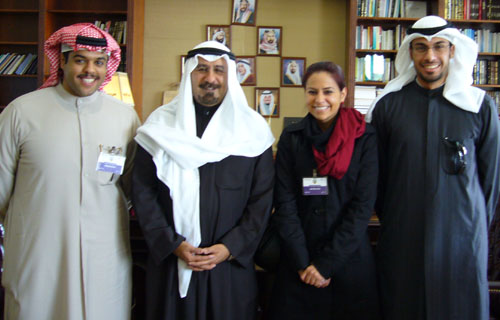
The three founders of MUNAUK, Faculty advisor Shareefa Al-Adwani, President Fahad Mohammad and Vice President Fahad Al-Tukhaim meeting the Deputy Prime Minister and Minister of Foreign Affairs his Excellency Sheikh Dr. Mohammad Sabah Al-Salim Al Sabah in his office prior to their trip to Harvard
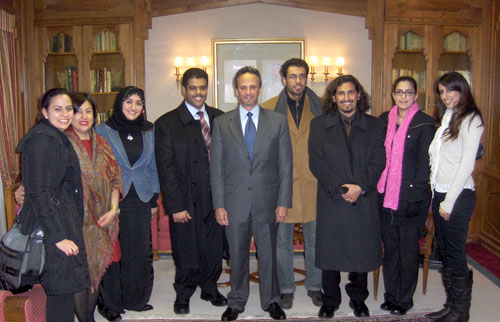
Meeting the Kuwaiti Ambassador to the United States His Excellency Ambassador Sheikh Salim Al-Abdullah Al-Jaber Al-Sabah along with the Cultural Attache Dr. Fatima Nazar in Washington DC
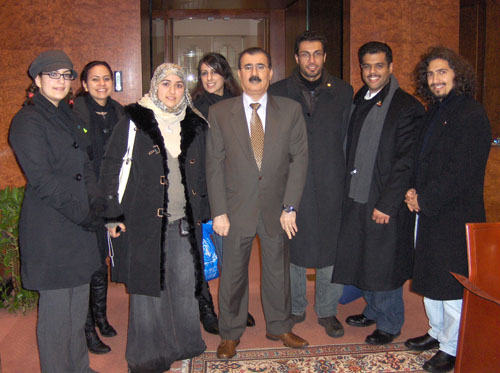
Meeting the Permanent Representative of Kuwait to the United Nations His Excellency Ambassador Abdullah Al-Murad in New york
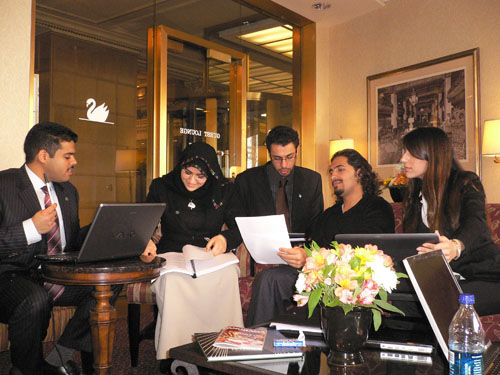
MUNAUK students hard at work on their speeches and Arguments
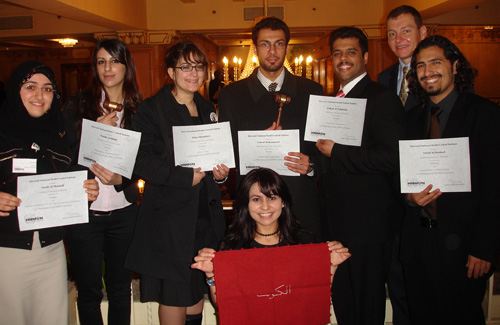
MUNAUK students with their certificates of Participation from Harvard National Model United Nations (HNMUN)
Related News
AUK Students Embark on Semester Abroad at Sciences Po
27, Sep 2026
Dr. Nizar Hamzeh Publishes Research on Kuwait’s Constitutional Approach to International Law
16, Sep 2026
AUK Provides 200 School Bags to Support Families in Collaboration with LOYAC
13, Sep 2026
AUK Tutoring Center Renews International CRLA Certification
25, Aug 2026
American University of Kuwait Partners with Ruba to Facilitate Flexible Tuition Payment Solutions
24, Aug 2026
American University of Kuwait Professor Clark Stoeckley Showcases Work at Dartmouth
18, Aug 2026
American University of Kuwait and Kuwait Airways Sign Memorandum of Understanding to Strengthen Academic and Professional Collaboration
09, Aug 2026
AUK Faculty Strengthen International Research Collaboration Through Dartmouth Partnership
26, Jul 2026
AUK Showcases Its Academic Programs at Universities Exhibition
24, Jul 2026
AUK Signs an MOU with the Kuwait Association of Accountants and Auditors to Strengthen Academic and Professional Collaboration
22, Jul 2026