

AUK Holds Discussion on "Degrees of Belonging in Kuwait"
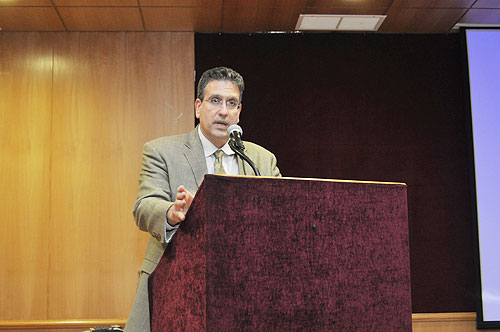
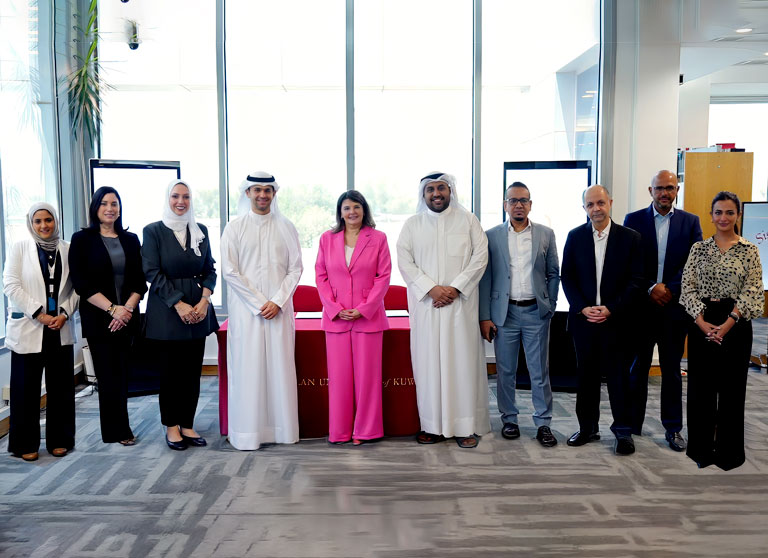
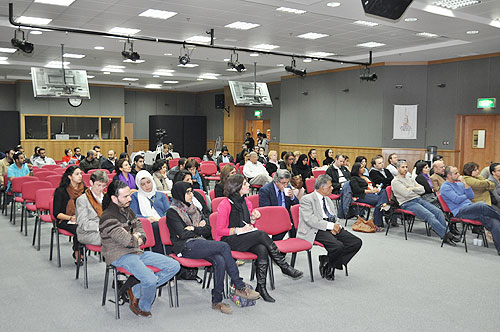
A panel discussion entitled "Degrees of Belonging in Kuwait" was held at the American University of Kuwait (AUK) on February 22. The panel discussion was co-organized by the Social and Behavioral Sciences Program (SBSA) and the Human Rights Club.
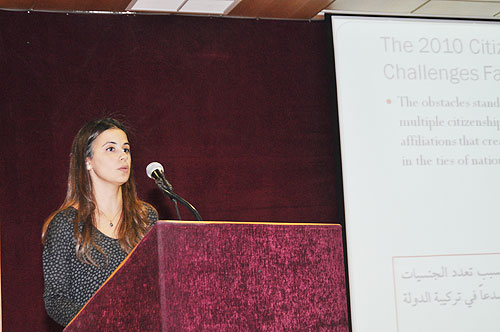
The panel discussion, which was sponsored by the Center for Gulf Studies (CGS) at AUK, tackled questions pertaining to levels of citizenship, gender inequality in cases of Kuwaiti women married to non-Kuwaitis, national identity, and statelessness. The panel, consisted of four guest speakers; Dr. Ibtihal Al-Khatib, Assistant Professor of English and Literature at Kuwait University; Ms. Rania Al Nakib, M.Ed, and Ph.D. Candidate at the Institute of Education, University of London; Dr. Mohammad Al-Wuhaib, Assistant Professor of Philosophy at Kuwait University and also the Director of the Kuwait Center for Active Citizens; and Dr. Ghanim Al-Najjar, Professor of Political Science at Kuwait University and Board Member of the Arab Human Rights Fund.
During his speech, Al- Wahaib discussed the historical and social context of citizenship in Kuwait pointing to the way Arab States were carved out of European and Ottoman colonial the needs and Arab identities formed from post-colonial nation-making efforts. According to Al- Wahaib, the colonial history created totalitarian regimes that often identified the country's name with that of the ruling families, such as in the case of Saudi Arabia.
Al-Nakib, who is conducting research on civic education curriculum in Kuwaiti government schools, spoke of how education modules in Kuwait conflate citizenship with national identity. According to Al-Nakib, belonging and participation in the Kuwaiti society is usually associated with adult Muslim males of origin, leaving out women, young adults, Christian Kuwaitis, or Kuwaitis who do not to reveal their religious affiliations. Al- Nakib also talked about the limitations and challenges faced by teachers conducting classes about this issue.
Reinforcing the research findings of Ms. Al-Nakib's, Al-Najjar spoke of his experience with the Human Rights curriculum, which he worked on developing, and how it had been politicized and Islamized. In his own point of view, belonging and citizenship should never be equated because a person could belong without having citizenship and vice versa. Referring to his comparative analysis on identity and conflict in Somalia, Iraq and Kuwait, Al-Najjar argued that the case of Kuwait is less complex than those other countries. Al-Najjar also explained how fear of loss of status permeates Kuwaiti society and how the government contributed to that fear.
From a human rights perspective, Al-Khatib focused on how Kuwaiti women are treated as second class citizens because of the patriarchal way of passing citizenship to offspring, which deprives children of Kuwaiti women married to non-Kuwaitis from receiving citizenship. Al-Khatib specifically shed light on the case of Kuwaiti women married to Bidoons, a status in which women are usually alienated from the legal system and socially pressured into divorce. Referring to the history of Bidoons, Al-khatib emphasized the link between the legal issues of Bidoons and the recent protests and arrests. Al-Khatib concluded her discussion by pointing out solutions to the current Bidoon issue including, granting citizenships to bidoons who qualified, reissuing the "Green Card" ID for those of whom it was pulled back, and the release of those who are still detained.
Released by the Office of Public Affairs on the 28th February 2012
Photography by the Office of Public Affairs (C) 2012
Related News