

AUK Participates in Live CNN Web Discussion
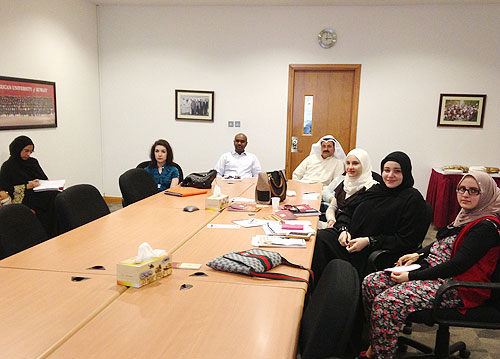
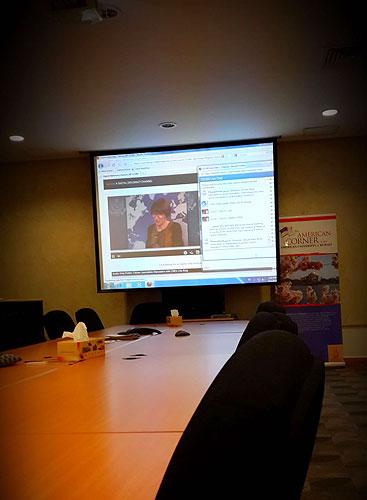
In celebration of the World Press Freedom Day, the American University of Kuwait (AUK) participated in a live web discussion on May 2nd with the CNN Senior Director for Social News.
The event, sponsored by the AUK Library, featured Lila King, who leads CNN's user-generated news website called iReport. King shared her thoughts and personal stories on citizen journalism and answered questions on the topic from different communities. Participants in the discussion tuned in from various parts of the world including Colombo, Dhaka, Hong Kong, Kuwait City, Lagos, and Riyadh, to ask questions about what King also refers to as "participatory journalism."
According to King, iReport is an initiative by CNN that allows regular citizens from around the globe to contribute to newsgathering by submitting videos, photographs, and stories about their communities. It is a means through which people can document their daily experiences and share them with the world in a journalistic setting. According to CNN, the tool invites everyone to have the opportunity to contribute and be part of story coverage. This allows a personal and nuanced view of an event or experience to be broadcasted to a global audience from a unique perspective. According to King, these experiences take the public into the "heart of the story" and help "expand our knowledge of communities in every corner of the world."
She further expressed that "seeing a story from the inside out and learning what it's really like to live through something and experience it is the best way in many cases to convey to the rest of us why we should care, why something really matters, and why we should get invested."
iReport is used mostly for stories related to breaking news, natural disasters, and weather reports, as often, a person can film, photograph, or describe the action on the spot as it unfolds around them faster than a news agency can. The prevalence of technological tools such as handheld digital devices and smartphone cameras has made this possible, which is transforming the way we experience the news.
One of the questions featured in the discussion was by an AUK participant, who asked if there was a particularly important and memorable contribution made to iReport. One contribution that stood out was during the Haitian earthquake in 2010. iReport received thousands of photos of the devastation, and people began to post photos of lost family members and friends on the platform. As stated by King, iReport started the process of restoring contact between separated family members through an initiative called "Looking for loved ones." By combining CNN's worldwide reach with social media, they created a compelling service. CNN formed a database of people who had been lost and found that was continuously updated in real time. Through the database, people with family and friends in Haiti were able to obtain information about their loved ones from others within the community who had seen them. The service was an example of a collaborative effort between CNN and iReporters who contributed worldwide.
In discussions of citizen journalism, there is always the question of whether citizen journalism poses a threat to professional journalism. King supports the opinion that professional journalists tend to adhere to journalistic ethics and standards that seek fair and balanced coverage, whereas citizen journalists may lack the expertise and practice of gathering, fact checking, and analyzing information, and thus each type of journalism has its own niche.
In response to a question raised by a viewer from Ghana concerning a code of ethics for citizen journalists, King mentions that a code for participatory journalists is yet to be established. She further discussed at length the "dangers" of social media as Facebook, Twitter, and Instagram. When it comes to social media, it is crucial that news channels ensure that citizen journalists report with integrity and serve their audiences candidly, much like professional journalists strive to ensure that information disseminated is truthfully conveyed. Journalists, therefore, have the responsibility to verify what circulates in social media by sifting truth from falsehood. "When we are all documenting the world, it just means we bear a shared responsibility to maintain ethics," King says.
To conclude her argument, King stressed that both schemes of journalism can coexist and collaborate, especially in instances when professional journalists have difficulty accessing the setting or people crucial to their story for one reason or another. "The combination and collaboration between citizens and professionals is what makes citizen journalism so incredibly powerful," King confirms. When citizens tell stories about something they are involved in, it becomes part of the larger global conversation, as the role of traditional media is to "pick up the signal, tease out the stories, and amplify them through their channels." This helps shed light on various issues that need attention. It is that connection that makes both citizen and professional journalists build a collaborative, communal, and symbiotic relationship with one another.
An audience member is no longer merely a viewer of news anymore. As a result of citizen journalism, citizens can now help add new voices to the daily commentary on world events.
Commenting on the live web discussion, Asma Al-Kanan, AUK Library Director, said, "It was really exciting to me to see students interact with international experts and other students and groups around the world by submitting questions through digital media. This is an interesting new way of exchanging thoughts and getting involved globally."
Released by the Office of Public Affairs on the 12th May 2013
Photography by the Office of Public Affairs (C) 2013
Related News