

AUK's Dr. Raymond Farrin Interviewed on Al-Rai TV
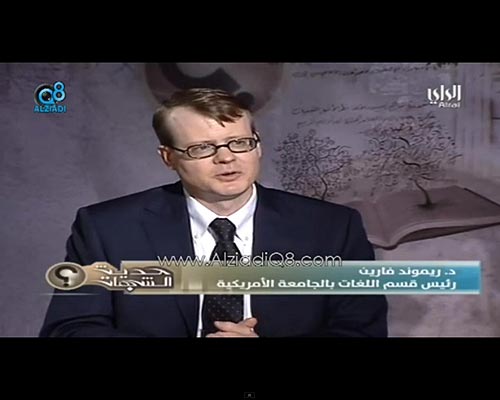
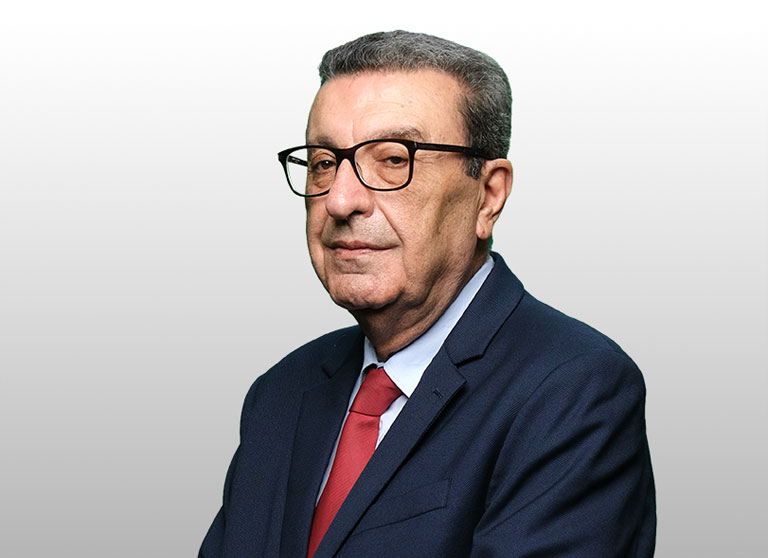
On October 21, Dr. Raymond Farrin, Chair of the Department of Arabic and Foreign Languages, was interviewed on Kuwait's Al-Rai TV about his book on classical Arabic poetry, Tharwa Min Al-Badiya (Abundance from the Desert). He was hosted by Dr. Muhammad Al-Awadhi on the show "Hadith Al-Shubuhaat" ("Speaking of Doubts.")
Dr. Al-Awadhi began the program by asking about Dr. Farrin's background of Arabic study in Cairo and later at Berkeley, expressing curiosity about what enamored him especially of the Arabic language. Dr. Farrin explained that he was attracted initially by the Arabic language's strange sounds (to an American ear), its rigorous grammar, its wonderfully rich literature, and its challenging nature "...such that one feels that there is always more to learn and new vocabulary to master, particularly in older texts."
The interview also tackled Dr. Taha Husayn's surprising1925 attack on pre-Islamic poetry, in which he contended that most of what the public considers as "pre-Islamic poetry" was actually forged at a later date. Dr. Farrin pointed out that recent scholarship has rendered this position untenable. "For example, it is clear that the early Umayyad poet Umar ibn Abi Rabi'a patterns himself after the pre-Islamic poet Imru' al-Qays- but could he have done so if Imru' al-Qays' poetry was invented later?" In the end, though, Taha Husayn's skepticism proved useful, as Dr. Farrin emphasized, since it stimulated new research and led to even greater confidence about the authenticity of pre-Islamic poetry.
During the interview, Dr. Al-Awadhi also asked about the contention by some Western scholars that classical Arabic poetry, beautiful as it may be, is not arranged coherently. Dr. Farrin responded with examples of ring composition (according to which the beginning connects to the end and the main element lies in the center, similar to the arrangement of a necklace) in works by Imru' Al-Qays, Al-Khansa', and Al-Mutanabbi.
The interview concluded with some remarks about the structure of the Holy Qur'an. Dr. Farrin referred to the assertions by various Western critics that the Holy Book is not put together cohesively. Against this claim, he mentioned earlier works in the field of 'Ilm Al-Munasaba (The Science of Correlations) that highlight the connectedness of the Qur'an, and gave examples of adjacent suras being closely linked structurally. Indeed, as Dr. Farrin contended, "close examination of the Qur'an from a structural perspective leads to the conclusion that the Book possesses a magnificent design."
The interview may be seen in full by clicking on the link below: www.youtube.com/watch?v=Y4hfciTII5A
Released by the Office of Public Affairs on the 23rd October 2013
Related News