

AUK's Human Rights Club Holds Discussion on Civil Engagement and Democracy
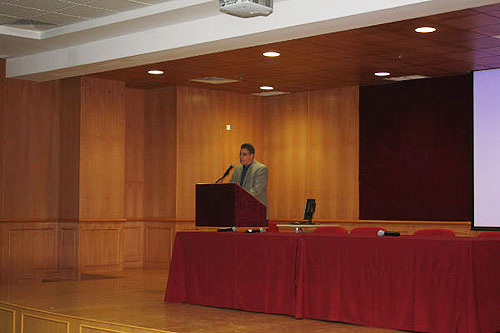
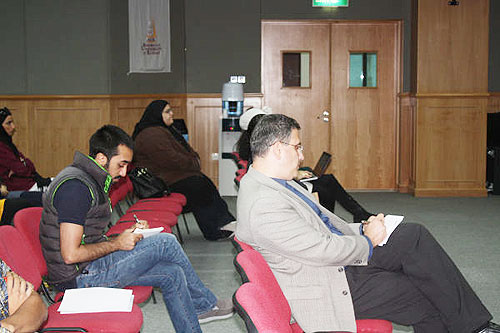
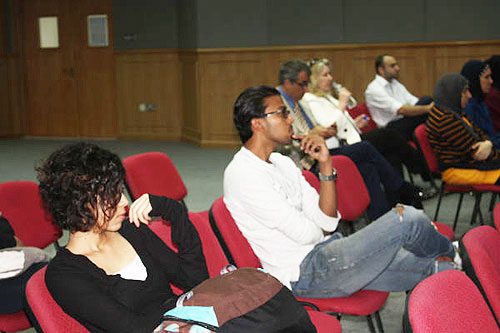
The Human Rights Club at the American University of Kuwait organized a discussion titled "Civil Engagement & Democracy" in the AUK Auditorium to explore the challenges and strategies for building greater citizen participation and social engagement in Kuwait. The speakers included Dr. Mohammad Al-Wuhaib, Professor of Philosophy at Kuwait University and the Director of the Kuwait Center for Activate Citizens, as well as Mr. Slobodan Milic, Deputy Director of the Gulf Program of the National Democratic Institute Regional Office in Dubai.
Dr. Al-Wuhaib began the discussion with a brief history of the formation of the modern Arab regional States. "In order to understand Kuwaiti civil societies towards democracy one must recall the history," he said. Dr. Al-Wuhaib explained the legacy of the Ottoman rule over the Arab world and the subsequent European colonial context that helped create the current dictatorships. According to Dr. Al-Wuhaib, the colonial legacy in particular left the Arab world struggling with many dualism such as secularism or sharia, tribal identity or national identity, democracy or authoritarianism. "People," he said, "end up doubting both value systems." He went on to discuss the current legal climate of civil associations in Kuwait. He said that as long as the state has the power to dissolve any association for any reason, the only associations that will develop are those that strictly support the status quo or religious institutions.
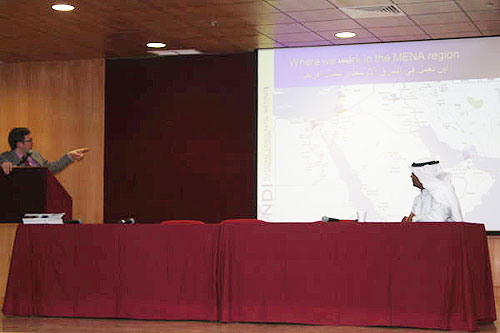
Mr. Slobodan Milic continued the discussion by speaking of possible strategies and solutions for building civil societies and enhancing democratic participation from examples drawn from different parts of the world. Mr. Milic first stated that from world history "democracy means different things to different people." He noted that some of the most repressive autocracies such as the former USSR, Hitler's Germany, Pol Pot's Cambodia, and the Bosnian militias have all called themselves democratic. Drawing from the ancient Greeks Mr. Milic defined Democratic society as "one where the citizens monitor, assess, intervene, and reorganize the system of power." He argued that citizens should take an active role within civil society to make sure that people in power don't fall into their "natural behavior" to monopolize resources and decision making. Mr. Milic emphasized the importance of women in political participation and that empowering women as political candidates should be a priority to building civil societies.
The Human Rights Club at the American University of Kuwait is a student organization that seeks to spread awareness about democracy and human rights.
The American University of Kuwait (AUK) is an independent, private, equal opportunity, and co-educational liberal arts institution of higher education. The educational, cultural and administrative structure, methods and standards of AUK are based on the American model of higher learning. The language of instruction is English. More information on the American University of Kuwait can be found at www.auk.edu.kw.
Released by the Office of Public Affairs on the 30th November 2011
Related News