

Center for Gulf Studies Hosts Lecture on Politics of the Gulf
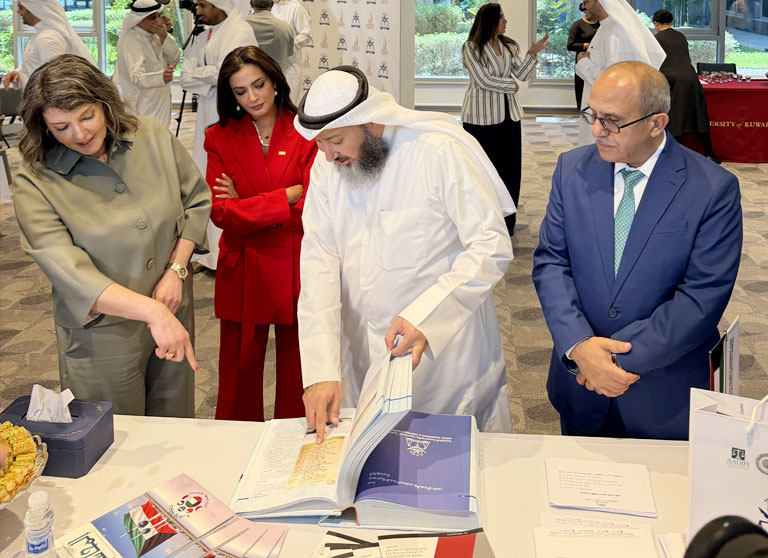
The Center for Gulf Studies at the American University of Kuwait hosted a lecture on December 5, 2012 by Dr. Mary Ann Tetreault, Cox Distinguished Professor of International Affairs Emerita at Trinity University, entitled "Politics in the Gulf Before and After the Arab Spring." During her talk Dr. Tetreault covered the different ways in which the social upheavals taking place around the Arab World, termed by many as the 'Arab Spring,' are impacting the Gulf region, with specific emphasis on Kuwait.
Dr. Tetreault began her lecture by describing the political and social evolution of the Gulf region over recent decades. According to Dr. Tetreault, the social contract between the citizens of the Gulf countries and their respective rulers has evolved away from classical rentier theory, which tends to characterize Gulf citizens as passive parties with no desire for reform so long as their material wants and needs are provided for by the ruling establishment. This theory, according to Dr. Tetreault, is no longer the case in today's Gulf society, with the demands of the Gulf citizen, and specifically the Kuwaiti, including: an increase in choice, fairness, transparency, and ultimately dignity, the latter being a universal theme across those countries that have experienced or are experiencing the so-called 'Arab Spring.' What has distinguished most of the social unrest in the Gulf region from their other Arab counterparts is the fact that such demands have not challenged the ruling system. They are instead demanding a 'rule of law' rather than a 'rule by law,' which implies an end to rampant corruption, the protection of human rights and the guarantee of equal opportunities.
Specifically within Kuwait, society has in recent years experienced increased fragmentation. Distinctions within the local Kuwaiti society include: divisions based on wealth, the badu (Bedouin) vs. the hadar (urban), the bidoon, the Sunni vs. the Shi'a, the youth vs. the old, and the religious vs. the secular. Cutting across these divisions are supra-divisions that separate those who are 'privileged' in society and from those who are not. More recently, another division cutting across all others is one that distinguishes those that support the political boycott (who Dr. Tetreault refers to as 'Reformers') from those who support political participation. Historically, Kuwait has done a poor job in addressing such divisions, and Dr. Tetreault points out that in some cases, divisions between different groups such as the hadar and badu have been exacerbated, as is the case in Kuwait's housing policy that often reinforces the spatial divide between such groups.
During the question and answer period, many in the audience mentioned the issue of wasta, the loose term describing favoritism attained through social connections. According to Dr. Tetreault, a major problem for the Gulf is that wasta has become institutionalized, and is rampant in critical areas of society such as within Parliament as well as across government institutions and ministries. In responding to another question about what the agenda was of the 'Reformers,' Dr. Tetreault emphasized that it is important to recognize that a democracy is not premised simply on having elections, but rather on establishing human rights and on guaranteeing protection of those rights, particularly those of women. When commenting on the growing antagonism between the different groups within Kuwait, Dr. Tetreault said that it is crucial for the different groups to continue dialogue and to come to terms with the fact that no group will attain everything they are demanding from the other. However, Dr. Tetreault expressed optimism for Kuwait's future when responding to a question about whether Arab countries were doomed to chaos, claiming that it is perfectly possible for there to be peaceful political reform in Kuwait so long as constant and meaningful dialogue is ensured and all parties can have their demands and grievances addressed.
The Center for Gulf Studies (CGS) at the American University of Kuwait aims to promote greater cultural understanding of and increased intellectual interest in the Gulf, by facilitating free and open academic discourse on a range of issues that both shape and challenge this critical region of the world. The goal of CGS is to enable scholars as well as political and civil society actors both within and outside the region to contribute and add value to the burgeoning field of Gulf Studies, while at the same time informing and engaging the general public. To this end, the CGS encourages, supports, and cultivates interesting and original research on the Gulf, while regularly organizing a variety of public academic events such as lectures, roundtable discussions, and conferences.
Released by the Office of Public Affairs on the 10th December 2012
Related News