

CGS Hosts "Challenges to Transition: The Egyptian Case"
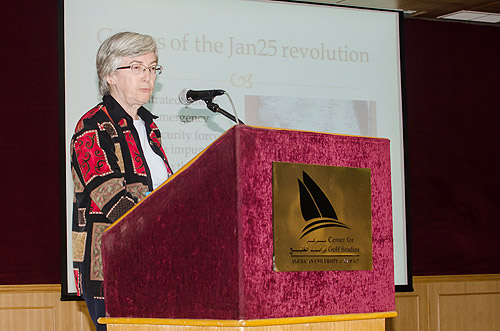
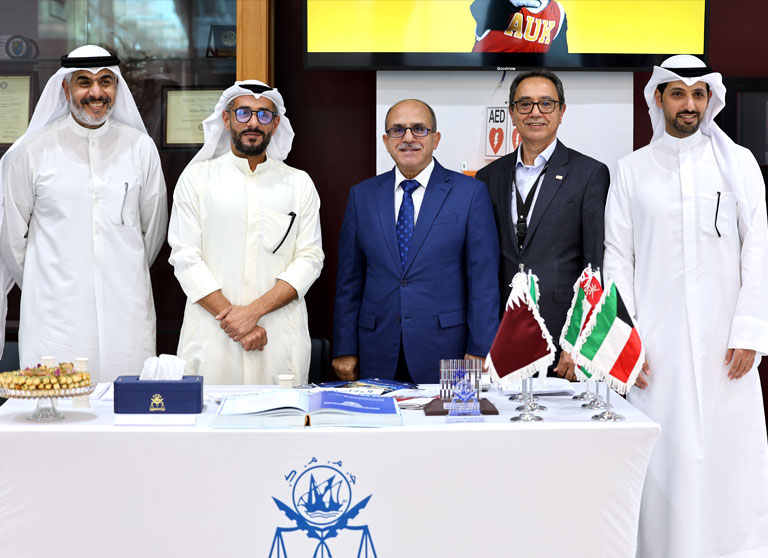
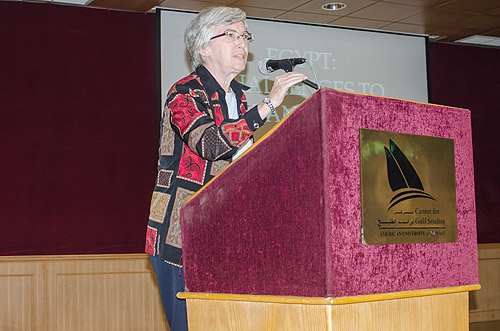
The Center for Gulf Studies (CGS) at AUK held a lecture last week about the transformation of the political landscape in Egypt and its challenges to adapt to the changes caused by the revolution.
The talk was presented by Dr. Ann Lesch, professor of Political Science and the Associate Provost of International at the American University of Cairo (AUC). During her discussion, Dr. Lesch provided an analysis of the present political situation and the future challenges in Egypt.
According to Dr. Lesch, there were several main drivers that led to the eventual downfall of Hosni Mubarak on February of 2011. The circumstances leading up to the Egyptian revolution of 2011 were characterized by a deteriorating economic situation for the majority of Egyptians since the Gamal Abdul Nasser era. This, coupled with a gradual erosion of public services and frustration regarding regional issues such as Palestine, led to several public protests taking place in the first decade of the 2000s. The torture and killing of Khalid Said in June, 2010 by Egyptian police as well as the popular revolution in Tunisia proved to be among the major catalysts that ignited the mass protests against Hosni Mubarak.
Turning to Egypt's present political situation, Dr. Lesch discussed the main positive and negative realities that exist today. Among the negatives, Dr. Lesch described the threat of growing sectarian tensions and a reduction in security, as well as a grim outlook for the economy. However, the positives she described included the growth in grassroots organizing to bring change on a community level, the ability to vote, freedom of speech, and a growth in cultural creativity. The key actors in today's Egypt include the Muslim Brotherhood, the Salafi movements, non-religious political parties, the Revolutionary Youth, the Supreme Council for the Armed Forces (SCAF), and civil society.
Dr. Lesch concluded her lecture by addressing possibilities for Egypt's political future. The Muslim Brotherhood enjoyed an increase in political influence after the revolution. However, will this influence decline as the economic situation continues to deteriorate and be exploited by other political actors such as the Salafist movements? Or will the Brotherhood's ability to mobilize and capitalize on successes such as Egypt's role in ending the Gaza war of 2012 allow them to maintain their political prominence? According to Dr. Lesch, the political future of Egypt remains unpredictable, with key issues unaddressed such as the role of the SCAF in Egyptian politics, and the continued lack of accountability for those who committed crimes against civilians during the 2011 protests.
Dr. Lesch acquired her doctorate from Columbia University and joined AUC as Dean of Humanities and Social Sciences in 2004. As co-founder of the Palestinian American Research Center, Dr. Lesch's research interests cover Palestinian, Egyptian, and Sudanese politics. Dr. Lesch has published 60 academic articles and book chapters, and authored 10 books that focus on the Arab-Israeli conflict and inter-Arab relations. The lecture will highlight and address the struggles and obstacles faced by the Egyptian people and the region's attempts to transition.
The Center for Gulf Studies (CGS) at the American University of Kuwait aims to promote greater cultural understanding of and increased intellectual interest in the Gulf, by facilitating free and open academic discourse on a range of issues that both shape and challenge this critical region of the world. The goal of CGS is to enable scholars as well as political and civil society actors both within and outside the region to contribute and add value to the burgeoning field of Gulf Studies, while at the same time informing and engaging the general public. To this end, the CGS encourages, supports, and cultivates interesting and original research on the Gulf, while regularly organizing a variety of public academic events such as lectures, roundtable discussions, and conferences.
Released by the Office of Public Affairs on the 20th February 2013
Photography by the Office of Public Affairs (C) 2013
Related News