


Dr. Bilal Orfali Lectures at AUK on Hijâ' Al-Mudun (Against Cities) in Arabic Poetry
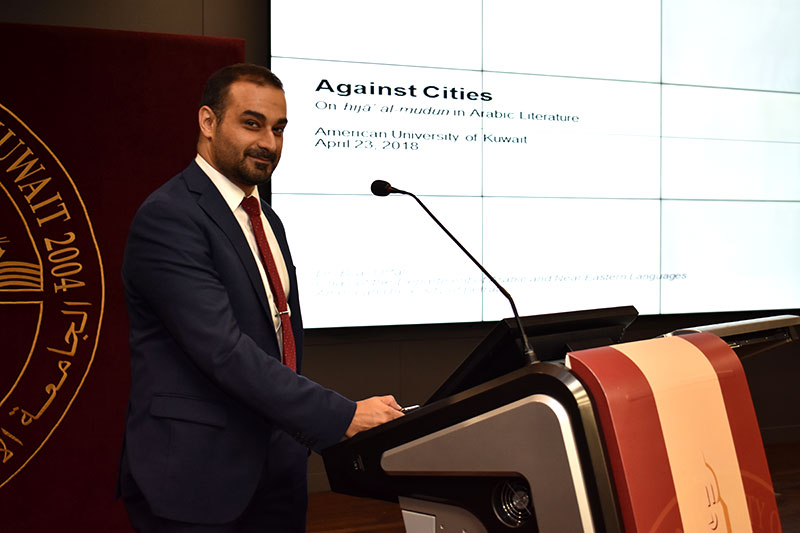
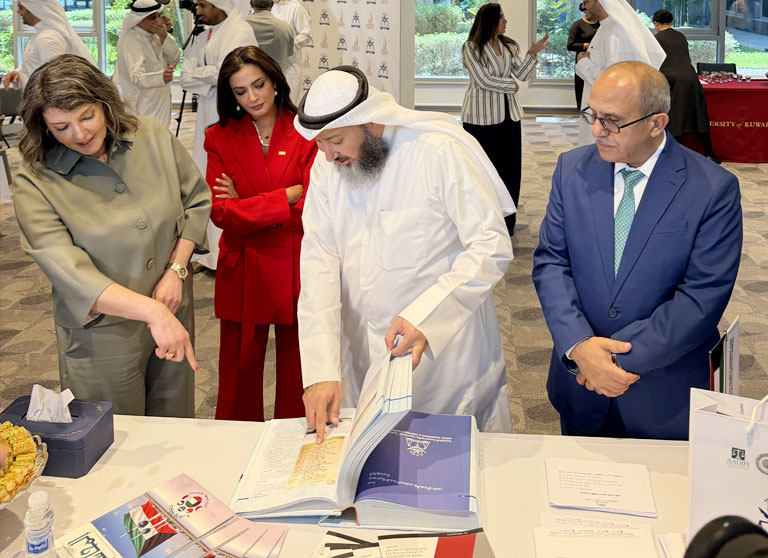
The Department of Arabic and Foreign Languages at AUK organized a lecture on Hijâ' al-Mudun (Against Cities) in Arabic Poetry, delivered by Professor of Arabic Studies at the American University of Beirut, Dr. Bilal Orfali, author of several studies in the field of Arabic literature, with emphasis on literature, Sufism, and Qur'anic studies.
Orfali started his lecture by defining the genre of Madîh al-mudun (On Praising Cities). He notes that in the premodern Muslim world, it was customary for a poet to praise his homeland. The definition of home, however, and the poet's relation to it, developed with the changing topography of organized social and political life. Regardless of the nature of the poet's homeland, its praise utilized themes of nostalgia (hanîn), alienation and/or estrangement (ghurba), and lament (rithâ').
Some poets, however, did the opposite-they attacked their homeland or the cities in which they dwelled. This negative attitude to the homeland was often the flip side of praising a certain place. Orfali noted for example the Arabic compilations of al-mahâsin wa-l-masâwi' (merits and faults) couple censure of homeland with its praise. In these books the homeland is redefined as "the place where you land." All friends, neighbors, lovers, and towns are replaceable. Lands are equal and the same and it is the seeking of livelihood, profit, money, fortune, success, riches, and abundance that is encouraged. Travel brings renewal, while remaining in one's homeland becomes a sign of laziness. Travel is a means of escaping debasement, humiliation, hardship, oppression, and tyranny. It is freedom, a way to pursue virtue and to satisfy curiosity.
Orfali observed that the notion of home was expanded in the Umayyad period to include cities in response to the recent sociopolitical changes seen throughout the Islamic world. The city became equivalent to the patron, the caliph or the emir himself. Entry and exit to and from the city were basically entry and exit to and from the patron's presence and favors. Moreover, the proliferation of courts in the fourth and fifth century of Islam and the rise of the phenomenon of the career poet are factors that made the relationship of poets to the cities they visited transitory.
The bitter attacks on cities, as Orfali stressed, reveal what one might describe as a rivalry between poets and cities. A poet would relate to a city on an individual level, and as such, it was possible to win over a city. This is also why attacking a city, or even insulting it, would carry a direct and almost personal tone. The poet here still envisions his persona and that of the city as equals. That relationship, however, dramatically changes with time. The poet's persona shrinks in comparison to that of the city, which transforms from a situation that can be entered and exited into a prevailing state of mind, persistent and insurmountable.
What was notable is that Orfali's examples came from all periods of Arabic literature, ranging from pre-Islam to the modern period and from all geographical locations, from Al-Andalus in the west to Bukhāra in the eastern part of the Islamic world. Students then asked questions and engaged with what they described as a mind-blowing and eye-opening lecture.
Orfali started his lecture by defining the genre of Madîh al-mudun (On Praising Cities). He notes that in the premodern Muslim world, it was customary for a poet to praise his homeland. The definition of home, however, and the poet's relation to it, developed with the changing topography of organized social and political life. Regardless of the nature of the poet's homeland, its praise utilized themes of nostalgia (hanîn), alienation and/or estrangement (ghurba), and lament (rithâ').
Some poets, however, did the opposite-they attacked their homeland or the cities in which they dwelled. This negative attitude to the homeland was often the flip side of praising a certain place. Orfali noted for example the Arabic compilations of al-mahâsin wa-l-masâwi' (merits and faults) couple censure of homeland with its praise. In these books the homeland is redefined as "the place where you land." All friends, neighbors, lovers, and towns are replaceable. Lands are equal and the same and it is the seeking of livelihood, profit, money, fortune, success, riches, and abundance that is encouraged. Travel brings renewal, while remaining in one's homeland becomes a sign of laziness. Travel is a means of escaping debasement, humiliation, hardship, oppression, and tyranny. It is freedom, a way to pursue virtue and to satisfy curiosity.
Orfali observed that the notion of home was expanded in the Umayyad period to include cities in response to the recent sociopolitical changes seen throughout the Islamic world. The city became equivalent to the patron, the caliph or the emir himself. Entry and exit to and from the city were basically entry and exit to and from the patron's presence and favors. Moreover, the proliferation of courts in the fourth and fifth century of Islam and the rise of the phenomenon of the career poet are factors that made the relationship of poets to the cities they visited transitory.
The bitter attacks on cities, as Orfali stressed, reveal what one might describe as a rivalry between poets and cities. A poet would relate to a city on an individual level, and as such, it was possible to win over a city. This is also why attacking a city, or even insulting it, would carry a direct and almost personal tone. The poet here still envisions his persona and that of the city as equals. That relationship, however, dramatically changes with time. The poet's persona shrinks in comparison to that of the city, which transforms from a situation that can be entered and exited into a prevailing state of mind, persistent and insurmountable.
What was notable is that Orfali's examples came from all periods of Arabic literature, ranging from pre-Islam to the modern period and from all geographical locations, from Al-Andalus in the west to Bukhāra in the eastern part of the Islamic world. Students then asked questions and engaged with what they described as a mind-blowing and eye-opening lecture.
Related News

AUK Students Embark on Semester Abroad at Sciences Po
27, Sep 2026

Dr. Nizar Hamzeh Publishes Research on Kuwait’s Constitutional Approach to International Law
16, Sep 2026
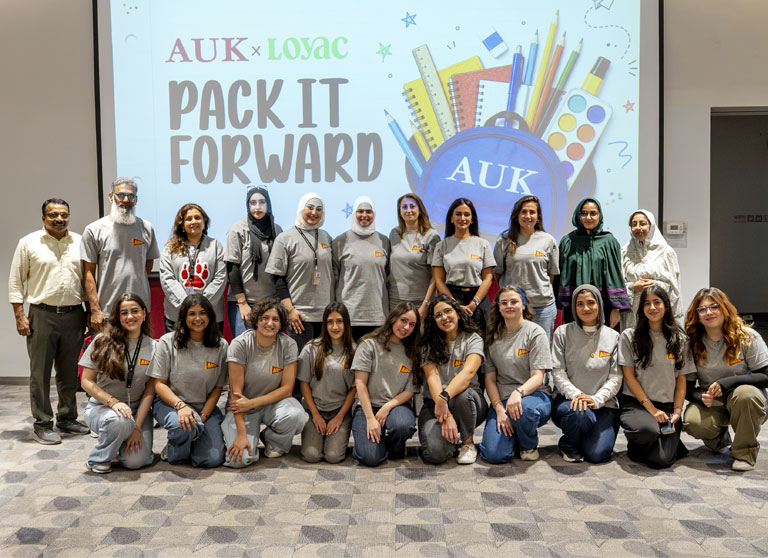
AUK Provides 200 School Bags to Support Families in Collaboration with LOYAC
13, Sep 2026
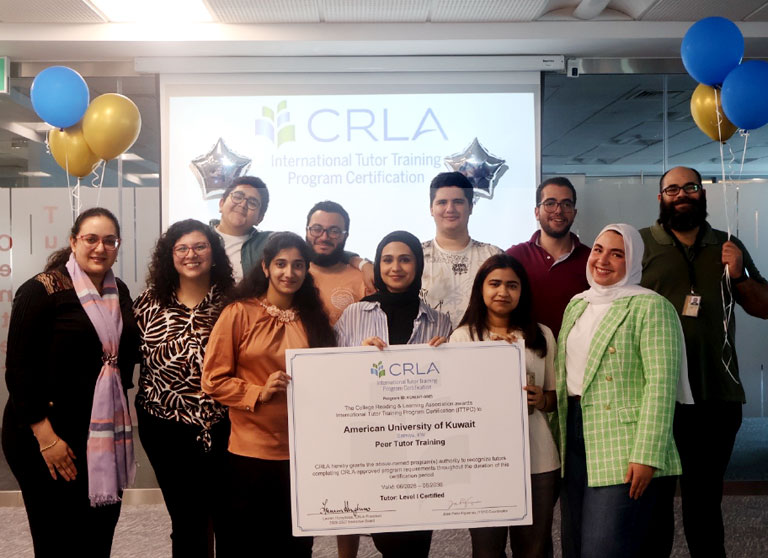
AUK Tutoring Center Renews International CRLA Certification
25, Aug 2026
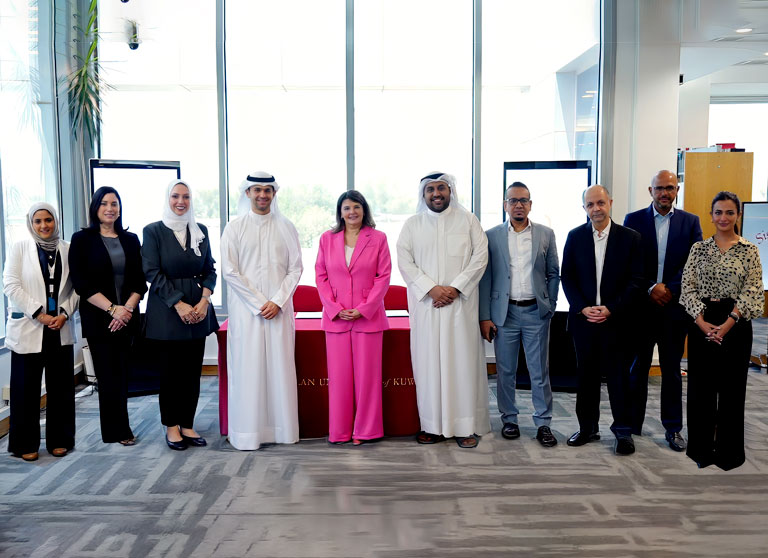
American University of Kuwait Partners with Ruba to Facilitate Flexible Tuition Payment Solutions
24, Aug 2026
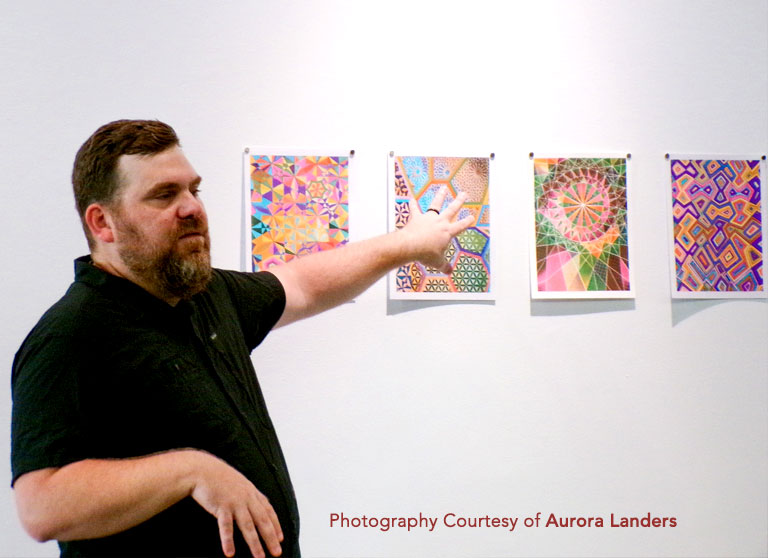
American University of Kuwait Professor Clark Stoeckley Showcases Work at Dartmouth
18, Aug 2026
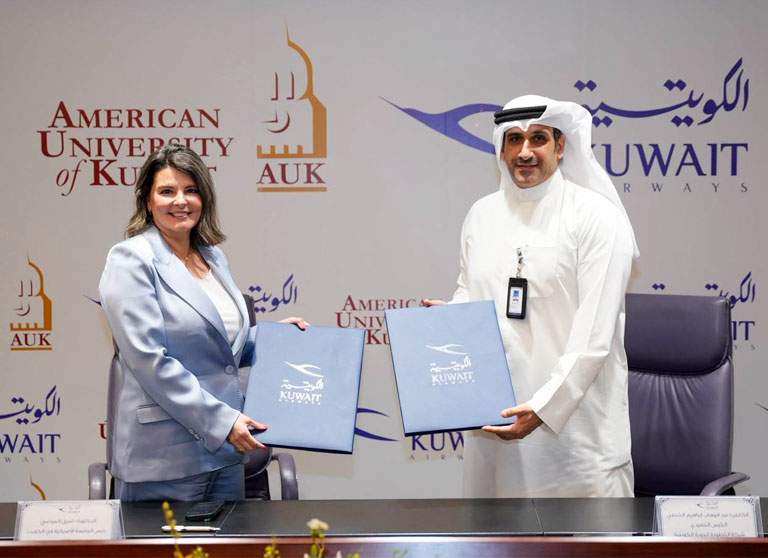
American University of Kuwait and Kuwait Airways Sign Memorandum of Understanding to Strengthen Academic and Professional Collaboration
09, Aug 2026
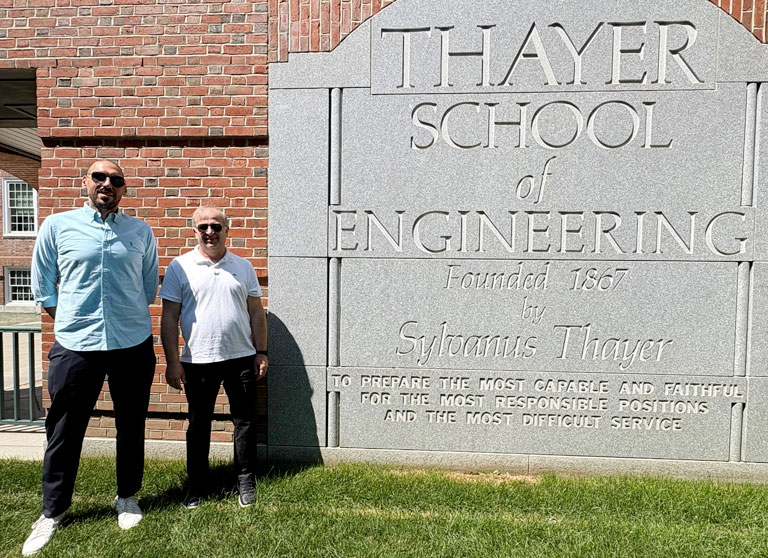
AUK Faculty Strengthen International Research Collaboration Through Dartmouth Partnership
26, Jul 2026

AUK Showcases Its Academic Programs at Universities Exhibition
24, Jul 2026
AUK Signs an MOU with the Kuwait Association of Accountants and Auditors to Strengthen Academic and Professional Collaboration
22, Jul 2026