

Kuwait gave birth to Sawt Culture
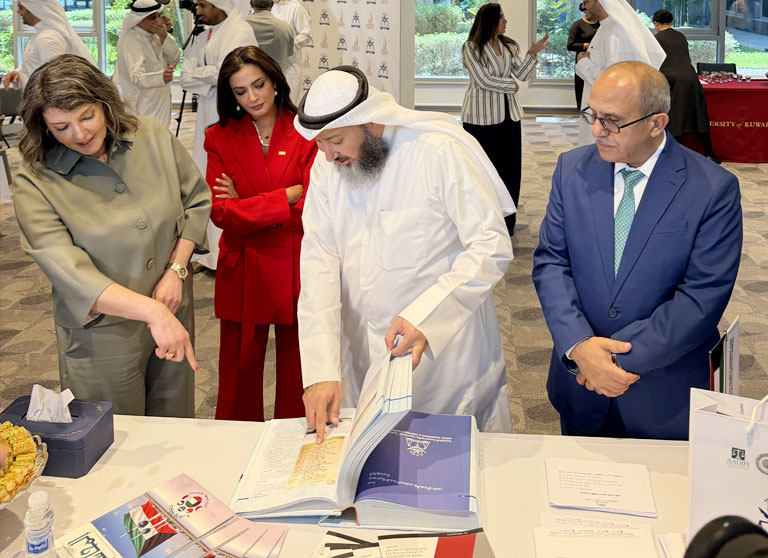
Dr. Urkevich takes a look at the origin and evolution of art form
By Valiya S. Sajjad
Courtesy of Arab Times
24th January, 2007
The event was held on Monday 22nd January, 2007
Sawt is the leading traditional music of Kuwait, says Dr Lisa Urkevich, Head of Humanities and Arts and Professor of Musicology and Ethnomusicology at the American University of Kuwait (AUK).
She was giving a lecture at Dar Al Athar Islamiyyah Monday on the topic "Sawt: The Art Song of Kuwait." Audience were given a demonstration of the art form by a group of Kuwaiti students prior to the lecture.
The professor compared Sawt to the Blues of the western traditions owing to the "rebel nature of its early musicians and its lovelorn lyrics." Sawt pieces are usually performed with one singer accampanied by three main instruments: The Ud (lute), Mirwas (small hand drum) and the violin.
She explained the evolution of Sawt from humble art form intially performed by a small ensemble gathered in an intimate setting with a modest group of guestsinto a celebratory music of the sea community, attracting hundreds of audiences. "Paired dancing and robust handclapping was also part of the early Sawt culture."
"In the early days of its expansion, Sawt was distinguished by descriptive titles such as Sawt Yamani, Sawt Sanyani, Sawt Bubula etc. But these designations had nothing to do with the musical structure, and were merely programmatic. Since around 1950 Sawt has been classified by their rhythmic modes, of which three meters are prominent: Shami (in 8), Arabi (in 6) and Khayyali (in 12). Khayyali is found only in Kuwait, not in Bahrain."
Sawt draws from Arab Traditions, like Yemen, although its core is Kuwaiti. "It was innovated by the Kuwaiti Abdullah Al Farraj (1836-1903) and his early manifestations were kept alive by his immediate followers such as the brothers Khalid Al Bakr Yusuf Al Bakr (1875-1955). Sawt was further developed by famous musicians like Abdulatif Al Kuwaiti (1904-1975); Mahmood Al Kuwaiti and the Jewish brothers Daud (1910-1976) and Saleh Al Kuwaiti (1908-1986). They later moved to Iraq Where their career flourished."
Dr Lisa Urkevich came to Kuwait in 2003 to research through a grant from the US State Department Fulbright program. For over two years, she made field recordings and documented findings on the music and musicians of Kuwait and the neighbouring countries of the Gulf. This contributed to her earlier work in Saudi Arabia where, for four years, she lived and did research in various areas of the kingdom.
Before coming to Kuwait, Dr Urkevich was a professor at Boston University where she taught Arabian music. She has also been a visiting professor at various institutions.
She has four degrees in music: a PhD from the University of Maryland, a MM degree from Florida State University, a BS from Towson University and a BA from the university of Maryland. She is currently working on a CD with a book project with her colleague Ahmed Al Salhi on Kuwaiti Sawt.
Copyright (C) 2007 Arab Times
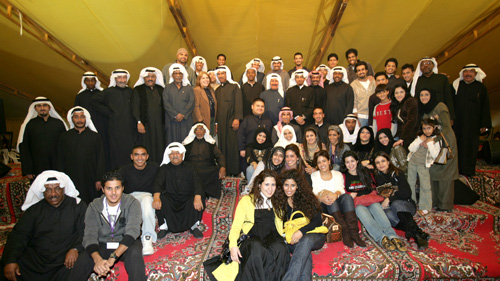
Dr Urkevich with members of Bin Hussain Sea band and AUK students
Related News