

"Kuwait's Energy Profile: Present-Day Challenges and Future Outlooks"

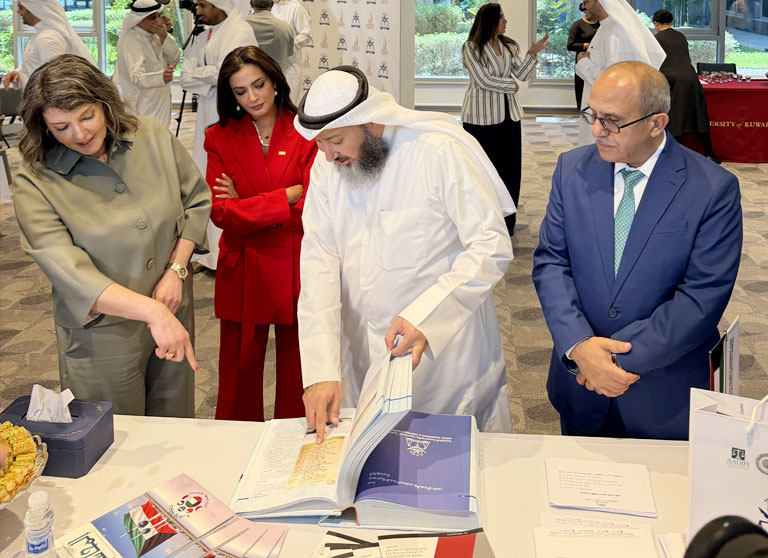
On Wednesday October 23, 2013, the Center for Gulf Studies at the American University of Kuwait hosted a joint-lecture entitled "Kuwait's Energy Profile: Present-Day Challenges and Future Outlooks" by Dr. Osamah Alsayegh and Dr. Bassam Shuhaibar from the Kuwait Institute for Scientific Research (KISR). The lecture focused on what current economic and energy trends say about the state of Kuwaitâs energy capacity, what challenges to the energy security of Kuwait exist, and how these challenges may be resolved.
Dr. Alsayegh introduced the energy status quo in Kuwait and providing a background to contemporary energy issues and expanded upon the challenges currently facing Kuwait and the potential means of addressing these issues, primarily through the development of alternative energy sources, the diversification of Kuwait's economy, and increasing domestic energy efficiency. He concluded by highlighting the need to balance what he termed the energy triangle in order to achieve a sustainable and secure future for Kuwait and the planet.
Dr. Shuhaibar explained what potential alternatives exist to crude oil and petroleum, focusing primarily on nuclear energy as a solution to Kuwait's energy crisis. After emphasizing the importance of exploring other potential sources of energy, he listed the specific alternatives, their advantages and disadvantages compared to petroleum, as well as their implications on the environment. Finally, he concluded by highlighting the need for a nuanced approach to alterative energy that uses a combination of solutions in order to achieve sustainability.
Following the lecture, a lively question and answer period took place, allowing both lecturers to expand upon some of their previous thoughts and introduce new points as well. Some audience members asked the presenters to comment on specific forms of sustainable energy, such as the potential for solar power and wind power in Kuwait. Others took the time to highlight additional points relevant to the lecture, such as the possibility of raising energy prices as a means of discouraging overconsumption as well the capacity for integrating sustainable energy solutions in urban planning and design.
Both lecturers answered each question thoughtfully, taking the opportunity to emphasize the need to reform not only energy infrastructure within Kuwait, but human behaviors as well. Dr. Alsayegh poignantly highlighted that traditions such as desert camping in Kuwait, though often regarded as benign pastimes, have the power to irreversibly damage the ecosystem and only work to stymie sustainable energy developments. Dr. Shuhaibar added how organizations such as KISR interact with legislative bodies, and after which he reaffirmed the importance of creating a national energy oversight council responsible for keeping issues like energy security and sustainability relevant within the policy agenda of the nation.
The Center for Gulf Studies (CGS) at the American University of Kuwait aims to promote greater cultural understanding of and increased intellectual interest in the Gulf, by facilitating free and open academic discourse on a range of issues that both shape and challenge this critical region of the world. The goal of CGS is to enable scholars as well as political and civil society actors both within and outside the region to contribute and add value to the burgeoning field of Gulf Studies, while at the same time informing and engaging the general public. To this end, the CGS encourages, supports, and cultivates interesting and original research on the Gulf, while regularly organizing a variety of public academic events such as lectures, roundtable discussions, and conferences.
Released by the Office of Public Affairs on the 3rd November 2013
Related News