

Kuwait's Urban Crisis: Malls, Violence, and the Right to the City
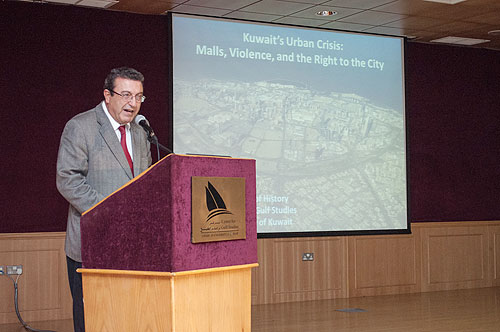
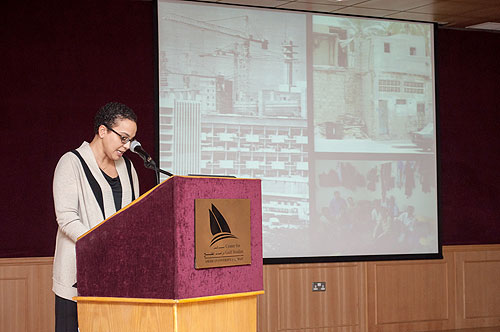
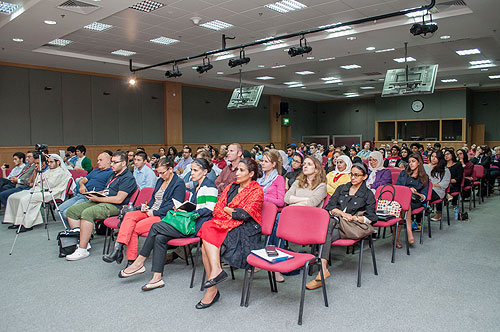
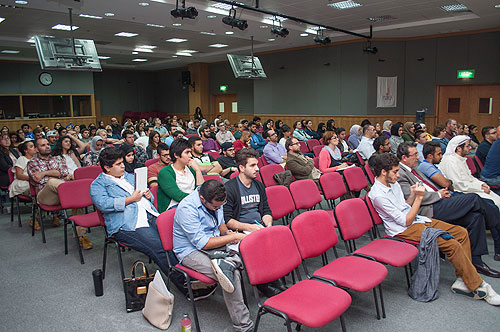
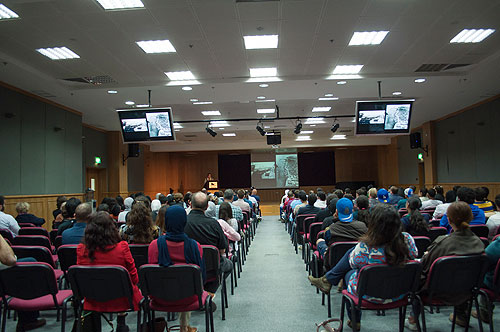
The Director of the Center for Gulf Studies at the American University of Kuwait (AUK), Dr. Farah Al-Nakib, presented a lecture on Wednesday 13 November in the AUK Auditorium entitled "Kuwait's Urban Crisis: Malls, Violence, and the Right to the City." The lecture, which was open to the public, as well as members of the AUK community, identified various aspects Kuwait City's urban development since the advent of oil modernization in 1950, and the impacts they have had on urban society, social relations, and public behavior. The lecture commenced with an introduction by the AUK's Interim President, Dr. Nizar Hamzeh, highlighting the importance of the discussed topic to the Kuwaiti community and commending Dr. Al Nakib on her scholarly contributions.
In her lecture, Dr. Al-Nakib argued that although Kuwait today may display some physical attributes of a modern city, Kuwaiti society has lost the main features that used to define its urban identity before oil. She explained that in the pre-oil period, Kuwaitis were very open and tolerant of difference, and the difficulty of everyday life before oil required that members of the community cooperated closely in a very public urban life.
This openness and sense of community that were once embedded within the culture of pre-oil Kuwait have diminished in recent decades. Dr. Al-Nakib related this to the transformation of the urban landscape of the city after oil. From 1950 onwards, state planning authorities regularly hired international planners to redesign Kuwait into a modern city. The reconstruction of the city required the relocation of its inhabitants to new suburbs beyond the old town wall. This led to a substantial change in everyday life.
According to Dr. Al-Nakib, before oil people used to live, work, and socialize within the same areas, and people of different ethnic and religious backgrounds lived in the same neighborhoods. This put members of the society in constant contact with different people, activities, and ideas. This was key to making Kuwaiti society open to and tolerant of difference. However, as she argued, "urban life in Kuwait after oil became highly differentiated and separated out into discrete spheres. People went to work in the city center, spent their leisure time along the coast, shopped in the new commercial district of Salmiya, and went home to rest in the suburbs, and moved between these spaces entirely by private car." The new suburbs also divided people based on background, with different neighborhoods designated for urban Kuwaitis, Bedouin Kuwaitis, and non-Kuwaitis. Over time, this separation of people and activities made people more privatized, and less open to difference.
Dr. Al-Nakib explained that the city we make and live in is a reflection of who and what we are as a society. The very inter-connected and closely-knit nature of the pre-oil urban landscape reflected the inter-connected and close-knit nature of the community that inhabited it. Today, by contrast, "With its vast network of highways, walled villas in the extensive suburbs, enclosed malls and towers, and non-existent sidewalks and public spaces, our city is a highly privatized, isolated, and unaccommodating place. And now, so is our society."
One example Dr. Al-Nakib discussed to explain this change in Kuwaiti society was the violent mall stabbings that look place in the Avenues mall last year and in Marina Mall last month; in both instances, a young man was fatally stabbed by other young men for very trivial reasons. Rather than focusing specifically on why these crimes were committed, Dr. Al-Nakib focused on the public response to them when they occurred. She explained that although these crimes took place in full public view, no one in the malls who watched intervened to stop them. She cited this passive response as an example of the degree of disassociation people have from the community, and the lack of any sense of responsibility towards the general public good. Dr. Al-Nakib linked this passive response to the privatization of Kuwaiti society that has come about through the privatization of urban space (in places like shopping malls) and society's disconnection from the city and public life.
Dr. Al-Nakib proposes that the only way to restore Kuwaiti society's historic urban identity is with a restored right to the city. By a "right to the city," she means primarily a right to an urban life characterized by a constant interaction with different people, ideas, and activities. Bringing Kuwaitis back to the city for more than just work will put them into closer contact with people of different ethnic and class backgrounds than they are used to in the suburbs, and with new kinds of public activities that they do not experience in malls. Dr. Al-Nakib believed that this could be one small step towards restoring Kuwaiti society's historically open, tolerant, and cosmopolitan lifestyle.
The Center for Gulf Studies (CGS) at the American University of Kuwait aims to promote greater cultural understanding of and increased intellectual interest in the Gulf, by facilitating free and open academic discourse on a range of issues that both shape and challenge this critical region of the world. The goal of CGS is to enable scholars as well as political and civil society actors both within and outside the region to contribute and add value to the burgeoning field of Gulf Studies, while at the same time informing and engaging the general public. To this end, the CGS encourages, supports, and cultivates interesting and original research on the Gulf, while regularly organizing a variety of public academic events such as lectures, roundtable discussions, and conferences.
Released by the Office of Public Affairs on the 26th November 2013
Photography by the Office of Public Affairs (C) 2013
Related News