

'Opening up' of market good for Kuwait: Gnehm
Courtesy of Arab Times
5-6th January, 2006
Event was held on 4th January, 2006
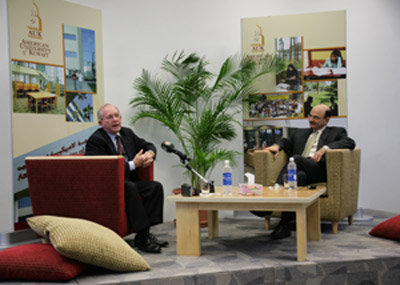
Kuwait City, Jan 4: Opening up of the Kuwaiti market, said Edward W. Gnehm Jr, is the most important economic reform to be adopted for the development of the private sector. The former American envoy to Kuwait and an expert in Middle Eastern geopolitics was lecturing at the American University of Kuwait (AUK) Wednesday, sharing some of his views on critical issues in the region to an au-fait audience comprising professors and students.
Dr. Shafiq Ghabra, President of AUK, introduced Gnehm as the American ambassador who had his tenure during the most difficult times of Kuwait, "invasion and the first Gulf war that followed." The former ambassador, he added, was one of the first envoys to return to Kuwait after the war, "when the oil wells were still raging and the sky was black."
Gnehm said he sees Kuwait as steadily marching in the way of progress and development. Kuwait, he added, is also a country with a growing population of talented youngsters. "The country has also been playing a leadership role in the region post invasion, always in the frontlines of problem-solving alliances." Regarding the opening up of the Kuwaiti market, he said it might wipe out some of the traditional businesses in the face of competition, but would ultimately do good to the economy.
Answering a question on the important challenges in the region, Gnehm identified Iraq as the biggest challenge. Without further deliberation on the point, he counted the next challenge: "Iran" He was quick to add: "our eyesight should not be clouded by just nuclear issues while dealing with the country. Israel fell next in his list of challenges gripping the region, and lastly figured energy, which though is available in vast reserves, still is not inexhaustible." Despite Iraq featuring on top of his "problem" list, he said he is very confident that Iraq will sooner or later return to normalcy. "The pressure tendencies, sociology and history of the country point to this fact. There will be pressure on ethnic groups to unite, as every group has interests in the country, all of which can be realized only in an atmosphere of peace."
Gnehm then dwelled upon the reasons for his lack of hope for an amicabe le settlement of the Palestine-Israel problem in the near future, citing the inability of the Palestinians to get their acts together, while the coalitional nature of Israel's government affects smooth tabling of decisions. He also rued the lack of a strong political will in the US to see a solution to this Middle East crisis. "There is not a single constituency in America today that is pushing for peace in the Middle East." The reason for this, he said, is because "after 9/11 the American public is focused on terrorism. The continuing violence by Palestinian uprising is increasingly seen as terrorism by the US electorate, which is losing sympathy for the Palestinian cause."
Watching what's happening on the ground in the conflict-ridden Israel and Palestine, "things are moving away from a peaceful solution." The ex-envoy hit out at the Israeli premier, Ariel Sharon, saying, "if he gets re-elected, he will not have any of the agenda that he is talking about now." Sharon, he added, is only trying play up "demography versus geography, i.e. whatever is there in the Israel that he carves out will be Jewish, and nothing Arabic."
President Bush, he stressed, strongly believes in a two nation theory, separate states for Palestinians and Jews, and thinks that will be the only logical solution to the problem. "However, the administration did not pursue this agenda and drifted away from it."
Gnehm then answered informed queries on the geo-economics of the region, with reference to oil pipelines and their routes, connecting the energy rich Caspian area to other parts of Asia.
He underscored an important aspect of the American foreign policy: "not to let the energy resources of the world to fall into hostile powers. First it was the Soviet Union, then it was Iraq and now it is Iran."Therefore, he summed up, a pipeline through Iran is out of question. However, he also added that despite the trouble with Iran since 1979, "we - Iran and the US- have common interests."
Copyright (C) 2006 Arab Times
Related News