

Specialists Discuss Causes, Consequences and Cures of Addiction at AUK
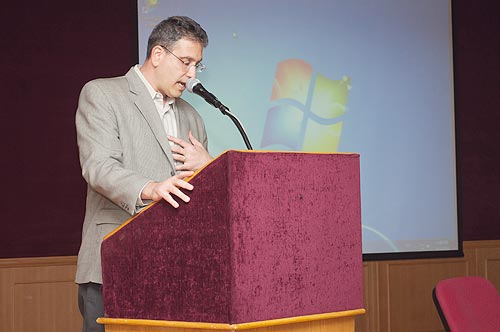
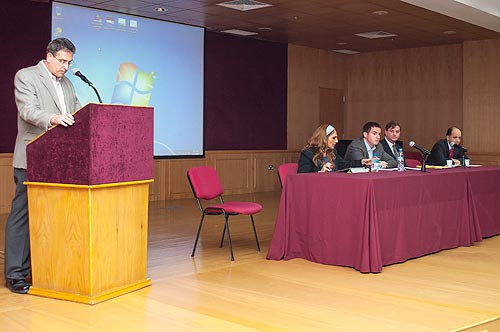
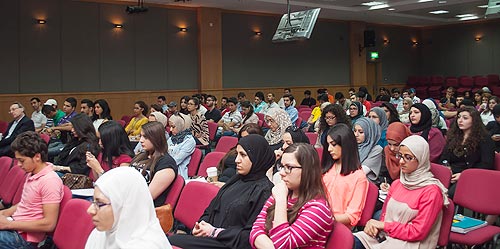
A panel discussion on addiction has been organized at AUK as a collaborative effort between the Department of Social & Behavioral Sciences and the Department Math & Natural Sciences. The multidisciplinary discussion included AUK faculty panelists in the fields of psychology, Anthropology, and Biology to talk about the causes, consequences, and treatment of drug abuse.
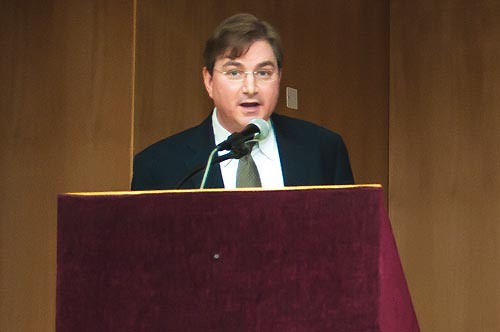
Moderated by Dr. Pellegrino Luciano, Assistant Professor of Anthropology, the panel was composed of Dr. Ali Charara, Associate professor of Biology; Dr. James Rose, Assistant professor of Psychology; Dr. Nicholas Scull, Assistant professor of Psychology; and Dr. Juliet Dinkha, Associate Professor of Psychology.
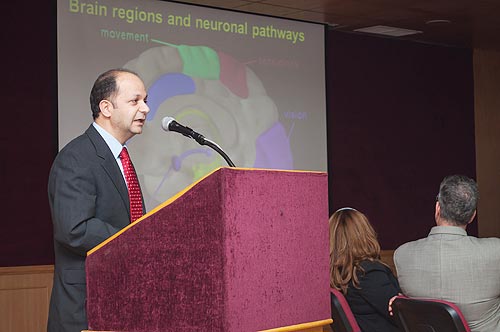
The discussion started by an explanation of the neurobiology of addiction and potential implications for its treatment. According to Dr. Charara, there are a variety of drugs and addiction comes in all shapes and forms. Dr. Charara distinguished between natural rewards such as food and sex; experiences we have evolved to find rewarding as they contribute to our wellbeing and survival, and artificial rewards such as drugs that have a negative effect on one's health.
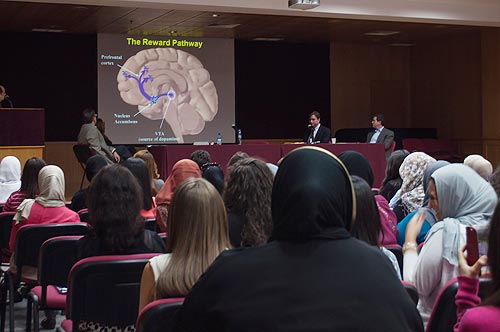
Furthermore, Dr. Charara explained that a pathway in the brain is responsible for rewarding behaviors, known as the "reward pathway". Drugs alter the brain's pathway through which pleasurable feelings are activated, indicating that this increases the cravings associated with an addiction. Akin to any rewarding experience, the rewarding feeling of drugs triggers the release of euphoric brain chemicals, informing the brain to repeat the satisfying behavior. This gradually leads to loss of control in limiting intake of the addictive substance.
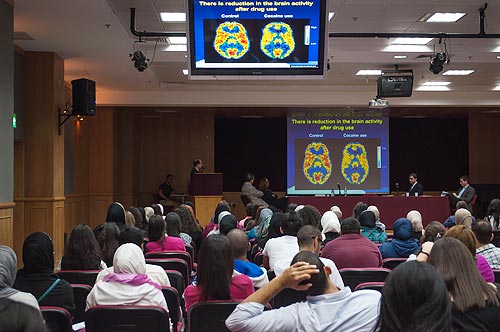
Thanks to new and advanced imaging technology, neuroscientists are able to study the effects of addiction on the brain. Through brain scans, Dr. Charara demonstrated that there is a reduction in brain activity after drug use. He showed that drugs cause fundamental alterations in brain function, and that the activity of the brain never returns to its normal state even after 10 years of abstinence. Based on the brain scans, it is evident that the brain of an addict is distinctly different from that of a non-addict. He further stressed that drug addiction is a long-lasting disease, and concluded that understanding the mechanisms of the brain will help in developing treatment for addiction.
Dr. Rose, highlighted the causes of addiction through insights from animal research. He emphasized that animal models such as rodents and monkeys help to elucidate the causes of addiction in humans. Dr. Rose discussed at length an experiment in which rats were permitted to self-inject cocaine or heroin. Researchers found that these animals will self-administer drugs much like human addicts. Moreover, the animals demonstrated a variety of health problems similar to human addicts.
Dr. Rose added that certain factors influence drug self-administration in animals. In particular, he discussed the influence of genetics and the effects of stressful environments early in life. Likewise, Dr. Rose discussed the causes of addiction in humans, including the influence of genetics and a variety of early environmental factors, including parental criminality, domestic violence, childhood physical and sexual abuse, and childhood neglect.
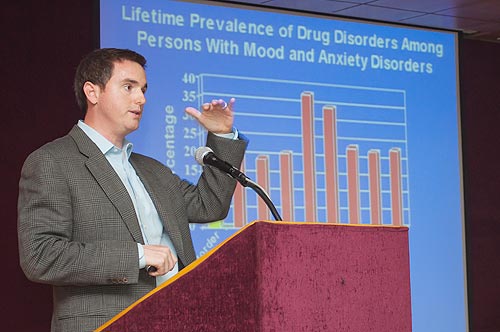
Turning to substance use disorders in the Middle East, Dr. Scull looked at the rates of substance usage worldwide. He reviewed research on the use of alcohol among college students in Egypt and Jordan. Dr. Scull also discussed research done with a clinical sample in Saudi Arabia that found that heroin was the most frequently used drug. A limitation in the current body of research in the Middle East, he stated, is that studies are mostly based on clinical samples rather than community sample.
As for Kuwait, there is a need for more research as exact rates are unclear, but some research indicates that rates of substance use disorders are increasing. Dr. Scull also added that there is an absence of preventative programs and public health education, which are likely related to the apparent increase in prevalence. However, adherence to Islam appears to be related to decreased alcohol and drug use. Dr. Scull further identified the reasons for substance abuse in Kuwait. Curiosity, experimentation, international travel, personal problems at home, and excessive unsupervised free time are among the main identifiable reasons that may drive one to substance abuse.
In order to solve addiction problems in Kuwait, there is a need to acknowledge that a problem exists according to Dr. Scull. He also emphasized the need for research based on community samples in order to accurately measure the use of substance abuse in Kuwait. Furthermore, educating the public about the dangers of substance use through public health campaigns is an important step toward minimizing addiction problems. Among other recommendations, Dr. Scull stressed the importance of improving mental health care in Kuwait, especially for the treatment of substance abuse. Along with this, efforts should be made to "destigmatize" drug and alcohol treatment. Without significant changes in these areas, Dr. Scull warned that rates of substance use in Kuwait may continue to rise.
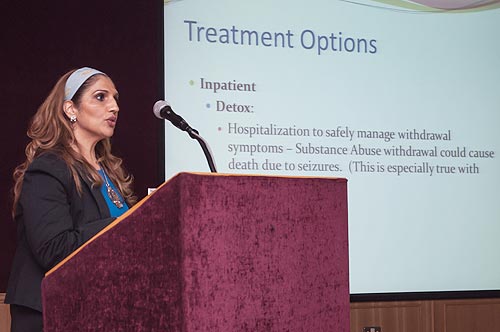
Lastly, Dr. Dinkha pointed to several treatments in the process of rehabilitation. She stated that addiction leads to not only serious physical damage but psychological harm as well. According to Dr. Dinkha, there a number of treatment options, medications, and drug deterrents that can be taken to reduce drug cravings and ultimately recover from substance dependence. Beside Detox treatment, Dr. Dinkha talked about the importance of outpatient treatment which includes Alcoholics Anonymous (AA) and Narcotics Anonymous (NA) support groups, individual therapy, and family therapy. She emphasized that drug abuse patients need a lot of emotional support from friends and family in order to avoid relapsing. Better yet, abstinence should be the goal for anyone with substance addiction. Dr. Dinkha concluded that addiction is hard to battle, as it is a long-recovery process that requires time and a lot of support.
Released by the Office of Public Affairs on the 24th March 2013
Photography by the Office of Public Affairs (C) 2013
Related News