


The American University of Kuwait hosts Anti-violence Forum
The Office of Student Life at the American University of Kuwait held an 'Anti-Violence Forum' on Anti-Violence Day as part of their 5th Annual Social Awareness Week. The forum, which took place on November 3, 2010, involved AUK's Student Success Center and Division of Social Sciences professors and students. An introduction about violence, intimate partner violence, family and violent behavior in children and adolescents, recognizing structural violence, and individual practices toward reducing violence in society were the topics discussed.
Mr. Jason Sullivan is an SSC Mental Health Counselor, with an M.A. in Counseling, RTS Orlando; and a B.A. in Philosophy and Religious Studies, University of Tennessee. In his introduction about violence, he highlighted why awareness is so necessary, as violence appears in many forms. It can be an expression of how we feel, it can be an event acted out on us. It can also be the effect an event has on us, based on our perception of that event, for example, violent storms, Hurricane Katrina and the aftermath. As part of his introduction Mr. Sullivan explained that sometimes violence is used as a means of expression when one's voice is frustrated. It could also be a means of psychological release, both of which are malignant forms of satisfaction. Violence, whether we are acting from it or reacting to it has a large impact on how we see ourselves and how we are seen.
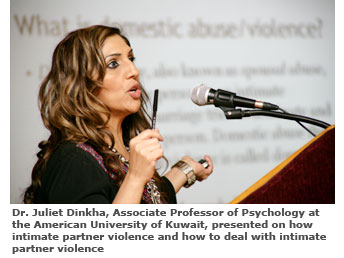
Dr. Juliet Dinkha is an Associate Professor of Psychology at the American University of Kuwait, licensed Clinical Psychologist, and member of the American Psychological Association, holder of Doctorate degree in Clinical Psychology from Illinois School of Professional Psychology (ISPP), and Masters degree in Clinical Psychology also from (ISPP). Dr Dinkha presented on how intimate partner violence identified domestic abuse, also known as spousal abuse, which occurs when one person in an intimate relationship or marriage tries to dominate and control the other. Domestic abuse, including physical violence, is dubbed domestic violence. It could be physical, psychological, emotional, economical, or sexual. She shared with the audience, facts about domestic violence/abuse and how domestic violence/abuse develops or the "Domestic Violence Cycle", highlighting the characteristics that might identify a potential pattern. In her response to audience questions about how to deal with intimate partner violence, Dr. Dinkha said that women who face abuse should not wait until unacceptable behavior is ingrained into the abuser's unconscious and is treated as being 'normal'. Victims should seek counseling or assistance immediately.
Dr. James Rose is an Assistant Professor of Psychology at the American University of Kuwait. He received a Ph.D. in Developmental Psychology from the University of Virginia, and a M.A. degree in Educational Psychology from the University of Chicago. In discussing research on the effects of parenting on aggressive behavior in children and adolescents, Dr. Rose explained that highly aggressive children are more likely to become adults with histories of physical aggression and criminality. Moreover, both the family environment and child's genetics influence the likelihood of the child engaging in criminal and aggressive behavior. Research has found that children with parents who use harsh physical punishment, such as severe spanking, are more aggressive with their peers. This is particularly true when the punishment is impulsive, and when there is a poor relationship between the child and parent. Therefore, parents should refrain from using physical punishment, and use alternative methods of discipline, such as the withdrawing of privileges.
Dr. Pellegrino A. Luciano is an Assistant Professor of Anthropology at the American University of Kuwait, he received his Ph.D. in Anthropology from the City University of New York. Dr. Luciano discussed the importance of recognizing structural violence, highlighting how understanding the concept of structural violence helps us explain the social causes of physical harm. He argued that violence should not only be thought of in terms of direct acts of physical aggression, but should include the consequences of poverty and inequality as well when it produces physical harm to people. In effect, people who die of malnutrition or disease often do not die because of lack of food or medicine in the world but for political and economic reasons. Decisions made at the institutional level in the form of economic policies can indirectly result in physical harm, or foster a social condition that promotes direct physical harm such as crime or war. Dr. Luciano concluded that recognizing structural violence requires greater social awareness.
Monica Matta, an AUK Student majoring in Business Management and doing a minor in Psychology. Ms. Matta, who works with Dr. Juliet Dinkha as a research assistant, discussed how individuals' common practice can reduce violence in society. This can be achieved by helping yourself first, not being embarrassed to seek support, and reporting violent behavior as soon as it is detected. In addition, she emphasized eliminating violent language from one's vocabulary, refraining from punishing children, and not using violence as a reaction to violence.
Mr. Ayman Shouman the Student Engagement Officer and organizer of the Annual Social Awareness Week, adjourned the forum by presenting to the discussion panel certificates of appreciation as acknowledgment for their valued participation in this interactive learning activity that aimed to raise awareness about violence and its different typologies, and emphasized on how individual practices can reduce violence in society.
Mr. Jason Sullivan is an SSC Mental Health Counselor, with an M.A. in Counseling, RTS Orlando; and a B.A. in Philosophy and Religious Studies, University of Tennessee. In his introduction about violence, he highlighted why awareness is so necessary, as violence appears in many forms. It can be an expression of how we feel, it can be an event acted out on us. It can also be the effect an event has on us, based on our perception of that event, for example, violent storms, Hurricane Katrina and the aftermath. As part of his introduction Mr. Sullivan explained that sometimes violence is used as a means of expression when one's voice is frustrated. It could also be a means of psychological release, both of which are malignant forms of satisfaction. Violence, whether we are acting from it or reacting to it has a large impact on how we see ourselves and how we are seen.
Dr. Juliet Dinkha is an Associate Professor of Psychology at the American University of Kuwait, licensed Clinical Psychologist, and member of the American Psychological Association, holder of Doctorate degree in Clinical Psychology from Illinois School of Professional Psychology (ISPP), and Masters degree in Clinical Psychology also from (ISPP). Dr Dinkha presented on how intimate partner violence identified domestic abuse, also known as spousal abuse, which occurs when one person in an intimate relationship or marriage tries to dominate and control the other. Domestic abuse, including physical violence, is dubbed domestic violence. It could be physical, psychological, emotional, economical, or sexual. She shared with the audience, facts about domestic violence/abuse and how domestic violence/abuse develops or the "Domestic Violence Cycle", highlighting the characteristics that might identify a potential pattern. In her response to audience questions about how to deal with intimate partner violence, Dr. Dinkha said that women who face abuse should not wait until unacceptable behavior is ingrained into the abuser's unconscious and is treated as being 'normal'. Victims should seek counseling or assistance immediately.
Dr. James Rose is an Assistant Professor of Psychology at the American University of Kuwait. He received a Ph.D. in Developmental Psychology from the University of Virginia, and a M.A. degree in Educational Psychology from the University of Chicago. In discussing research on the effects of parenting on aggressive behavior in children and adolescents, Dr. Rose explained that highly aggressive children are more likely to become adults with histories of physical aggression and criminality. Moreover, both the family environment and child's genetics influence the likelihood of the child engaging in criminal and aggressive behavior. Research has found that children with parents who use harsh physical punishment, such as severe spanking, are more aggressive with their peers. This is particularly true when the punishment is impulsive, and when there is a poor relationship between the child and parent. Therefore, parents should refrain from using physical punishment, and use alternative methods of discipline, such as the withdrawing of privileges.
Dr. Pellegrino A. Luciano is an Assistant Professor of Anthropology at the American University of Kuwait, he received his Ph.D. in Anthropology from the City University of New York. Dr. Luciano discussed the importance of recognizing structural violence, highlighting how understanding the concept of structural violence helps us explain the social causes of physical harm. He argued that violence should not only be thought of in terms of direct acts of physical aggression, but should include the consequences of poverty and inequality as well when it produces physical harm to people. In effect, people who die of malnutrition or disease often do not die because of lack of food or medicine in the world but for political and economic reasons. Decisions made at the institutional level in the form of economic policies can indirectly result in physical harm, or foster a social condition that promotes direct physical harm such as crime or war. Dr. Luciano concluded that recognizing structural violence requires greater social awareness.
Monica Matta, an AUK Student majoring in Business Management and doing a minor in Psychology. Ms. Matta, who works with Dr. Juliet Dinkha as a research assistant, discussed how individuals' common practice can reduce violence in society. This can be achieved by helping yourself first, not being embarrassed to seek support, and reporting violent behavior as soon as it is detected. In addition, she emphasized eliminating violent language from one's vocabulary, refraining from punishing children, and not using violence as a reaction to violence.
Mr. Ayman Shouman the Student Engagement Officer and organizer of the Annual Social Awareness Week, adjourned the forum by presenting to the discussion panel certificates of appreciation as acknowledgment for their valued participation in this interactive learning activity that aimed to raise awareness about violence and its different typologies, and emphasized on how individual practices can reduce violence in society.
Dr. Juliet Dinkha, Associate Professor of Psychology at the American University of Kuwait, presented on how intimate partner violence and how to deal with intimate partner violence
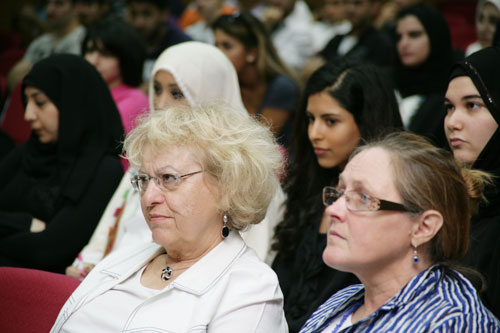
Anti -Violence Forum Audience
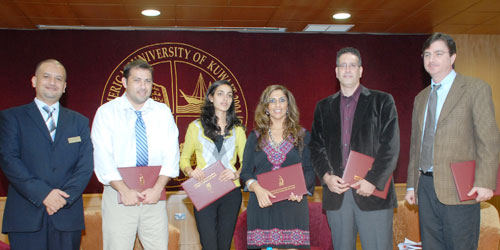
Mr. Ayman Shouman the Student Engagement Officer and organizer of the Annual Social Awareness Week, adjourned the forum by presenting to the discussion panel certificates of appreciation. Mr. Jason Sullivan, AUK Mental Health Counselor with the Student Success Center, Dr. Juliet Dinkha, Dr. James Rose Dr. Pellegrino Luciano, and AUK student Monica Matta
Related News
AUK Data Club Students Showcase Advanced Data Analytics at PAI
18, Oct 2026

The American University of Kuwait Celebrates the Class of 2026
15, Oct 2026
RACXpert Shortlisted for QS Reimagine Education Awards 2026
13, Oct 2026
AUK Promotes Mental Health Awareness Through the “Houna” Initiative
13, Oct 2026

AUK Signs MoU with Burgan Bank to Enhance Financial Support for Students
13, Oct 2026
Celebrating Gulf Accounting Week 2026!
11, Oct 2026
AUK Students Embark on Semester Abroad at Sciences Po
27, Sep 2026
Dr. Nizar Hamzeh Publishes Research on Kuwait’s Constitutional Approach to International Law
16, Sep 2026
AUK Provides 200 School Bags to Support Families in Collaboration with LOYAC
13, Sep 2026
AUK Tutoring Center Renews International CRLA Certification
25, Aug 2026