

The Center for Gulf Studies at AUK Discusses New Perspectives on the Iraqi Invasion
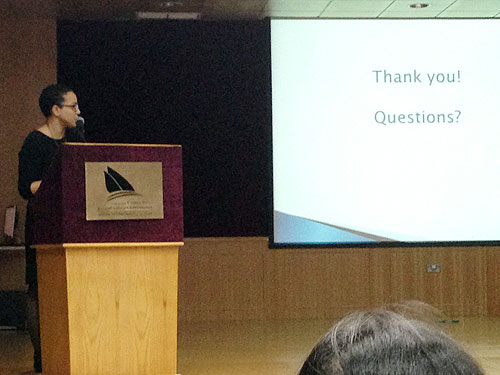
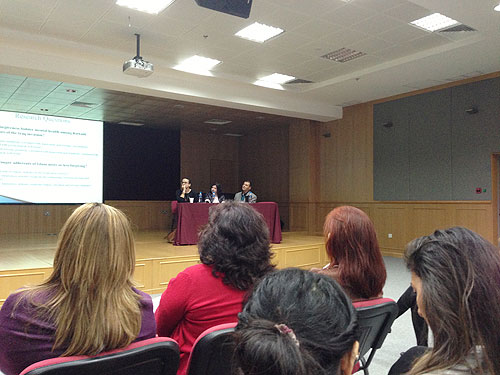
The Center for Gulf Studies (CGS) at the American University of Kuwait hosted a panel discussion titled, 'Memory, Identity, Forgiveness: New Perspectives on the Iraqi Invasion of Kuwait' on. Research by the panelists was conducted primarily through the collection of oral history accounts of the invasion and liberation of Kuwait, providing a unique and innovative approach to analyzing the events of 1990 and 1991.
The panelists included: - Dr. Ildiko Kaposi (speaker), Assistant Professor of Communications and Media at AUK.
- Dr. Christopher Ohan (speaker), Associate Professor of History and Chair of the Department of International Relations at AUK.
- Dr. Nicholas Scull (speaker), Assistant Professor of Psychology at AUK.
- Dr. Farah Al Nakib (moderator), Assistant Professor of History at AUK and Director of the Center for Gulf Studies.
The discussion commenced with the first speaker, Dr. Kaposi, who explored the connections between media and memory in the context of the 1990 invasion and 1991 liberation of Kuwait. According to Dr. Kaposi, the first Gulf War can be characterized as the first war that was televised live to a global audience. This, she describes, created a sense of surrealism towards the war among those living outside Kuwait. To some, it seemed to be taking place on the TV screens rather than on the ground, and was regarded as more of a media spectacle than an actual war. This, along with the mainstream global media's need to provide a simplified narrative suitable for mass consumption, contrasted sharply with local memories of the conflict. The media emerged as a powerful force in shaping Kuwaiti memories, along with interpersonal interactions and oral communication. For example, while those outside of Kuwait experienced the invasion purely as a media spectacle, those inside were able to draw on both global media and local experiences to form their memories.
Dr. Ohan began his talk by explaining that common identity is often produced by shared experiences and that in most cases, a collective traumatic experience produces unity. In Kuwait, however, the invasion did not produce a unified experience, but instead, it served to increase distinction between Kuwaitis and 'the other.' For many expatriates living in Kuwait at the time, such as Syrians, Palestinians, and Lebanese who had grown up in Kuwait, the invasion diminished their sense of belonging in the country.
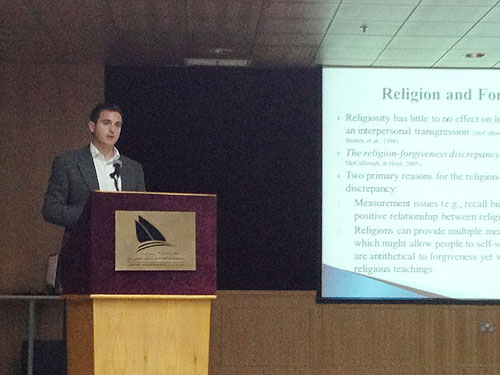
During his talk, Dr. Scull explored the idea of forgiveness and the role of Islam in mediating forgiveness. Dr. Scull attempted to ascertain whether forgiving those who have transgressed, such as those who have experienced trauma in Kuwait at the hands of the Iraqi army during the invasion, actually bolsters the mental health of those involved. His results revealed that people who had forgiven those who had wronged them and had less vengeful sentiments experienced lower rates of depression and greater psychological well-being. Regarding the role of Islam, Dr. Scull noted that those who were more religious tended to be less forgiving. This, he claimed, is consistent with trends for other religions that he researched in the past. Most importantly, however, was the realization by Dr. Scull that those who emphasized the role of Islam as a means of forgiveness tended to be the most forgiving. This means that, among adherents to Islam, simple devotion to the religion along with the practices of the pillars, etc. did not produce high levels of forgiveness. However, people who are conscious of Islam's favorability towards forgiveness are likely to forgive those who have wronged them.
After all the panelists spoke, members of the audience engaged in a Q&A with the panelists. The discussion explored further the aftermath of the invasion and what it means for citizens and residents of Kuwait today.
The Center for Gulf Studies (CGS) at the American University of Kuwait aims to promote greater cultural understanding of and increased intellectual interest in the Gulf, by facilitating free and open academic discourse on a range of issues that both shape and challenge this critical region of the world. The goal of CGS is to enable scholars as well as political and civil society actors both within and outside the region to contribute and add value to the burgeoning field of Gulf Studies, while at the same time informing and engaging the general public. To this end, the CGS encourages, supports, and cultivates interesting and original research on the Gulf, while regularly organizing a variety of public academic events such as lectures, roundtable discussions, and conferences.
Released by the Office of Public Affairs on the 6th December 2012
Photography by the Office of Public Affairs (C) 2012
Related News