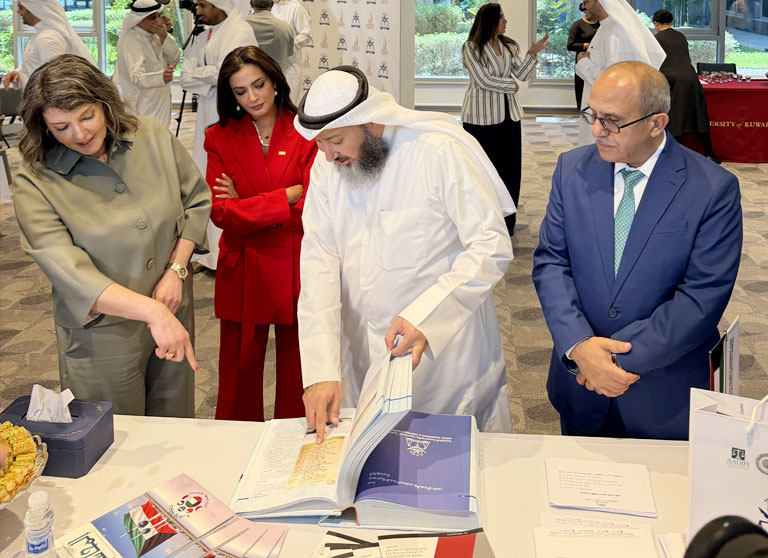


The CGS and the Arabana Project Discuss Environmental Aspects of Subbiya Development

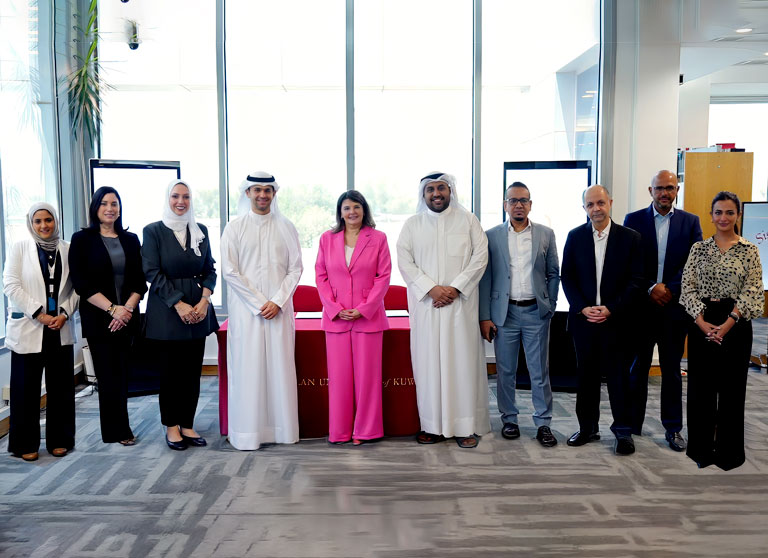
Continuing the series of lectures about Subbiya development, the Center for Gulf Studies (CGS) at the American University of Kuwait (AUK) and the Arabana Project co-organized the second panel discussion entitled "Subbiya: Part II: Environmental Impacts and Opportunities". The lecture hosted a number of experts in environmental research and ecology including, Dr. Ali Khuraibet, Founder and General Manager of ECO Environmental Consultants, Dr. Khaled Al-Banaa, and Dr. James Bishop, researchers for the Kuwait Institute for Scientific Research (KISR). The panel discussion, which was moderated by Mr. Abdullatif Al-Mishari of the Arabana Project, focused on the various risks and considerations of Subbiya's development from an environmental perspective.
During his talk, Dr. Khuraibet mentioned that part of the significance of Subbiya is that it is the site of the earliest inhabitants of Kuwait, dating back to 1620. The importance of the area and its preservation, therefore, has a political and social dimension, and is a significant component of reinforcing the Kuwaiti identity and spirit.
Dr. Bishop highlighted the importance of Subbiya from an ecological point of view. He mentioned that Subbiya is home to more intertidal mudflats than anywhere else in the Gulf region. Subbiya is also rich in biodiversity, rare species of animals, and is a critical feeding area for migratory birds heading south. It is therefore especially important that considerations are taken to preserve, as much as possible, this "virgin area" that to date has been virtually unaffected by human interaction.
The speakers pointed to several major environmental risks involved with the extensive development of Subbiya. Dr. Al Banaa drew attention to Subbiya's major power plant and its proximity to the location of the future city. He noted that the extra power and desalination capacity required to power this new city would have to be accommodated, and that using water to cool the plants would increase the salinity of Kuwait's Bay, creating major environmental risksDr.
The speakers spoke at length about the potential impact of the construction of the 20 km bridge that would link Kuwait City with Subbiya. Construction of both the bridge and the port would require extremely high volumes of dredging, which will need to be done on a continuous basis. This is both expensive and potentially environmentally damaging, if not done carefully. Recycling the dredge, according to Dr. Khuraibet, would minimize the harm, rather than dumping it in landfills. However, avoiding the environmental damage resulting from the port's use, and the subsequent shipping lanes along Kuwait will be much more difficult. According to Dr. Bishop, this will surely have an adverse effect on the quality of Kuwait's fisheries, biodiversity, and intertidal habitat.
With regards to the construction of the city itself, the panelists discussed key aspects that required specific consideration. There is the need to avoid repeating the mistake of Kuwait City by building exclusively along the coast. Furthermore, careful zoning plans are needed to avoid repeating the mistake of zoning the residential area of Sabah Al Salem close to various industrial zones, or of the proximity of landfills with the residential area of Al Qurain.
The subbiya project is part of a comprehensive national plan to develop the northern sub-region of Kuwait. The site consists of the planned "Silk City", the causeway that will link with Kuwait City, and the new deep-water port on Bubiyan Island. The region will also include employment and residential areas, as well as possible cultural and resort facilities. The projection is for the northern sub-region to initially accommodate approximately 200,000-300,000 people by 2030, and will have the capacity to accommodate up to 1 million people in the long term.
The 2nd panel discussion on Subbiya came as part of the collaborative efforts of CGS and the Arabana Project to educate the public about the different aspects of the project. The aim of the panel series is to cultivate public discussion and interaction in the planning process of Subbiya's development. It was noted that only through the involvement of all the stakeholders (including the government, the public, NGOs and other civil society actors) could the planning process truly reflect the needs and desires of the public. The 3rd Subbiya panel discussion is expected to take place in May 2012, and will address key economic and strategic considerations.
The Center for Gulf Studies (CGS) at the American University of Kuwait aims to promote greater cultural understanding of and increased intellectual interest in the Gulf, by facilitating free and open academic discourse on a range of issues that both shape and challenge this critical region of the world. The goal of CGS is to enable scholars as well as political and civil society actors both within and outside the region to contribute and add value to the burgeoning field of Gulf Studies, while at the same time informing and engaging the general public. To this end, the CGS encourages, supports, and cultivates interesting and original research on the Gulf, while regularly organizing a variety of public academic events such as lectures, roundtable discussions, and conferences. For more information about CGS, visit www.auk.edu.kw/cgs/project_lectures_kuwait.jsp
Released by the Office of Public Affairs on the 1st April 2012
Photography by the Office of Public Affairs (C) 2012
Related News