

News
The American University of Kuwait played host to the first ever Kuwait Freestyle Football Talent Quest earlier this month. Sponsored by Tonino Lamborghini and supported by The Freestyle Football Federation, this four day event promoted freestyle football around Kuwait, offering audience members a chance to learn new freestyle skills from professional freestylers and the opportunity to compete in a freestyle football competition were the winner received a fully paid trip to London to watch a Chelsea FC game, as well as VIP treatment and Chelsea FC souvenirs. The event was held in a different location each day, taking place in three select universities and at the 360 Mall.
Throughout the day Andrew Henderson, the current World Freestyle Football Champion, showcased his amazing talent, displaying tricks that seemed near impossible to perform. When he wasn't performing, Mr. Henderson was out meeting the AUK community, personally giving freestyle pointers and teaching the crowd crazy tricks. Also giving freestyle tips were some of the top freestylers in Kuwait. In the evening there was a freestyle football competition, were people could display their freestyle skills. Participants had one minute to show-off their skills in front of a panel of professional judges, which included Andrew Henderson himself and Dan Wood, CEO and President of the Freestyle Football Federation.
At the end of the day, the judges picked the top 3 freestylers from AUK. Third place went to Ahmed Mustafa. Second place was awarded to Hovig Mouradian. First place, including a fully paid trip to London to watch a Chelsea game, was given to Amr Abdulraheem.
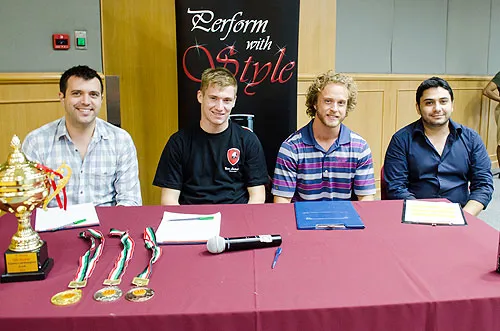
Freestyle Football Judges
The World Champion, Andrew Henderson and AUK Sports Coordinator, Trevor Taylor
The World Champion, Andrew Henderson and AUK Sports Coordinator, Trevor Taylor
The World Champion, Andrew Henderson
AUK Contestant
First Place Winner, Amr Abdulraheem
Second Place Winner, Hovig Mouradian
AUK Contestant
Third Place Winner, Ahmed Mustafa
From left: Third Place Winner, Ahmed Mustafa and World Champion Andrew Henderson
CEO Dan Wood awarding Second Place Winner, Hovig Mouradian
First Place Winner, Amr Abdulraheem
The World Champion, Andrew Henderson and the winning contestants
The Judges and the Host
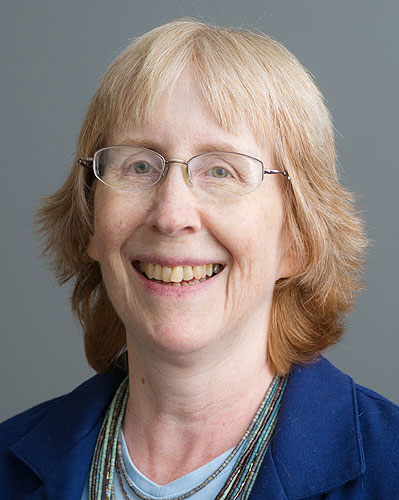
Elizabeth "Beth" Hindmarsh, Program Manager for AUK-Dartmouth, joined the program in October 2011. She worked previously at the Geisel School of Medicine at Dartmouth. This earlier job provided her with occasional opportunities to work on international projects. As Beth says, "The AUK-Dartmouth Program allows me to contribute full time to one of Dartmouth's major international commitments."
Her work involves regular contact with students, faculty, and administrators on both the Dartmouth and AUK campuses. "I especially like the Dartmouth-to-AUK and AUK-to-Dartmouth student exchanges," Beth says. "It's exciting to see the students explore new environments and meet new people."
When asked what she likes to do when not working with the AUK-Dartmouth Program, she replied, "In Winter I like to ice skate on frozen lakes. After the ice melts, I enjoy canoeing." She hopes that her involvement with AUK will allow her to visit the Salmiya campus soon.
Beth will be working closely with Dale F. Eickelman, Ralph and Richard Lazarus Professor of Anthropology and International Relations at Dartmouth College, and Relationship Coordinator of the American University of Kuwait-Dartmouth College Program.
Released by the Office of Public Affairs on the 28th November 2012
Photography by the Office of Public Affairs (C) 2012
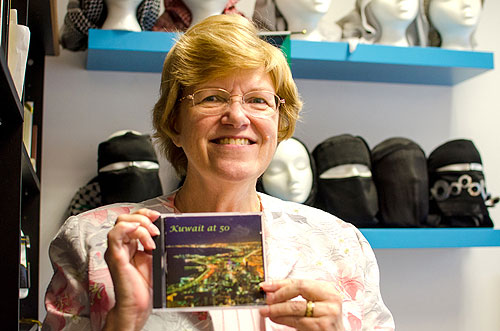
AUK anthropology professor Marjorie Kelly has recently completed a three-year project titled "Kuwait at 50". It consists of almost 800 photos of contemporary Kuwait, organized into four programs: clothing, food, leisure activities, and architecture. AUK students were instrumental in developing the project. They posed for photos, took pictures, organized traditional Kuwaiti meals so they could be photographed, suggested topics, and reviewed the presentation for accuracy as it developed.
The project was initiated when a student gave Dr. Kelly the clothing that was used in the first student exhibition held at AUK in 2006. This sparked Dr. Kelly's interest and she eventually wrote an article on contemporary clothing choices in Kuwait which was published in Fashion Theory. While selecting photos for the article Dr. Kelly realized that the real impact of her findings was not in the text but in the photos. She said, "I thought someone ought to do a full visual ethnography of clothing in Kuwait so that is what I did." As the project progressed, the three other topics were added to provide a fuller picture of life in modern Kuwait.
Recent AUK graduate Dana Al-Failakawi narrated all four programs and assisted in writing the thirty-three page Teacher's Guide. In addition to a printed version of the script, the Teacher's Guide contains some background notes on Kuwait, a glossary, and suggested readings. The DVD and Guide are being distributed without charge for use in American and British classrooms to give the students in those countries a more accurate view of life in Kuwait.
The first presentation of the material for the general public was at the March meeting of the Kuwait Textile Arts Association at Sadu House. The clothing section of the DVD was introduced and shown by Dr. Kelly, then former students Dana Al-Failakawi and Dalal Al-Sharhan modeled several dara'as for an enthusiastic audience.
The entire project - research, production, and distribution of materials - was underwritten by a grant from Wataniya Telecom. Thanks to Wataniya's generosity, all those attending this year's Gulf Studies Conference at the University of Exeter received a copy of the DVD to share with their students. DVDs will also be made available for members of the Association for Gulf and Arabian Peninsula Studies at the Middle East Studies Associationâs annual meeting to be held in November in Denver. For further information about the project and the availability of the DVD and/or the Guide, please contact Dr. Kelly at mkelly@auk.edu.kw.
Released by the Office of Public Affairs on the 28th November 2012
Photography by the Office of Public Affairs (C) 2012
The Arts and Graphic Design Department at the American University of Kuwait (AUK) hosted the Artist & Designer, Salman Alhajri to conduct class visits, lectures and workshops on Arabic Calligraphy. He also displayed some of his artwork at the AUK Auditorium.
In his lecture, Alhajri discussed the elements that constitute contemporary Arabic calligraphy and graphic art. He also provided a comparison between classical and contemporary forms of Arabic calligraphy.
According to Alhajiri, contemporary Arabic calligraphy, is a form of art where artists can reflect their own identity and cultural background. As for graphic art, it reflects the artists' feelings and state of mind. When filling the white canvas, the artist can subconsciously and for a specific period of time, use or add the same set of colors in his work, based on his current environment.
Comparing between classical and contemporary Arabic calligraphy, Alhajri pointed out that the main difference lies in the degree of freedom allowed within each form. In classical form, there is less freedom to interpret art work, which limits creativity, due to the standards required, such as mathematical measures. With contemporary forms, there is more freedom to use different compositions and create new formats with letters.
Speaking about his design techniques, Alhajri demonstrated some of his artwork and explained the different compositions used and the value of each design. The use of different elements and the value of contrast between colors add to an artist's style and give a unique identity. Alhajri also pointed out the importance of experimenting with new forms of art, using new techniques and different compositions. He emphasized how he experiments with the use of laser in printing letters on glass, and how he is always seeking new ways of experimenting with art.
Alhajri concluded his lecture by urging students to research and learn the different elements of design, as it is important for artists and graphic designers to practice with an extensive knowledge. He also encouraged students to follow their intuitions and look for main shapes repeated in their artwork as a starting point to define their style.
Salman Alhajri, Omani artist and designer, is also a lecturer at the Department of Art Education at Sultan Qaboos University and, currently, a PhD candidate in Loughborough University, UK. He was invited to AUK through Dr. Marcella Kulchitsky, Assistant Professor of Graphic Design, who heard about his work from Dr. Raymond Farrin, Associate Professor, and Department Chair of the Arabic Department at AUK. Alhajri is also the designer of Dr. Farrin's latest book "Abundance from the Desert".
Released by the Office of Public Affairs on the 28th November 2012
Photography by the Office of Public Affairs (C) 2012
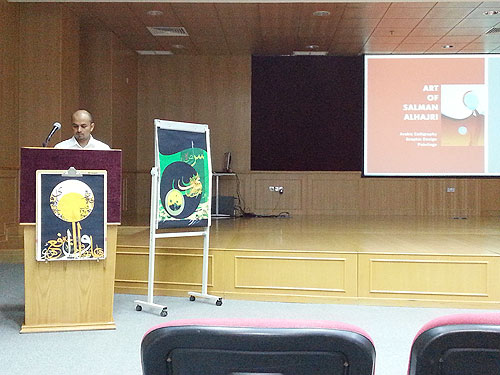
Kuwait 25th November, 2012: In collaboration with the office of Public Affairs at the American University of Kuwait (AUK), Managing Editor of Al Anbaa Newspaper, Mr. Mohamed Al-Husinni, presented a lecture titled "Social Media and their Impact on Print Media".
In his speech, Al-Husinni addressed the concept of New Media, and how its emergence is affecting the traditional media of newspaper, radio, television and cinema. Al-Husinni explained the main four stages involved with news and information, which are: news gathering, selecting medium of transfer, disseminating the news, then public reaction monitoring.
He continued that Traditional media were in total control of one of the main stages, disseminating the news. Nowadays, with the advent of New Media, everyone has the ability to control the different stages of information and become a medium capable of spreading ideas in an open global space.
Al-Husinni stressed that the evolution of new media did not devaluate the role of the traditional media as a complementary partner that needs to exist and continue production. On the contrary, competition between traditional and new media had helped liberate traditional media from some of the constraints faced in the past.
Al-Husinni ended his speech by outlining some of the hitches the New Media encounter, which include: misuse and easy spread of rumors, through fake accounts and false users who impersonate others. This puts societies in a challenge between freedom of expression and legal regulations to reserve people's rights.
In the question and answer session following Al-Husinni's speech, many questions were raised concerning the future of traditional media, future of journalism as a profession and effects of social media on the nature of news.
Al-Husinni responded that traditional media, mainly newspapers, will continue to exist as long as there are subscribers, points of selling and advertisements, as a resource of income to the newspaper, and a form of subsidy. However, the industry of paper making and the environmental risks associated with it, may affect newspaper production in the future.
Responding to a question about the threats to journalism as a profession, Al-Husinni said that journalism is based on main elements including: verification, objectivity, fairness and distinction between opinions and fact. New Media does not function with those elements, making journalism as a profession indispensable. He also added that with increasing freedom of expression, journalists are still bound with those elements of the profession to clarify whether their writing is based on their personal opinion or on existing facts.
Released by the Office of Public Affairs on the 26th November 2012
Photography by the Office of Public Affairs (C) 2012
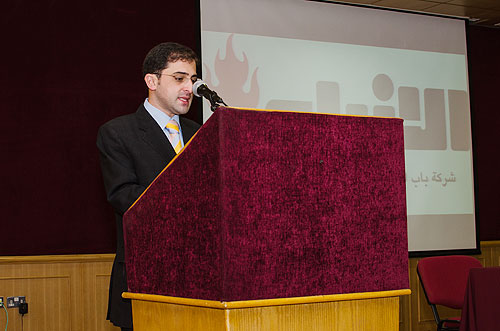
Kuwait--Nov.21, 2012: After a few initial meetings, the new Student Government Association (SGA) at AUK is ready and fuelled with the motivation and enthusiasm needed to adequately represent the AUK student body. The members have begun formulating an action plan for the year with three main goals in mind; to find solutions to student issues and advocate student needs, to promote active student involvement in activities and events to foster a sense of community on campus, and to ensure that SGA and the AUK administration cooperate on every level in an effort to implement positive changes to AUK.
The new SGA has been elected last October to represent the AUK student body for the academic year 2012-2013. Voter turn-out this year was the highest in AUK history, reaching 35.5% of the students participating in this year's election.
At AUK, the SGA is the voice of the students. Composed of elected representatives from the student population, SGA is responsible for representing the opinions, concerns and recommended resolutions of the student body to other constituencies of the AUK community. In addition, to serving as the student voice, SGA works with other student organizations to sponsor events that promote the academic and social lives of students at AUK. Students can get involved with SGA by running for an elected position in SGA, participation in a General Assembly, SGA committees or as an SGA volunteer. Participation and representation in student government is open to all registered students of the University.
The new SGA members 2012-2013
Mohammad Al Abdulrazzaq - President
Fajer Al Sabah - Vice President
Mohammad Al Mousawi - Treasurer
Fouz Al Khonaini - Secretary
Fadwa Al Ajeel - Community Liaison Officer
Eshraka Sumrain - Communications Officer
Yousef Al Qenaie - Productions Officer
Released by the Office of Public Affairs on the 22nd November 2012
Photography by the Office of Public Affairs (C) 2012
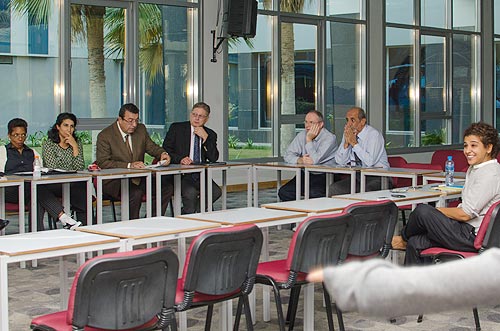
The American University of Kuwait (AUK) is pleased to announce its contribution to the Grand Map project "Kuwait: More than a Home", launched last week at the Avenues Mall. The project is a creation of Universal Watch Advertising under the sponsorship of the Ministry of Information and major Kuwait organizations, including AUK. The project, which is taking place for the first time in the Middle East, comes as part of the celebrations of Kuwait's constitution 50th Anniversary. It is expected to run until the end of November.
The Grand Map is a 680 square meter map of Kuwait constructed on the floor of The Avenues (Phase 2) with special symbols scattered all around the map. Through a special smart phone application (Treek), visitors will be able to view a digital archive of Kuwait's' history and achievements by scanning certain spots on the map. This 300 year narrative of Kuwait's history is presented through the latest picture recognition technology and interactive marketing.
The opening ceremony of the Grand Map was attended by key figures from the Ministry of Information, Touristic Enterprise Company (TEC), as well as, Mabanee, the mall management company of The Avenues. Representatives from the sponsoring companies, including, Zain, IKEA, and Kuwait Food Company (Americana), were also present. The huge glass map has attracted many of The Avenues visitors, who were particularly impressed by the technological aspect of the project.
"Participation in this project comes as part of AUK's efforts to support profound initiatives of national and cultural significance" commented Dr. Carol Scott-Ross, Vice President for Administrative & Student Affairs at AUK "We appreciate this innovative way of celebrating the 50th Anniversary of Kuwait's constitution", she continued.
On the Grand Map, AUK has been associated with locations of culture, art, and history, among others. The most significant historical site AUK has been linked to is Al Seif Palace, which is also depicted in the AUK official logo.
Released by the Office of Public Affairs on the 22nd November 2012
Photography by the Office of Public Affairs (C) 2012
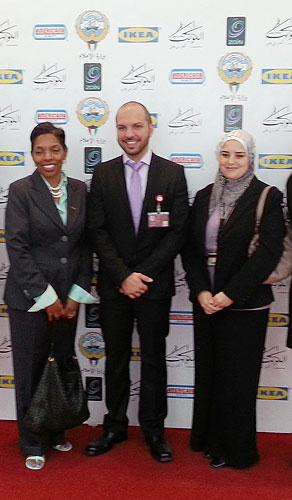
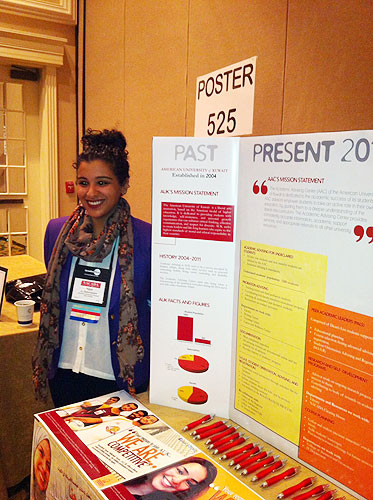
Director of the Academic Advising Center (AAC) Dr. Kathryn Kleypas and Assistant Director Hala Al-Abdulrazzaq attended the Annual Conference of the National Academic Advising Association (NACADA) in Nashville, Tennessee in early October. They presented a poster session and a panel on the theme of academic advising at an American-style university in the Gulf. In their panel presentation they explored varying viewpoints on the appropriateness of American theories of advising for students outside the US and discussed awareness of students' academic and emotional preparedness for American-style education.
Dr. Kleypas and Hala also attended a variety of workshops and panels throughout the duration of the conference. Both participants found the topics of the panels and workshops very enriching. While the topics of the panels varied, they all focused in one way or another on the theme of student support and ways that advisors can have a powerful impact on the students' academic careers. Dr. Kleypas and Hala are very excited to implement some of the new approaches to advising they were exposed to at the conference at AUK. The National Academic Advising Association is eager to develop their network of international universities and Dr. Kleypas and Hala are looking forward to being active participants in the association's initiatives and continuing to foster the professional relationships they established at the conference.
The Academic Advising Center (AAC) provides academic support to all currently undeclared students. Programs include academic advising, academic support (tutoring, supplemental instruction and success skills workshops), and retention initiatives.
Released by the Office of Public Affairs on the 21st November 2012
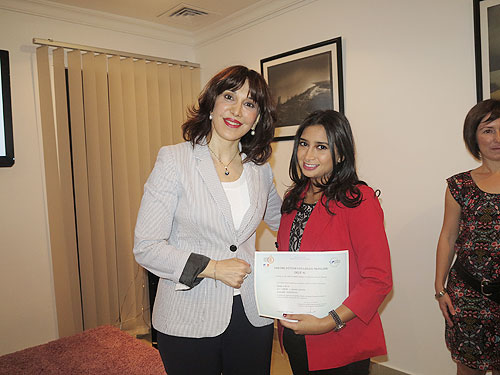
AUK student Mariam Al Refai from professor Joseph Fiannaca' s Spring 2012 French class successfully passed the DELF A1 (the French language proficiency test) in June 2012. An award ceremony took place on Saturday, November 20 in Jabriya at the Institut Français, the official French language center in Kuwait. The French ambassador, her Excellency Mrs. Nada Yafi, handed the certificates to the graduates. Also in attendance was the director of the Institut Français, Mr. Julian Clech as well as Mrs. Sadia Klitim, the co-director.
In an awards ceremony held at the Institut Français, the official French language center in Kuwait, AUK Student Mariam Al Refai received a French language proficiency certificate for successfully completing DELF A1, the French language proficiency test, in June 2012. The French Ambassador to Kuwait, HE Mrs. Nada Yafi, handed the certificates to the graduates. Also in attendance were: the Director of the Institut Français, Mr. Julian Clech, as well as, the Co-director, Mrs. Sadia Klitim.
Al Refai is a student from Professor Fiannaca's FRNC 389 class. Fiannaca commented on Al Refai's achievement saying "Even though AUK doesn't offer a Minor in French yet, it is always a great honor to see our students willing to pursue their studies in French language and pass the DELF examinations".
The DELF diploma is an official qualification awarded by the French Ministry of Education to certify the competency of candidates from outside France in the French language.
Released by the Office of Public Affairs on the 21st November 2012
Kuwait, 10th November, 2012:The Center for Gulf Studies, in collaboration with the Arabana Project, hosted the third and final lecture series on the planned development of Subbiya. The lecture, which was held at the Kuwait National Library, was titled "Subbiya: Building Kuwait's Second City - Part III: Strategic Considerations" and was presented by Dr. Sami Alfaraj, President of the Kuwait Center for Strategic Studies.
During his talk, Dr. Alfaraj outlined the various strategic priorities Kuwait will need to address in order for the Subbiya project to be a success. These included, considerations on both the local and the regional level. Referencing his studies, 'Bridge 21: Crossing to a New Century' and 'The Strategic Vision For the State of Kuwait' (published between 1998 and 2000), Alfaraj articulated the direct link between the successful development of Subbiya, or the 'Silk City' as it is also known, and maintaining the strategic security of Kuwait as a whole.
Locally, the strategic priorities for Kuwait, according to Alfaraj, start with developing and improving the education sector. This includes modernizing the sector to promote specialization in strategically significant fields that will allow Kuwait to diversify its economy and become a producerof original ideas and technology. Another priority mentioned by Alfaraj is the promotion of a unified and inclusive society that brings together all of Kuwait's various groupings including women, Shiites, Hadthar (urbanites), Badu (Bedouins), tribes, etc... Reestablishing a common Kuwaiti identity that supersedes these factions will allow the country to move forward effectively on a common vision and purpose. Other priorities include addressing issues of accountability, entitlement, corruption, and bureaucratic reform.
On the regional level, Dr. Alfaraj pointed out that Kuwait was a small country surrounded by three regional powers: Saudi Arabia, Iraq, and Iran. The overarching interest of all parties, particularly Kuwait, is to maintain peace between all neighbors. In the case of Iran, maintaining stable relationships necessitates including Iran in regional projects such as pipelines, and opposing Iran's international isolation. In the case of Iraq, improving communication and trust in order to reach common goals is essential. One case in point is that of the Mubarak Al Kabeer Port that is being constructed in the north of Kuwait. Improved communication on the mutual gains of this project will go a long way in improving ties between the two nations.
Answering a question about the return on investment for the expensive construction of Subbiya, a city that will not be based on the production of oil, Dr. Alfaraj explained that the goal of Subbiya will be to spearhead Kuwait's economic diversification, serving as a financial, trade, touristic, and technological center for the country and region. Achieving this, he reiterated, will depend on Kuwait rediscovering a common, united vision for the future.
The Center for Gulf Studies (CGS) at the American University of Kuwait aims to promote greater cultural understanding of and increased intellectual interest in the Gulf, by facilitating free and open academic discourse on a range of issues that both shape and challenge this critical region of the world. The goal of CGS is to enable scholars as well as political and civil society actors both within and outside the region to contribute and add value to the burgeoning field of Gulf Studies, while at the same time informing and engaging the general public. To this end, the CGS encourages, supports, and cultivates interesting and original research on the Gulf, while regularly organizing a variety of public academic events such as lectures, roundtable discussions, and conferences.
Released by the Office of Public Affairs on the 13th November 2012