


News
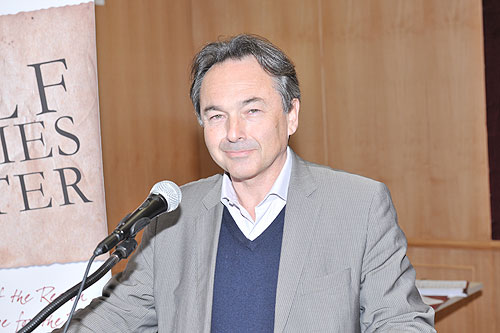
Kuwait -- As part of his visit to Kuwait, Dr. Gilles Kepel , a world-renown expert in Middle Eastern studies, gave a talk at the American University of Kuwait (AUK) on Monday, November 21, 2011. The talk titled "A New Arab World: Implications and Challenges Facing the Gulf Countries" was hosted by the Center for Gulf Studies at AUK and took place at the AUK Salmiya Campus.
Dr. Kepel, who is the author of more than ten books on the Middle East, talked about the present situation in the Arab world in light of the wave of protests and revolutions that started in late 2010, now commonly referred to as the "Arab Spring". In his lecture, Dr. Kepel analyzed the political, social, and strategic dimensions of each revolution taking place in the Arab World, as well as the domestic and international dynamics that are shaping these movements. Dr. Kepel also discussed what he believed to be the major causes for the "Arab Spring", and offered insights on likely scenarios for the future. In his lecture, Dr. Kepel classified the Arab countries being impacted by the "Arab Spring" based on those whose influence on the world system outweighs domestic considerations, and those with less global significance. The speaker concluded his lecture with some thoughts on the challenges and prospects facing the Arab World in the near future. After the lecture Dr. Kepel took several questions from the audience.
The lecture, which lasted for approximately two hours, attracted many students, scholars and public audience, who were keen to share their different experiences and expectations about the political statuses of their countries.
Dr. Kepel is the Academic Director of the Kuwait Program at Sciences Po, a Gulf-focused research and training program established in 2007 and funded by the Kuwait Foundation for the Advancement of Sciences (KFAS). Dr. Kepel is also a Professor of Middle East Studies at Sciences Po University, a Senior Fellow at the Institut Universitaire de France, and a Senior Visiting Fellow at the London School of Economics. In addition, Dr. Kepel is the General Editor of the Near East Series at Presses Universitaires de France - PUF - Publishing House.
The Center for Gulf Studies (CGS) at the American University of Kuwait aims to promote greater cultural understanding of and increased intellectual interest in the Gulf, by facilitating free and open academic discourse on a range of issues that both shape and challenge this critical region of the world. The goal of CGS is to enable scholars as well as political and civil society actors both within and outside the region to contribute and add value to the burgeoning field of Gulf Studies, while at the same time informing and engaging the general public. To this end, the CGS encourages, supports, and cultivates interesting and original research on the Gulf, while regularly organizing a variety of public academic events such as lectures, roundtable discussions, and conferences.
Released by the Office of Public Affairs on the 23rd November 2011
Photography by the Office of Public Affairs (C) 2011
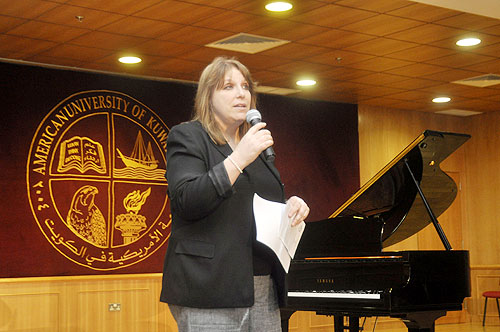
The Music Program of the American University of Kuwait (AUK) in collaboration with Dartmouth College, one of the premiere "Ivy League" universities of the USA, presented a stellar music recital at 7pm on Monday 14 November in the AUK Auditorium Liberal Arts Building, Salmiya Campus. Before a packed house of an audience of over 300, advanced student musicians from both distinguished institutions, accompanied by faculty, performed an exciting repertoire of vocal and instrumental solo and chamber works, demonstrating the continued success of AUK's cultural collaboration with Dartmouth.
The concert, which was the fourth AUK-Dartmouth recital, featured great variety, including works by Chopin, Haydn, Fauré, Mozart, and Verdi. Music professionals, Drs. Elena Tsenkova (piano) and Feruza Kadirova (violin), and Professors Anna Karadimitrova (voice), Agnieszka Fajga (cello), and Dagmara Galas (flute) showcased both their and their students' talents. The Dartmouth intern at AUK Shloka Kini, playing guitar, accompanied AUK student Sara Suliman (flute) on two pieces. Ms. Kini went on to perform a Kuhlau solo piano sonatina, and then joined the full ensemble as a singer in the finale Schubert Serenade.
Outstanding AUK instrumental students included Faisal Al-Bahairi (piano), who opened the evening with a charming Chopin waltz. Khaled Abdel Ghaffar (guitar) next mesmerized the crowd with a classical Spanish piece. Featured on three works, including a duet with Professor Dagmara Galas, was the advanced student Sara Suliman (flute). Sarah Al-Ajmi (piano) presented a lovely Nielsen composition, and Alaa Buqammaz joined Dr. Tsenkova in a fiesty piano duet version of Mozart's Symphone 40, 1st movement. A show-stopper of the evening was the impressive Bach Double Violin Concerto performed by talented AUK student Salem Almathkour along with Dr. Feruza Kadirova, accompanied by Dr. Tsenkova on piano.
A highlight of the evening included vocal students Bashayer Al-Saad, Khaldah Al-Rowdan, Sarah Al-Arbeed, and Zainab Al-Sammak. Their spirited rendition of an American folksong thrilled all. The "Kuwaiti Three Tenors"--Ali Atesh, Nader Abdullah, Yousef Al-Jenai--took the stage next with a crowd-pleasing version of Verdi's "La donna e mobile."
Political science professor Dr. George Irani joined lead soprano Prof. Anna Karadimitrova in a Penella duet, rousing great cheer from the students in the audience. The grand finale piece included all professional instrumentalists and student singers, leaving the audience wanting more.
"This may have been our best concert yet," said Dr. Lisa Urkevich, Coordinator of the Music Program. "The quality of the performances gets better and better each year. The AUK Music Program is certainly making an impact, not just on campus, but in the community. In fact, I was delighted to see so many students in attendance who came from other universities and high schools, all interested in the quality of our program."
The American University of Kuwait (AUK) is an independent, private, equal opportunity, and co-educational liberal arts institution of higher education. The educational, cultural and administrative structure, methods and standards of AUK are based on the American model of higher learning. The lanuage of instruction is English.
AUK and Dartmouth College in Hanover, New Hampshire (USA) have worked closley together since 2003, when the two institutions signed a Memorandum of Understanding that facilitated a serios of advisory, consultative and cooperative projects. Dartmouth College is a member of the group of universities in the United States known as the "Ivy League", more information on Dartmouth College can be found at www.dartmouth.edu.
Released by the Office of Public Affairs on the 17th November 2011
Photography by the Office of Public Affairs (C) 2011
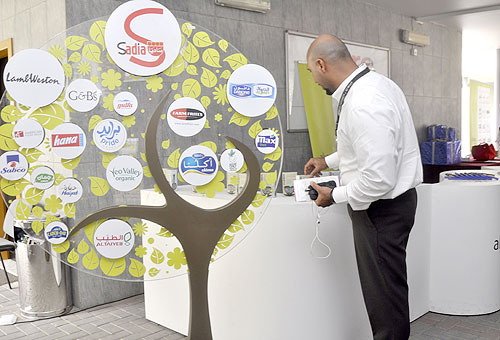
For the seventh year, the American University of Kuwait (AUK) hosted the Annual Health Fair in its Salmiya campus on November 15th. The full day popular exhibition was sponsored by the Career Services and Wellness Center and hosted a variety of health and wellness participating companies including, gyms, healthy restaurants, organic product companies, clinics, spas, hospitals, and health related societies.
During the event, participating companies provided health education literature and information about mental health issues. Clinics provided free checkups for teeth, eyes, skin, blood pressure, and diabetes. Food companies provided free samples of healthy foods and drinks. Gyms provided free trials of exercise equipment. In addition, doctors and nutritionists on site provided free consultations.
The Health Fair provided students with knowledge of how to utilize resources in Kuwait to create and maintain a healthier lifestyle. The five sponsoring companies, Al-Yasra Foods, Firin Gluten-Free Bakery, Fit Football, Hassan's Optics, and Maidan Clinic, presented memberships, vouchers, and other interesting prizes in an effort to encourage and promote such lifestyle choices.
The fair provided a great opportunity for the AUK community to learn about the various health & wellness companies in Kuwait. Other participating companies included Casper & Gambini's, Health Stop Café and Grill, Kuwait Counseling Center, Media Committee from Kuwait Dental Association, Paintball Kuwait, Six Senses Spa, Kefan Optics, Kuwait United Medical Projects Company, Diet Center, and Landmark Group.
"This year's health fair was a huge success" said Mr. Jason R. Sullivan, the Assistant Director of the Career Services and Wellness center at AUK. "We had a great student turnout and each company was very well represented by eager and friendly staff. We are already looking forward to next year's event and all the opportunities to work with such professional companies".
The American University of Kuwait (AUK) is an independent, private, equal opportunity, and co-educational liberal arts institution of higher education. The educational, cultural and administrative structure, methods and standards of AUK are based on the American model of higher learning. The lanuage of instruction is English.
Released by the Office of Public Affairs on the 17th November 2011
Photography by the Office of Public Affairs (C) 2011
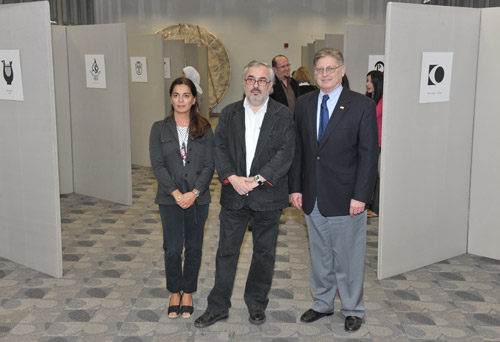
The Graphic Design Program at the American University of Kuwait hosted a design exhibition featuring the works of Stefan Kirov Kanchev on October 24-27, 2011. The exhibition, which presented a large variety of trademark and logo designs from Kanchev's extensive career, was appreciated by students, staff and faculty alike who enjoyed the works of one of the worlds most prominent logo designers. Kanchev's designs are inspiring, educational and continue to be significant to graphic design practice and history.
Stefan Kirov Kanchev, (Aug. 6, 1915 - Aug. 22, 2001) was an applied graphic artist born in Kalofer, Bulgaria. He studied mural painting under Dechko Uzunov at the National Academy of Arts in Sofia. Kanchev is best known for his logo design work and been referred to as the "father of Bulgarian graphic design" and the "master of the trademark". In total, Kanchev has authored around 1,600 logos and his work spanned most varieties of applied art, though he was most productive in his trademark and logo work and as a designer of book covers, posters, greetings cards, print advertisements, stamps, product labels and packaging. As a designer, Kanchev was often inspired by traditional Bulgarian art and folklore. His works are imaginative, with calm and clear composition, felicitous relation between fonts and shapes, clear forms and creative ideas.
Released by the Office of Public Affairs on the 12th October 2011
Photography by the Office of Public Affairs (C) 2011
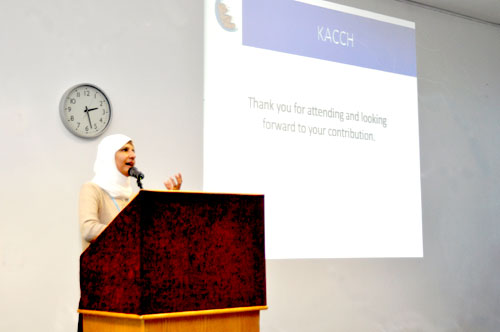
The Office of Student Life launched AUK's Volunteer Program 'Refuse to be Ordinary' on October 18, 2011. This event provided AUK students with the information and opportunity to become significant contributors to the Kuwaiti community through service. Six organizations that perform exemplary service in Kuwait came to AUK. They were Kuwait Red Crescent Society, K's Path, Operation HOPE, PAWS, KACCH and the Kuwaiti Team 4 Global Warming (KT4GW).
The afternoon began with a short address by Dr. Carol, Vice President for Administrative and Student Affairs, where she commended AUK students for their generosity saying, "They will give the shirt off their back and all the money in their pocket." She added that it is now time to take it to the next level and give a helping hand by becoming volunteers. She ended by encouraging them to give their time and effort to help others, to get involved with their hearts and hands because it will make all the difference in the world.
Following Dr. Carol's speech, each organization made a short presentation about what they do, and what volunteers could hope do at their organizations. Once all the presentations were complete, students moved into the hallway where they could go to each organization's table, sign up, ask questions and get more information. Since the organizations were so different, students got an opportunity to select from a wide range of causes that included animals, marine conservation, humanitarian missions, working for the underprivileged, global warming and children in hospital.
The event was attended by over 120 students, as well as others who came to the sign up tables. All those who attended the event were treated to frozen yoghurt from Pinkberry. Overall about 130 students signed up with the six organizations and will soon begin to engage in meaningful service, thus showing that they 'Refuse to be Ordinary'.
The Office of Student Life will continue to serve as a focal point for all those students and staff members who wish to find out more about the participating organizations or to volunteer. For those who missed the event and would like to know how to get involved please stop by the Office of Student Life or email Laveena Lobo at llobo@auk.edu.kw.
Released by the Office of Public Affairs on the 27th October 2011
Photography by the Office of Public Affairs (C) 2011
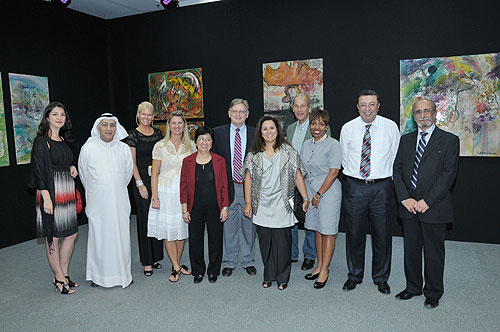
The American University of Kuwait hosted an exclusive art Exhibition featuring the works of internationally famous artist Matt Lamb, as well as held workshops where, students, faculty, staff as well as the general public painted umbrellas to raise awareness for peace.
The Matt Lamb Umbrellas for Peace SM Project is a global art project involving painting and decorating umbrellas by children and adults. The individual will artistically design umbrellas that represent their personal values of world peace. The first day saw approximately 150 AUK students painting umbrellas that were then hung from the ceiling of the AUK Liberal Arts Building. High School students from KES, GES, ACA and KAS also shared in the fun, visiting the AUK campus to take part in this peace initiative and participated in the umbrella painting.
AUK invited Matt Lamb as well as the Matt Lamb Umbrella for Peace SM project to raise awareness among our student body as well as the rest of the country on issues of peace. This event goes hand in hand with AUK's liberal arts values and gives AUK the opportunity to showcase a great artist as well as a great cause.
"The message of peace through art is a great way for AUK to encourage students to be active and socially aware citizens," said AUK President Dr. Winfred Thompson.
AUK hosted the Matt Lamb Umbrellas for Peace SM project for the first time to Kuwait. The Project has been conducted in Argentina, Australia, Austria, Belgium, Brazil, Canada, Czech Republic, France, Germany, Greece, Ireland, Italy, Japan, Lithuania, Luxemburg, Panama, Philippines, Poland, Slovenia, Russia, Singapore, Spain, United Kingdom, USA, Thailand and Vietnam.
Released by the Office of Public Affairs on the 16th October 2011
Photography by the Office of Public Affairs (C) 2011
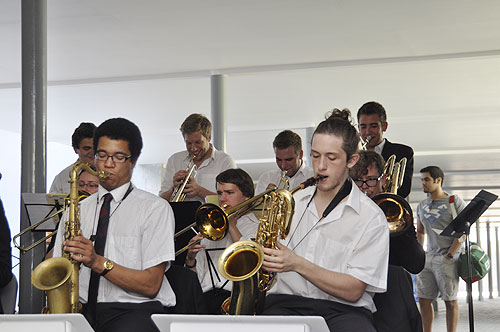
The AUK Music Program hosted The German Youth Jazz Orchestra of North Rhine - Wesphalia who performed in the AUK central campus area on October 10th for hundreds of AUK students, staff and faculty. Under the patronage of the German Embassy in Kuwait and the Goethe Institute of Germany the 35-piece wind band with solo singers, performed several intricate American jazz and Latin works that were well received by the crowd. Afterwards, the large band divided into a small ensemble for a workshop.
Band members, all of whom are between the ages of 17 and 24, were delighted by the AUK reception and commented on the spirit of the campus. Dr. Lisa Urkevich, Coordinator of the Music Program said, "The German Youth Jazz Orchestra really struck a chord here. It is the only youth organization like it in all of Germany. Having them perform at AUK provided our students with a wonderful cultural experience that was unique to many."
Released by the Office of Public Affairs on the 12th October 2011
Photography by the Office of Public Affairs (C) 2011
The American Academy for Liberal Education's (AALE) Board of Trustees awarded the American University of Kuwait International Program Accreditation for its Arts and Humanities Division, Social Sciences Division as well as the University General Education Program.
The Academy certifies and accredits institutions and programs worldwide that are concerned with liberal education and the liberal arts. Accreditation by AALE signifies institutional integrity and a strong commitment to liberal education. Membership certifies that the institution meets or exceeds the Academy's independently established Education Standards.
The AALE Board, Council of Scholars and Site Evaluation Visit Team all agree that, "The University's commitment to provide liberal education extends from AUK's administrators and Board of Trustees to the faculty and students." They added that AUK students "are strongly enthusiastic about inquiry, reflection, critical evaluation, debate and preferring thoughtful critique over memorization." Further, the Visiting Team Report added that "the AUK Faculty is commended for the many ways they seek out and implement additional learning opportunities that enhance the quality of education and global experiences of their students."
AALE accreditation demonstrates that AUK utilizes the best traditions of liberal education, and certifies that the Divisions of Arts and Humanities and Social Sciences as well as the General Education Programs meet International Accreditation standards. AUK President Dr. Winfred Thompson recognized the significance of this step forward saying, "Our aim is to aspire to the highest standard of quality, and with this award we are one step closer to ensuring that AUK provides the highest quality education in Kuwait and the region."
The Academy's Education Standards provide stakeholders in higher education, including parents and prospective students, with a clear means of identifying colleges and programs with focused, well-articulated goals for liberal learning in areas such as history, mathematics, science, literature, languages and philosophy, and with coherent approaches to liberal education.
Dean of the College of Arts and Sciences, Professor Nizar Hamzeh, thanked all those who have contributed to the AALE Self-Study, and in particular members of the AALE Steering Committee chaired by Dr. Rawda Awwad, Assistant Dean for Accreditation and Curriculum. He added, "From my own experience, receiving international program accreditation is not only a tremendous academic achievement but is a testimony to the excellent qualifications, hard work, and leadership and integrity enjoyed by the university faculty, administration and staff."
The American University of Kuwait (AUK) is an independent, private, equal opportunity, and co-educational liberal arts institution of higher education. The educational, cultural and administrative structure, methods and standards of AUK are based on the American model of higher learning. The lanuage of instruction is English.
AUK and Dartmouth College in Hanover, New Hampshire (USA) have worked closley together since 2003, when the two institutions signed a Memorandum of Understanding that facilitated a serios of advisory, consultative and cooperative projects. Dartmouth College is a member of the group of universities in the United States known as the "Ivy League", more information on Dartmouth College can be found at www.dartmouth.edu.
Released by the Office of Public Affairs on the 11th October 2011
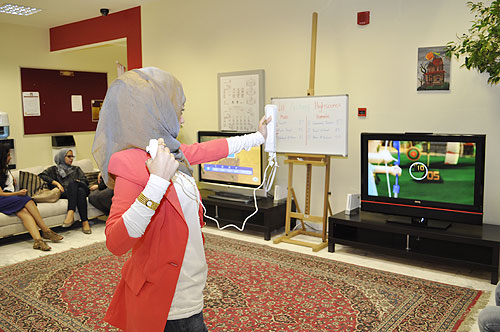
AUK Intramural Sports held its 2nd Annual Wii Sports Tournament last week. The Science Building lobby was transformed into a Wii Sports arena where students, faculty, and staff had the chance to compete against each other in hopes of becoming a High Score Champion. The week began with a practice day, giving the AUK community the opportunity to familiarize themselves with the unique controls for the Wii Sports video game. When playing Wii Sports, participants must mimic the motions a person does when actually playing a sport. For example, when playing tennis on the Wii, players hold the controller in one hand and physically swing their arms as if they are hitting a forehand or backhand. Participants quickly realize that playing Wii Sports is not as easy as it looks; timing, control, and consistency are just as important in this video game as they are when playing the actual sport.
Once people had a chance to understand how the video game worked, the rest of the week was dedicated to a different high score challenge each day. Participants tested their Wii skill in archery, basketball, bowling and jet-ski. At the end of each day the male and female with the highest score was crowned High Score Champion. IEP Students, Undergradates from freshman to senior, and even the occasional professor and staff member participated in this year's Wii Sports Tournament; over 100 people tested their sport skills on the Wii, with many competing each day. AUK Sports Coordinator, Trevor Taylor, commented "The Wii Tournament was a great opportunity for the entire AUK Community to be involved in a sports activity, no matter their physical fitness level or physical limitations. It was great to see so many people enjoying friendly competition."
Congratulations to this year's Wii tournament High Score Champions:
Archery
| 1st Ali Alhabib | 102 | 1st Sarah Khalaf | 90 |
| 2nd Abdulmajid El-Kassem | 88 | 2nd Ghaneema Qudmani | 87 |
| 3rd Kevork Awakimian | 87 | 3rd Hanan Al-Awadhi | 83 |
Basket Ball
| 1st Nigel D'Souza | 23* | 1st Hanan Al-Awadhi | 21 |
| 2nd Mark Rangel | 23 | 2nd Njoud Aweis | 20 |
| 3rd Ahmed Abutaleb | 23 | 3rd Eman Khalil | 19 |
|
* scored 23 pts with 11.3 secs left on the clock |
Bowling
| 1st Majid El- Kassen | 215 | 1st Yasmeen Al- Enzy | 190 |
| 2nd Ali Al Habib | 201 | 2nd Farah Al- Souri | 186 |
| 3rd Jassim Al- Kazemi | 182 | 3rd Zainab Al- Khalifah | 171 |
Jet-ski
| 1st Ali Alhabib | 191.5 | 1st Ghaneema Qudmani | 180.3 |
| 2nd Aziz Al-Thuwaini | 181.9 | 2nd Salwa Al-Qattan | 174.1 |
| 3rd Abdullah Alshemmeri | 176.9 | 3rd Hanan Al-Awadhi | 161.3 |
Pictures from the event
Released by the Office of Public Affairs on the 6th October 2011
Photography by the Office of Public Affairs (C) 2011
AUK welcomed two new members to its senior administration, Dr. Jeanine Romano, Assistant to the President for Institutional Research and Assessment and Mr. Rusty Bruns, Director of the Information Technology Department.
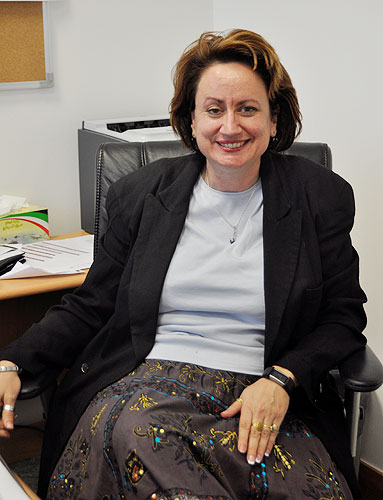
Dr. Jeanine Romano joined AUK on August 18, 2011, from the American University of Sharjah, where she was the Director of Institutional Research from 2007-2010. Prior to going to the UAE, she worked at the University of Tampa from 1996 through 2007 both as a mathematics faculty member and in Institutional Research and Assessment. In addition, she taught several courses in measurement and research design in the College of Education at the University of South Florida. She has participated in over 44 research conference presentations for several organizations. Her work has been published in the Journal of Experimental Education, Journal of Educational and Psychological Measurement, Journal of College Student Development and Internet and Higher Education. She is a founding member of the newly formed Middle East North Africa Association of Institutional Research (MENA-AIR). She has been nominated for the Florida Educational Research Association's distinguished paper award six times and has won this award both in 2004 and 2006. She was also the recipient of the 2007 Florida Association of Institutional Research Best Paper award. Dr. Romano has a PhD in Curriculum and Instruction with an emphasis in Measurement and Evaluation from the University of South Florida.
Mr. Bruns joined AUK on September 18, 2011 after spending 15 years at Charleston Southern University in Charleston, SC as the university's Chief Information Officer. Prior to that, he was a full-time adjunct professor (15 hours) at Trident Technical College in the Business and Technology Department and is a retired U.S. Naval Officer. Mr. Bruns holds a bachelorâs degree in Education from Southern Illinois University, a master's (dual major) in Business and Management Information Systems from Webster University and is currently working on his dissertation for his D.B.A. at Northcentral University. He is married to wife Sandra and has two sons.
AUK is happy to welcome Mr. Bruns and Dr. Jeanine as they will make a great addition to the AUK community.
Released by the Office of Public Affairs on the 3rd October 2011
Photography by the Office of Public Affairs (C) 2011