


News
19, May 2009
New Private Universities in Kuwait Pin Their Hopes on U.S. Partners
THE CHRONICLE OF HIGHER EDUCATION
International
http://chronicle.com/weekly/v55/i37/37a02401.htm
From the issue dated May 22, 2009
New Private Universities in Kuwait Pin Their Hopes on U.S. Partners
By ANDREW MILLS
From the issue dated May 22, 2009
Kuwait
Sharply dressed in black suits and bright red ties, the two recruiters latch onto high-school students as they walk through the gates of Exhibition Hall No. 8 at the Kuwait fairgrounds. "I want to tell you about the American University of the Middle East," one of the recruiters says, following a visitor into the university fair.
"We're affiliated with Purdue University, from the United States. Do you know Purdue?" his sidekick adds, brandishing a clipboard emblazoned with the Purdue logo. "Would you like more information? Just fill out this card and visit our booth. We have a coffee bar there." These recruiters have figured out that the key to selling private higher education in Kuwait is to emphasize what may be their year-old institution's most important asset: its affiliation with a top foreign university.
"The international affiliation is very important. Purdue is a good American university. Its reputation is known," says Ahmad Al-Jaber, one of many high-school seniors who swarm around the American University of the Middle East's booth. "And it's not going to put its name with a school that is not good. Is it?" This implied assurance of quality is more than just an institutional strategy. It's a national one. When Kuwait lifted a ban on private higher education less than a decade ago, it decided that the best way to ensure the development of academically sound universities was to require all new institutions to have foreign partners.
That policy has helped the country rapidly build a credible private higher-education system where none existed before. In only eight years, eight private colleges have opened in this sprawling city-state, catering to some 13,000 students. Nine additional institutions have been authorized to open in the next few years.
Two other Kuwaiti universities have paired with American colleges. The Gulf University for Science and Technology, a polytechnic, teamed up with the University of Missouri at St. Louis; and the American University of Kuwait, a liberal-arts college, is in partnership with Dartmouth College. Other private colleges have Australian or European partners.
To be sure, Kuwait's private universities have not yet established the kind of academic profile
needed to place the small nation on the academic map. When it comes to the Middle East's higher-education renaissance, nobody mentions Kuwait's colleges in the same breath as New York University's soon-to-open campus in Abu Dhabi or Qatar's Education City, whose six U.S. branch campuses have established Doha as a college town on the Persian Gulf.
But here in Kuwait, the private universities have transformed the local scene.
For more than three decades, private higher education was banned in Kuwait. The giant, stateowned Kuwait University was the only option for students who wanted to earn a college degree in this emirate at the northern end of the Persian Gulf. But as the number of Kuwaitis edged close to a million during the 1990s, Kuwait University simply could not keep up with the demand.
Qatar and the United Arab Emirates faced similar challenges. But the unopposed rulers of those petrodollar-rich monarchies could set aside the kind of public money needed to build flashy campuses and lure top foreign universities to fill them up.
Politics are much more complicated in Kuwait, an aspiring democracy where a tumultuous parliament frequently exercises its power to oppose the ruling family's decisions, including on the national budget. Public money has never been as easily available as it has been among Kuwait's neighbors.
So the Ministry of Higher Education settled on a more cost-effective approach: It turned to the private sector.
The government has set out a number of requirements for private investors wishing to develop their own universities. The foreign partner must be ranked among the top 200 by The Times Higher Education Supplement or appear on U.S. News and World Report's top tier of colleges. The relationship between the Kuwaiti institution and its foreign partner must be a meaningful one. "We don't want to be in a situation where we're buying degrees - fancy degrees, with fancy names, but not enough meat," says Imad Alatiqi, secretary general of the Private Universities Council, which regulates all private universities in Kuwait. "We want substantive relationships, where there is a commitment of quality from the local people and from the international people."
Within those requirements, though, there is quite a bit of variety. The University of Maastricht Business School, in the Netherlands, and the Box Hill Institute, in Australia, have opened branch campuses or franchises of their home institutions in Kuwait. The Kuwaiti partners take a back seat when it comes to day-to-day operations. Other local investors have chosen to seek advice from their foreign partners, but manage their own academics and operations.
In those cases, the Private Universities Council requires the foreign partner to submit a formal opinion every time the Kuwaiti university makes a major academic decision, such as starting a program or hiring an academic officer. The council, which licenses and accredits all institutions, also sets the standards it expects private universities in Kuwait to meet. "Any arrangement between the two universities that can deliver those standards, we welcome," Mr. Alatiqi says.
A Liberal-Arts Alternative
In 2003 a group of investors led by Sheikha Dana Nasser Al-Sabah, a member of Kuwait's ruling family, wanted to establish an American-style liberal-arts college. They approached Dartmouth, which offered the kind of curriculum and approach to teaching they hoped to emulate.
They first called Dale F. Eickelman, a Dartmouth anthropologist. It was clear to him, he says, that the Kuwaiti investors wanted to develop a deep relationship.
"From the start, their instinct was to say to us, 'We don't just want you to sign off on things for us, we want you to help us aim for the highest level,'" says Mr. Eickelman, who has spent more than three decades working in the Middle East.
Dartmouth found the idea of helping build a liberal-arts college in the Middle East, a relatively uncommon concept here, hard to resist.
Six years later, hundreds of students now mingle in the shaded courtyards of the American University of Kuwait, switching seamlessly from Arabic to English and back again.
The compact campus on the outskirts of this dusty city, with its palm trees and glass buildings, could not seem farther from Hanover, N.H. But inside its classrooms, the approach to learning is similar.
The largely Western-educated faculty members do not expect their students to memorize lectures, as is common in Middle Eastern universities. Instead, Dartmouth has helped the American University of Kuwait set up the kind of curriculum and structure that, Mr. Eickelman says, encourage students to learn how to form their own opinions.
The university emphasizes a broad liberal education. After the Private Universities Council concluded that Kuwait had no need for anthropologists, Dartmouth worked with university officials to successfully argue that degrees in anthropology and sociology would prepare students for a wide variety of careers.
Dartmouth's agreement with the American University of Kuwait, which extends until at least 2013, is intentionally vague, says Laurel R. Stavis, executive director of the Dartmouth College-American University of Kuwait Project. There is no pro forma checklist of things the two institutions must do for each other. Instead the relationship is an "organic" one that changes to meet the Kuwaiti university's needs as it matures, Ms. Stavis says.
Administrators and faculty members from the American University of Kuwait are able to turn to a group of Dartmouth consultants, selected by Ms. Stavis and Mr. Eickelman, for advice on issues like governance, faculty recruiting, and communications. Students from both universities have begun traveling back and forth. This summer an American University of Kuwait faculty member will be awarded a fellowship to spend a month conducting research in Hanover.
Ms. Stavis is also helping develop a dual-degree program that would enable Kuwaiti students interested in engineering degrees, which are not offered by the American University of Kuwait, to complete their studies in New Hampshire, earning a Dartmouth degree.
The Kuwaiti university covers all of Dartmouth's expenses, but it is hardly a money-making opportunity for the college, Mr. Eickelman says. "The amount of money is a joke. Let's just say it's tremendously little for the work that is being done," he says, declining to say exactly how much money Dartmouth has brought in.
Building Up the Sciences
Joel Glassman, associate provost and director of the Center for International Studies at the University of Missouri at St. Louis, says his university is more interested in helping to build indigenous institutions overseas than in cloning the home campus and transplanting it to the other side of the world.
"It's not so mysterious," says Mr. Glassman, who heads up Missouri's work with the Gulf University for Science and Technology. "They're asking for our advice. Academics are not shy people. There is nothing we love more than being asked for advice."
Administrators and faculty members from St. Louis have helped the Kuwaiti university develop academic programs and curriculum, recruit faculty and staff members, and build the university's administrative organization.
The Gulf University for Science and Technology, which opened in 2002 and enrolls about 2,600 students, modeled its programs after those offered in Missouri. Students can earn undergraduate degrees in computer science, English, business, and mass communications, and a master's in business administration.
Like the American University of Kuwait, it requires all undergraduates to take a set of generaleducation courses.
The university has ambitious plans to spend $100-million to expand its campus to house a fullfledged engineering college.
This is Missouri's second such partnership in the Persian Gulf. It has advised the Modern College of Business and Science, in Muscat, Oman, since it opened in the early 1990s.
Now Missouri is helping the science-and-technology university as it seeks accreditation from AACSB International: the Association to Advance Collegiate Schools of Business.
Robert Cook, vice president for academic affairs at the university in Kuwait, is in the process of hiring 38 faculty members.
He says the relationship with the Missouri campus has given the university's recruitment efforts a boost. Attracting quality faculty members is often the biggest challenge new universities face in the region.
"For potential faculty members who have never been to the Middle East before, Kuwait can seem an intimidating place," says Mr. Cook. "So we did all the interviews for American candidates on the St. Louis campus, and a University of Missouri-St. Louis faculty member in the same field sat in on the interviews."
That assured candidates that the Gulf University for Science and Technology is a serious institution, strongly linked to a serious U.S. university, Mr. Cook says.
The Kuwaiti university has not yet built much of a regional reputation, but here in Kuwait its skills-based programs are highly regarded.
Mr. Cook boasts that 80 percent of its graduates are employed within six months of graduation.
Unlike most public-university graduates, who are automatically given government jobs, graduates of the Gulf University for Science and Technology typically find work in the private sector, where employers demand the best candidates, he says.
Gaining Credibility
Back at the university fair, the American University of the Middle East's recruiters have donetheir job: The university's booth is surrounded by teenagers filling out applications for next fall.
The campus is still in its first year of operation. About 100 students are enrolled in three degree programs - business, design, and information technology - which operate out of a single building at the edge of a windswept stretch of land.
Purdue has agreed to help the Kuwaiti university design and build "some very Purdue-like programs that will, over time, morph into the kind of programs they need in Kuwait," says Andrew Gillespie, Purdue's associate dean of international programs.
Kuwait's private universities face a clear challenge as they continue to expand. The best Kuwaiti students still prefer to study abroad. And two out of every five students - 20,000 of them take advantage of generous overseas government scholarships every year.
Mr. Al-Jaber, the Kuwaiti student, says that his first choice is to study abroad and his second choice is to study at the American University of Kuwait. But, he adds, the American University of the Middle East is not a bad third choice.
While that suggests that many Kuwaiti students still don't have confidence in the quality of their own higher-education system, Mr. Alatiqi, of the Private Universities Council, prefers to see the students as an untapped market.
"So you can see why we're so concerned about building quality universities," says Mr. Alatiqi, snapping his fingers. "We can pick up 20,000 more students just like that."
http://chronicle.com
Section: International
Volume 55, Issue 37, Page A24
Copyright©2009 by The Chronicle of Higher Education
International
http://chronicle.com/weekly/v55/i37/37a02401.htm
From the issue dated May 22, 2009
New Private Universities in Kuwait Pin Their Hopes on U.S. Partners
By ANDREW MILLS
From the issue dated May 22, 2009
Kuwait
Sharply dressed in black suits and bright red ties, the two recruiters latch onto high-school students as they walk through the gates of Exhibition Hall No. 8 at the Kuwait fairgrounds. "I want to tell you about the American University of the Middle East," one of the recruiters says, following a visitor into the university fair.
"We're affiliated with Purdue University, from the United States. Do you know Purdue?" his sidekick adds, brandishing a clipboard emblazoned with the Purdue logo. "Would you like more information? Just fill out this card and visit our booth. We have a coffee bar there." These recruiters have figured out that the key to selling private higher education in Kuwait is to emphasize what may be their year-old institution's most important asset: its affiliation with a top foreign university.
"The international affiliation is very important. Purdue is a good American university. Its reputation is known," says Ahmad Al-Jaber, one of many high-school seniors who swarm around the American University of the Middle East's booth. "And it's not going to put its name with a school that is not good. Is it?" This implied assurance of quality is more than just an institutional strategy. It's a national one. When Kuwait lifted a ban on private higher education less than a decade ago, it decided that the best way to ensure the development of academically sound universities was to require all new institutions to have foreign partners.
That policy has helped the country rapidly build a credible private higher-education system where none existed before. In only eight years, eight private colleges have opened in this sprawling city-state, catering to some 13,000 students. Nine additional institutions have been authorized to open in the next few years.
Two other Kuwaiti universities have paired with American colleges. The Gulf University for Science and Technology, a polytechnic, teamed up with the University of Missouri at St. Louis; and the American University of Kuwait, a liberal-arts college, is in partnership with Dartmouth College. Other private colleges have Australian or European partners.
To be sure, Kuwait's private universities have not yet established the kind of academic profile
needed to place the small nation on the academic map. When it comes to the Middle East's higher-education renaissance, nobody mentions Kuwait's colleges in the same breath as New York University's soon-to-open campus in Abu Dhabi or Qatar's Education City, whose six U.S. branch campuses have established Doha as a college town on the Persian Gulf.
But here in Kuwait, the private universities have transformed the local scene.
For more than three decades, private higher education was banned in Kuwait. The giant, stateowned Kuwait University was the only option for students who wanted to earn a college degree in this emirate at the northern end of the Persian Gulf. But as the number of Kuwaitis edged close to a million during the 1990s, Kuwait University simply could not keep up with the demand.
Qatar and the United Arab Emirates faced similar challenges. But the unopposed rulers of those petrodollar-rich monarchies could set aside the kind of public money needed to build flashy campuses and lure top foreign universities to fill them up.
Politics are much more complicated in Kuwait, an aspiring democracy where a tumultuous parliament frequently exercises its power to oppose the ruling family's decisions, including on the national budget. Public money has never been as easily available as it has been among Kuwait's neighbors.
So the Ministry of Higher Education settled on a more cost-effective approach: It turned to the private sector.
The government has set out a number of requirements for private investors wishing to develop their own universities. The foreign partner must be ranked among the top 200 by The Times Higher Education Supplement or appear on U.S. News and World Report's top tier of colleges. The relationship between the Kuwaiti institution and its foreign partner must be a meaningful one. "We don't want to be in a situation where we're buying degrees - fancy degrees, with fancy names, but not enough meat," says Imad Alatiqi, secretary general of the Private Universities Council, which regulates all private universities in Kuwait. "We want substantive relationships, where there is a commitment of quality from the local people and from the international people."
Within those requirements, though, there is quite a bit of variety. The University of Maastricht Business School, in the Netherlands, and the Box Hill Institute, in Australia, have opened branch campuses or franchises of their home institutions in Kuwait. The Kuwaiti partners take a back seat when it comes to day-to-day operations. Other local investors have chosen to seek advice from their foreign partners, but manage their own academics and operations.
In those cases, the Private Universities Council requires the foreign partner to submit a formal opinion every time the Kuwaiti university makes a major academic decision, such as starting a program or hiring an academic officer. The council, which licenses and accredits all institutions, also sets the standards it expects private universities in Kuwait to meet. "Any arrangement between the two universities that can deliver those standards, we welcome," Mr. Alatiqi says.
A Liberal-Arts Alternative
In 2003 a group of investors led by Sheikha Dana Nasser Al-Sabah, a member of Kuwait's ruling family, wanted to establish an American-style liberal-arts college. They approached Dartmouth, which offered the kind of curriculum and approach to teaching they hoped to emulate.
They first called Dale F. Eickelman, a Dartmouth anthropologist. It was clear to him, he says, that the Kuwaiti investors wanted to develop a deep relationship.
"From the start, their instinct was to say to us, 'We don't just want you to sign off on things for us, we want you to help us aim for the highest level,'" says Mr. Eickelman, who has spent more than three decades working in the Middle East.
Dartmouth found the idea of helping build a liberal-arts college in the Middle East, a relatively uncommon concept here, hard to resist.
Six years later, hundreds of students now mingle in the shaded courtyards of the American University of Kuwait, switching seamlessly from Arabic to English and back again.
The compact campus on the outskirts of this dusty city, with its palm trees and glass buildings, could not seem farther from Hanover, N.H. But inside its classrooms, the approach to learning is similar.
The largely Western-educated faculty members do not expect their students to memorize lectures, as is common in Middle Eastern universities. Instead, Dartmouth has helped the American University of Kuwait set up the kind of curriculum and structure that, Mr. Eickelman says, encourage students to learn how to form their own opinions.
The university emphasizes a broad liberal education. After the Private Universities Council concluded that Kuwait had no need for anthropologists, Dartmouth worked with university officials to successfully argue that degrees in anthropology and sociology would prepare students for a wide variety of careers.
Dartmouth's agreement with the American University of Kuwait, which extends until at least 2013, is intentionally vague, says Laurel R. Stavis, executive director of the Dartmouth College-American University of Kuwait Project. There is no pro forma checklist of things the two institutions must do for each other. Instead the relationship is an "organic" one that changes to meet the Kuwaiti university's needs as it matures, Ms. Stavis says.
Administrators and faculty members from the American University of Kuwait are able to turn to a group of Dartmouth consultants, selected by Ms. Stavis and Mr. Eickelman, for advice on issues like governance, faculty recruiting, and communications. Students from both universities have begun traveling back and forth. This summer an American University of Kuwait faculty member will be awarded a fellowship to spend a month conducting research in Hanover.
Ms. Stavis is also helping develop a dual-degree program that would enable Kuwaiti students interested in engineering degrees, which are not offered by the American University of Kuwait, to complete their studies in New Hampshire, earning a Dartmouth degree.
The Kuwaiti university covers all of Dartmouth's expenses, but it is hardly a money-making opportunity for the college, Mr. Eickelman says. "The amount of money is a joke. Let's just say it's tremendously little for the work that is being done," he says, declining to say exactly how much money Dartmouth has brought in.
Building Up the Sciences
Joel Glassman, associate provost and director of the Center for International Studies at the University of Missouri at St. Louis, says his university is more interested in helping to build indigenous institutions overseas than in cloning the home campus and transplanting it to the other side of the world.
"It's not so mysterious," says Mr. Glassman, who heads up Missouri's work with the Gulf University for Science and Technology. "They're asking for our advice. Academics are not shy people. There is nothing we love more than being asked for advice."
Administrators and faculty members from St. Louis have helped the Kuwaiti university develop academic programs and curriculum, recruit faculty and staff members, and build the university's administrative organization.
The Gulf University for Science and Technology, which opened in 2002 and enrolls about 2,600 students, modeled its programs after those offered in Missouri. Students can earn undergraduate degrees in computer science, English, business, and mass communications, and a master's in business administration.
Like the American University of Kuwait, it requires all undergraduates to take a set of generaleducation courses.
The university has ambitious plans to spend $100-million to expand its campus to house a fullfledged engineering college.
This is Missouri's second such partnership in the Persian Gulf. It has advised the Modern College of Business and Science, in Muscat, Oman, since it opened in the early 1990s.
Now Missouri is helping the science-and-technology university as it seeks accreditation from AACSB International: the Association to Advance Collegiate Schools of Business.
Robert Cook, vice president for academic affairs at the university in Kuwait, is in the process of hiring 38 faculty members.
He says the relationship with the Missouri campus has given the university's recruitment efforts a boost. Attracting quality faculty members is often the biggest challenge new universities face in the region.
"For potential faculty members who have never been to the Middle East before, Kuwait can seem an intimidating place," says Mr. Cook. "So we did all the interviews for American candidates on the St. Louis campus, and a University of Missouri-St. Louis faculty member in the same field sat in on the interviews."
That assured candidates that the Gulf University for Science and Technology is a serious institution, strongly linked to a serious U.S. university, Mr. Cook says.
The Kuwaiti university has not yet built much of a regional reputation, but here in Kuwait its skills-based programs are highly regarded.
Mr. Cook boasts that 80 percent of its graduates are employed within six months of graduation.
Unlike most public-university graduates, who are automatically given government jobs, graduates of the Gulf University for Science and Technology typically find work in the private sector, where employers demand the best candidates, he says.
Gaining Credibility
Back at the university fair, the American University of the Middle East's recruiters have donetheir job: The university's booth is surrounded by teenagers filling out applications for next fall.
The campus is still in its first year of operation. About 100 students are enrolled in three degree programs - business, design, and information technology - which operate out of a single building at the edge of a windswept stretch of land.
Purdue has agreed to help the Kuwaiti university design and build "some very Purdue-like programs that will, over time, morph into the kind of programs they need in Kuwait," says Andrew Gillespie, Purdue's associate dean of international programs.
Kuwait's private universities face a clear challenge as they continue to expand. The best Kuwaiti students still prefer to study abroad. And two out of every five students - 20,000 of them take advantage of generous overseas government scholarships every year.
Mr. Al-Jaber, the Kuwaiti student, says that his first choice is to study abroad and his second choice is to study at the American University of Kuwait. But, he adds, the American University of the Middle East is not a bad third choice.
While that suggests that many Kuwaiti students still don't have confidence in the quality of their own higher-education system, Mr. Alatiqi, of the Private Universities Council, prefers to see the students as an untapped market.
"So you can see why we're so concerned about building quality universities," says Mr. Alatiqi, snapping his fingers. "We can pick up 20,000 more students just like that."
http://chronicle.com
Section: International
Volume 55, Issue 37, Page A24
Copyright©2009 by The Chronicle of Higher Education
18, May 2009
Annual Dinner at American University of Kuwait
The American University of Kuwait held its Annual Faculty and Staff Dinner on May 7, to celebrate faculty and staff who have served AUK for five years and honor exemplary staff for their outstanding performance in all areas of university life. The awards are aimed at excellence in leadership skills, organizational skills, people skills and service to the AUK Community. Some even showcased hidden talents including Karaoke contestants Faten Al-Kadiri and Saleem Aboobacker. This event was sponsored by Habchi and Chalhoub, Tanagra, Swarovski, Tumi, Longchamp, Digits, KCCEC, Gulf Insurance Company, Al-Zuhair Medical Center, Trafalgar and KAPICO.
Five Year Service Awardees
Abdulaziz Abal Instructor, Intensive English Program (IEP)
Abdulraheem Sallam, Accountant (Receivables)
Ali Charara, Assistant Professor, Biology
Alia El Assaad, Outreach & Events Coordinator
Amna Al Omare, Director of Library
Anastacio Prades, Senior Instructor - IEP
Andrea Al Adwani, Student Affairs Counselor
Athmar Al-Salem, Assistant Professor of Management
Carol Ann Ross, Dean of Student Affairs
Craig Loomis, Division Head of Humanities and Arts
Dalal Al-Hubail, Corporate/Public Training Advisor
David Hart, Lab Coordinator, IEP
Fatma Khamis, Media & Communication Officer
Fernand Tessier, Associate Professor, Mathematics
Ghazi Nassir, Associate Professor, English & Literature
Hala Auchey, Executive Assistant to the President
Hana Kaouri, Library Automation Analyst
Hana Mathews, Assistant Registrar
Hussein Diab, Database Administrator
Jeremy Cripps, Professor of Accounting
John Barnett, Senior Instructor - IEP
Kalimullah Bhuiyan, AUK Driver
Liaquat Ali, Facilities Technician
Lisa Urkevich, Associate Professor - Music
Maha Khlat, Director of Information & Technology
Margaret Combs, Director of IEP
Michael McMurray, Instructor/Coordinator, IEP
Neamat Mosaad, Associate Professor, Physics
Pauline Arthur, Instructor, IEP
Rawda Awwad, Assistant Dean for Accreditation and Curriculum
Rebecca Loomis, Instructor/Coordinator, IEP
Shereef Abu Al-Maati, Division Head, Sciences and Engineering
Syed Fazululla, Driver/Stores Assistant
Following is a list of Awardees
Pareen Tajani - TEAM LEADER
Theodore Kruse - TEAM LEADER
Micheline Zouein - THE MOST HUMOROUS EMPLOYEE
Hala Al-Abdulrazzaq - THE MOST CREATIVE EMPLOYEE
Mazin Younis - EMPLOYEE OF THE YEAR (Finance& Administration)
Amal Hadeed - EMPLOYEE OF THE YEAR (Academic Affairs)
Basema Danaa - EMPLOYEE OF THE YEAR (Student Affairs)
Margaret Combs - EMPLOYEE OF THE YEAR (Management)
View More
Five Year Service Awardees
Abdulaziz Abal Instructor, Intensive English Program (IEP)
Abdulraheem Sallam, Accountant (Receivables)
Ali Charara, Assistant Professor, Biology
Alia El Assaad, Outreach & Events Coordinator
Amna Al Omare, Director of Library
Anastacio Prades, Senior Instructor - IEP
Andrea Al Adwani, Student Affairs Counselor
Athmar Al-Salem, Assistant Professor of Management
Carol Ann Ross, Dean of Student Affairs
Craig Loomis, Division Head of Humanities and Arts
Dalal Al-Hubail, Corporate/Public Training Advisor
David Hart, Lab Coordinator, IEP
Fatma Khamis, Media & Communication Officer
Fernand Tessier, Associate Professor, Mathematics
Ghazi Nassir, Associate Professor, English & Literature
Hala Auchey, Executive Assistant to the President
Hana Kaouri, Library Automation Analyst
Hana Mathews, Assistant Registrar
Hussein Diab, Database Administrator
Jeremy Cripps, Professor of Accounting
John Barnett, Senior Instructor - IEP
Kalimullah Bhuiyan, AUK Driver
Liaquat Ali, Facilities Technician
Lisa Urkevich, Associate Professor - Music
Maha Khlat, Director of Information & Technology
Margaret Combs, Director of IEP
Michael McMurray, Instructor/Coordinator, IEP
Neamat Mosaad, Associate Professor, Physics
Pauline Arthur, Instructor, IEP
Rawda Awwad, Assistant Dean for Accreditation and Curriculum
Rebecca Loomis, Instructor/Coordinator, IEP
Shereef Abu Al-Maati, Division Head, Sciences and Engineering
Syed Fazululla, Driver/Stores Assistant
Following is a list of Awardees
Pareen Tajani - TEAM LEADER
Theodore Kruse - TEAM LEADER
Micheline Zouein - THE MOST HUMOROUS EMPLOYEE
Hala Al-Abdulrazzaq - THE MOST CREATIVE EMPLOYEE
Mazin Younis - EMPLOYEE OF THE YEAR (Finance& Administration)
Amal Hadeed - EMPLOYEE OF THE YEAR (Academic Affairs)
Basema Danaa - EMPLOYEE OF THE YEAR (Student Affairs)
Margaret Combs - EMPLOYEE OF THE YEAR (Management)
Showing
10 Articles
of 1530
18, May 2009
AUK Employees Receive Six Sigma Certificat
The Council for Private Universities (PUC) held a ceremony on Tuesday May 12 to recognize and award Six Sigma training course certificates to participating university staff and faculty. AUK's Mourad Dakhli, Mutlaq Al-Mutairi and Theodore Kruse were among the participants at the well attended ceremony at the Kuwait Chamber of Commerce receiving the Six Sigma certificate, as well as a commemorative plaque on behalf of AUK. The certification received is of the Black Belt level of the Six Sigma business management strategy which PUC has extended to the private colleges and universities with the intention of bringing a business-like focus on improving operations management to Kuwait's higher education institutions.
18, May 2009
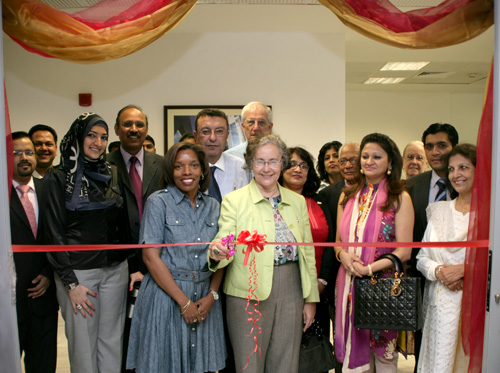
Fashion Fiesta at the AUK Bookstore
The AUK Bookstore organized, for the first time on the AUK Campus, a Fashion Fiesta on May 10, bringing the best Indian designers outfits to the bookstore. AUK President Dr. Marina Tolmacheva inaugurated the event along with Ms. Mandira Malhotra of Samsara and other dignitaries. President Marina applauded the effort made by the AUK Bookstore to bring Indian outfits, emphasizing that such events are very important for the students to understand multicultural society.
The AUK Bookstore in collaboration with Samsara has brought clothes by globally renowned designers like Manish Malhotra, Rocky S, Preeti Chandra, Neeta Lulla and more. These designers have worked for famous Indian film actors and actresses like Sahrukh Khan, Kareena Kapoor, Katrina Kaif, and Aishwarya Rai, and have worked on Hindi movies like Kuch Kuch Hota Hai, Kabhi Khusi Kabhi Gam and Jodha Akbar.
On this occasion Dr. Shoma Munshi, Division Head of Social Sciences, outlined the important role played by Bollywood in bringing Indian clothing to all parts of the world.
On behalf of the AUK Bookstore and its team Mr. Shailendra Srivastava would like to thank AUK administration, faculty and staff for their cooperation and support.
The AUK Bookstore in collaboration with Samsara has brought clothes by globally renowned designers like Manish Malhotra, Rocky S, Preeti Chandra, Neeta Lulla and more. These designers have worked for famous Indian film actors and actresses like Sahrukh Khan, Kareena Kapoor, Katrina Kaif, and Aishwarya Rai, and have worked on Hindi movies like Kuch Kuch Hota Hai, Kabhi Khusi Kabhi Gam and Jodha Akbar.
On this occasion Dr. Shoma Munshi, Division Head of Social Sciences, outlined the important role played by Bollywood in bringing Indian clothing to all parts of the world.
On behalf of the AUK Bookstore and its team Mr. Shailendra Srivastava would like to thank AUK administration, faculty and staff for their cooperation and support.
AUK President Dr. Marina Tolmacheva inaugurated the event along with Ms. Mandira Malhotra of Samsara and other dignitaries
14, May 2009
IEP Director Lends a Hand
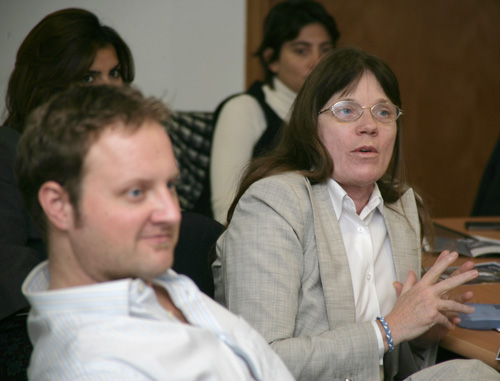
Intensive English Program (IEP) Director at AUK, Margaret Combs spent her Christmas Holidays in 2008 at the Asian University for Women in Chittagong, Bangladesh to help Access Academy teachers and staff with a host of issues relating to curriculum and assessment. Mrs. Combs' 30 year experience teaching English as a second language was a valuable asset and AUW has shown their gratitude by thanking Mrs. Combs in their Spring 2009 issue of AUWNews vol. 3 No. 1. Mrs. Combs will be traveling back to AUW in August of 2009 to once more offer her expertise.
Margaret Combs
14, May 2009
New Student Body Government at AUK
This Thursday the AUK student body elected its new officers for the Student Government Association for the 2009-2010 year, marking AUK's 5th election since opening and a student voter turnout of 42 per cent.
Abdullah Al-Sharrad will succeed Nora Al-Hilaly as Student Body President and Mohammad Al-Mutairi will serve under him as Vice President. Essa Al-Matar won as Treasurer and the Secretary position will be filled as per the Student Body Constitution. The 2009-2010 Media Officer will be Omar Al-Hussainan and Essa Al-Boloshy will serve as Public Relations Officer and Programming Officer is Mohammad Al-Shuraij.
For General Assembly, Sophomore Representative position is vacant. The election for the offices of Junior and Senior will be postponed. Business and Economic Representative will be Noha Aoun.
SGA currently ratified their constitution making significant changes that provide a major shift in the current SGA which allows for more participation and input from a diverse student body, specifically with the creation and implementation of the General Assembly (GA). Prior to this y ear, SGA consisted of only 9 board members and volunteers during events. Decisions were general made within their experience, with advice from administration, and represented AUK students. With the new SGA constitutional changes and the creation of the GA, SGA will now have representatives from a variety of areas of campus including the different academic divisions, clubs and organizations, sports, and class years. Thus, the makeup of SGA will now be totaling around 25 students. All major decisions will have to be discussed and go through the entire SGA including the board and the GA.
Abdullah Al-Sharrad will succeed Nora Al-Hilaly as Student Body President and Mohammad Al-Mutairi will serve under him as Vice President. Essa Al-Matar won as Treasurer and the Secretary position will be filled as per the Student Body Constitution. The 2009-2010 Media Officer will be Omar Al-Hussainan and Essa Al-Boloshy will serve as Public Relations Officer and Programming Officer is Mohammad Al-Shuraij.
For General Assembly, Sophomore Representative position is vacant. The election for the offices of Junior and Senior will be postponed. Business and Economic Representative will be Noha Aoun.
SGA currently ratified their constitution making significant changes that provide a major shift in the current SGA which allows for more participation and input from a diverse student body, specifically with the creation and implementation of the General Assembly (GA). Prior to this y ear, SGA consisted of only 9 board members and volunteers during events. Decisions were general made within their experience, with advice from administration, and represented AUK students. With the new SGA constitutional changes and the creation of the GA, SGA will now have representatives from a variety of areas of campus including the different academic divisions, clubs and organizations, sports, and class years. Thus, the makeup of SGA will now be totaling around 25 students. All major decisions will have to be discussed and go through the entire SGA including the board and the GA.
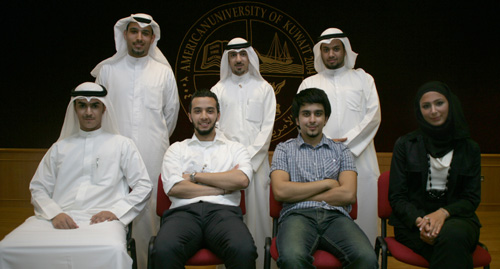
The Student Government Association for the 2009-2010. First row from left to right: Omar Al-Hussainan, Mohammad Al-Shuraij, Essa Al-Matar, Noha Aoun. Back row from left to right: Abdullah Al-Sharrad, Essa Al-Bolushy, Mohammad Al-Mutairi
Dr. Carol Ross, Dean of Student Affairs announces the results of the elections
2008-2009 SGA
AUK students congratulate the new memebers of the 2009-2010 SGA
AUK students congratulate the new memebers of the 2009-2010 SGA
13, May 2009
Halim Choueiry Conducts 3-day GDES Workshop
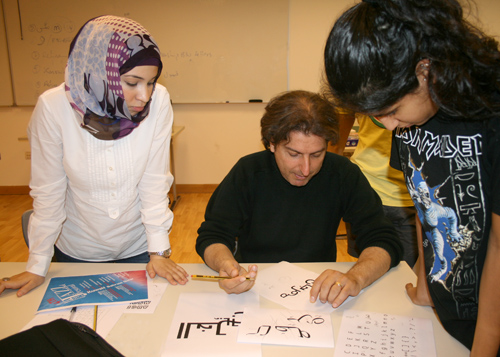
Over the course of three days, May 7-9, Halim Choueiry conducted a workshop for junior and senior GDES students at the American University of Kuwait, titled "Latin into Arabic" Choueiry, a famous graphic designer and Assistant Professor of Graphic Design, and Vice-President of Icograda (International Council of Graphic Design Associations), has tremendous energy and passion for the work he does, and very effectively transmitted that excitement on to the students involved, helping them through every painstaking step of the process.
The first day of the workshop consisted of a lecture and orientation for the students to understand the purpose of the assignment. Choueiry began by saying that we all "live by narrative, by stories, by the semiotics of things," by the way things are transformed, changed, and magnified, manifesting themselves "typographically, as the symbols of the story." It's not just the narrative of the artistic product, however, that Choueiry is talking about: it is the act of writing in and of itself. Like the chalky handprints of Neanderthal settlers in the caves of Lascaux and the rocky desert of the Libyan Sahara, the act of epigraphy and making one's mark in the world is what Choueiry finds so fascinating. "When designing something," he pointed out, "you need to guide your viewer to find a relationship between the words, the images, if they're there, and the meaning, and give all of these good readability."
The lecture detailed the history of the Arabic script "lughat a-Dad," or the language of a-Dad detailing briefly the developments the Arabic script has made since the ninth century, from the addition of diacritical marks to the development of the different scripts, from Kufic to Naskhi, Thuluth to Diwani, and so on. He also mentioned the inter-connectedness of the various Semitic languages, Aramaic, Hebrew, and Syrianic, also mentioning as the turning point in the synthesis of scripts, "Kashuni," Arabic written in Aramaic letters. From this, Choueiry said, the students would produce their own new synthesized creations of script that flowed well together.
For the next two days of the workshop, the students worked very hard on their own small projects. Every student brought parts of their portfolios for one-on-one sessions with Choueiry before they started on their Latin to Arabic project. On the final day, students made some final refinements and adjustments to their work before printing and mounting it on black board so that they might present their work before the class. Also, Mark, the creator and founder of the famous Kuwaiti blog, 2.48 am, was present to view and judge their work alongside Choueiry.
In discussing the real art and progress that one achieves in experimenting with different forms of expression, Choueiry quoted from Antoine de Sainte-Exupery's beloved fable of The Little Prince, speaking to what was by now an enchanted audience that "you can always see things clearly with your heart; what is essential is invisible to the eyes."
The first day of the workshop consisted of a lecture and orientation for the students to understand the purpose of the assignment. Choueiry began by saying that we all "live by narrative, by stories, by the semiotics of things," by the way things are transformed, changed, and magnified, manifesting themselves "typographically, as the symbols of the story." It's not just the narrative of the artistic product, however, that Choueiry is talking about: it is the act of writing in and of itself. Like the chalky handprints of Neanderthal settlers in the caves of Lascaux and the rocky desert of the Libyan Sahara, the act of epigraphy and making one's mark in the world is what Choueiry finds so fascinating. "When designing something," he pointed out, "you need to guide your viewer to find a relationship between the words, the images, if they're there, and the meaning, and give all of these good readability."
The lecture detailed the history of the Arabic script "lughat a-Dad," or the language of a-Dad detailing briefly the developments the Arabic script has made since the ninth century, from the addition of diacritical marks to the development of the different scripts, from Kufic to Naskhi, Thuluth to Diwani, and so on. He also mentioned the inter-connectedness of the various Semitic languages, Aramaic, Hebrew, and Syrianic, also mentioning as the turning point in the synthesis of scripts, "Kashuni," Arabic written in Aramaic letters. From this, Choueiry said, the students would produce their own new synthesized creations of script that flowed well together.
For the next two days of the workshop, the students worked very hard on their own small projects. Every student brought parts of their portfolios for one-on-one sessions with Choueiry before they started on their Latin to Arabic project. On the final day, students made some final refinements and adjustments to their work before printing and mounting it on black board so that they might present their work before the class. Also, Mark, the creator and founder of the famous Kuwaiti blog, 2.48 am, was present to view and judge their work alongside Choueiry.
In discussing the real art and progress that one achieves in experimenting with different forms of expression, Choueiry quoted from Antoine de Sainte-Exupery's beloved fable of The Little Prince, speaking to what was by now an enchanted audience that "you can always see things clearly with your heart; what is essential is invisible to the eyes."
Halim Choueiry with AUK students
Halim Choueiry with AUK students
GDES student work on her project during the workshop
12, May 2009
AUK Data Center Redesign Project
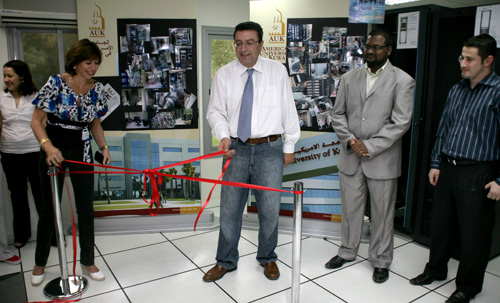
In an effort to establish a sustainable Data Center that meets with AUK's future IT requirements as well as accreditation standards, Ms. Maha Khlat - Director of the IT department - has embarked on a project to re-design and re-organize the existing server room. The newly redesigned Data Center was inaugurated by Dean of the College of Arts and Sciences Dr. Nizar Hamzeh on behalf of President Dr. Marina Tolmacheva on May 7th.
The importance of this project stems from the fact that a Data Center is the heart of the IT infrastructure. Given our dependency and reliance on IT systems to do our jobs, the project was quite critical to provide a healthy environment to AUK's servers and network and security appliances and it consisted of installing additional patch panels, cables and patch cords in the server room and in re-cabling and re-organizing all data center components. It had to be planned during a "slow" period since it was estimated that at least 3-4 days will be required to complete the project and all services would be unavailable during that time (Email service, Banner, Network, Internet, IP Phones). The President's Cabinet advised that it would be best to take advantage of the Spring mid-semester break (April 10th till April 18th) to plan for such a project. To further minimize downtime during working days, the IT team planned for the project to start on a weekend, and accordingly, the decision was made to conduct the project during the period starting on Friday April 10th and ending on Monday April 13th.
The IT team - Mr. Faeq Abu Khair, Mr. Shaik Sayeed and Mr. Hossam Omar - worked relentlessly with the cabling contractor's team for 12-14 hours a day on Friday, Saturday and Sunday to ensure that the project gets completed ahead of schedule and that all user services are reestablished impeccably and in record time. If it were not for the IT team's know-how and expertise with our systems, the project would have taken longer to complete and systems and services would not have been restored in a timely fashion.
The change was drastic and the outcome quite impressive. Consequently, and despite the fact that additional improvements are being planned (climate control and access control), AUK's current Data Center is definitely showcase material.
The importance of this project stems from the fact that a Data Center is the heart of the IT infrastructure. Given our dependency and reliance on IT systems to do our jobs, the project was quite critical to provide a healthy environment to AUK's servers and network and security appliances and it consisted of installing additional patch panels, cables and patch cords in the server room and in re-cabling and re-organizing all data center components. It had to be planned during a "slow" period since it was estimated that at least 3-4 days will be required to complete the project and all services would be unavailable during that time (Email service, Banner, Network, Internet, IP Phones). The President's Cabinet advised that it would be best to take advantage of the Spring mid-semester break (April 10th till April 18th) to plan for such a project. To further minimize downtime during working days, the IT team planned for the project to start on a weekend, and accordingly, the decision was made to conduct the project during the period starting on Friday April 10th and ending on Monday April 13th.
The IT team - Mr. Faeq Abu Khair, Mr. Shaik Sayeed and Mr. Hossam Omar - worked relentlessly with the cabling contractor's team for 12-14 hours a day on Friday, Saturday and Sunday to ensure that the project gets completed ahead of schedule and that all user services are reestablished impeccably and in record time. If it were not for the IT team's know-how and expertise with our systems, the project would have taken longer to complete and systems and services would not have been restored in a timely fashion.
The change was drastic and the outcome quite impressive. Consequently, and despite the fact that additional improvements are being planned (climate control and access control), AUK's current Data Center is definitely showcase material.
Dr. Nizar Hamzeh, Dean of the College of Arts and Sciences & Ms. Maha Khlat, Director of the IT department inaugurates the new Data Center
Before images
After images
11, May 2009
French Embassy Holds Art Exhibition
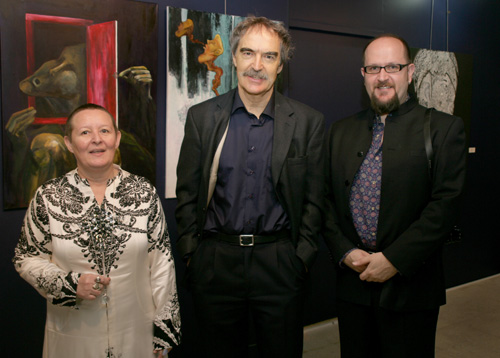
The Cercle Franchophone(CFK) of the French Embassy of Kuwait held an exhibit of artwork by American University of Kuwait students, alumni and faculty titled 'B307' from May 9th until May 23rd at the Library of the French Embassy. The opening reception was held on Saturday May 9th from 11 am until 1 pm. B307 is a rehearsal for a larger exhibit of similar artworks at Dubai's Opera Gallery this summer. Professor Dominique Malarde, the organizer of both exhibitions in Kuwait and Dubai said, 'What a wonderful adventure to accompany a young generation of Art students from the American University of Kuwait through a journey of creativity.' She added that, 'Wherever we are, Art transcends the barriers of culture, languages, and religions.' Professor William Andersen, who offered additional help organizing the exhibit and worked personally with the students to develop their artwork said, 'The exhibits pushed the students to work at a professional level and will give them the opportunity to display their work out in the real world.' The exhibit was attended by French Ambassador Jean-Rene Gettan and his spouse Sophie Gettan, Cultural Attache Oliver Desseez, Acting Public Affairs Officer from the U.S. Embassy Pamela G. Mills, Cercle Francophone representatives Zaida Slaiman and Alex d'Souza, as well as members of the AUK community and their families.
For more information contact The Cercle Franchophone(CFK) of the French Embassy of Kuwait - 22582075 Or the American University of Kuwait : 22248399 Ext. 306; Fax: 2571588.
French Embassy, Mansouriah, block 1, street 13, house 24
Opening hours for the Cercle Franchophone (CFK) - The French Embassy's Library
Saturday 11 a.m. - 1 p.m.
Sunday, Monday, Tuesday and Wednesday 8:30 a.m. - 2:00 p.m.
Thursday 3:30 p.m. - 6:30 p.m.
For more information contact The Cercle Franchophone(CFK) of the French Embassy of Kuwait - 22582075 Or the American University of Kuwait : 22248399 Ext. 306; Fax: 2571588.
French Embassy, Mansouriah, block 1, street 13, house 24
Opening hours for the Cercle Franchophone (CFK) - The French Embassy's Library
Saturday 11 a.m. - 1 p.m.
Sunday, Monday, Tuesday and Wednesday 8:30 a.m. - 2:00 p.m.
Thursday 3:30 p.m. - 6:30 p.m.
French Ambassador Jean-Rene Gettan with Professor Dominique Malarde and Professor William Andersen
Images from the exhibition of Artists & their work
04, May 2009
MUNAUK visits the Bahraini Ambassador to Kuwait
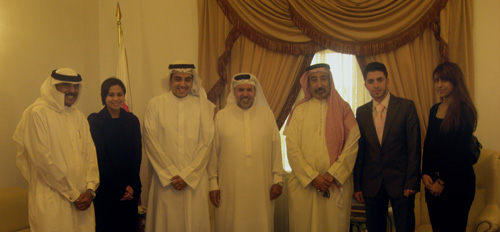
The Executive Committee of the Model United Nations at the American University of Kuwait visited His Excellency Sheikh Khaleefa bin Hamad Al Khaleefa, the Kingdom of Bahrain's Ambassador to Kuwait.
MUNAUK President Abdulaziz Safi Al Mutawa, Vice President Norah Al-Hilaly, and Secretary Mustapha Abou-Houeili, accompanied by MUNAUK Faculty Advisor Shareefa Al-Adwani, visited the Ambassador at the Kingdom of Bahrain Embassy in order to discuss the experiences of diplomats engaged in full-time decision-making, conflict resolution, and diplomacy.
When asked about his experience as a diplomat and his advice to the younger generation about becoming a diplomat, he emphasized the importance of educating future generations by using both today's academic standards and the past traditions. He noted that the remembrance of the past, culture, and tradition strengthen students to become diplomats that may faithfully serve their countries.
He also introduced the MUNAUK delegation to the Bahraini Chief Liaison of Education, who monitors educational issues between the Kingdom of Bahrain and the State of Kuwait. He noted that there was a brotherhood between the countries, and stated this strong relationship would endure time.
MUNAUK President Abdulaziz Safi Al Mutawa, Vice President Norah Al-Hilaly, and Secretary Mustapha Abou-Houeili, accompanied by MUNAUK Faculty Advisor Shareefa Al-Adwani, visited the Ambassador at the Kingdom of Bahrain Embassy in order to discuss the experiences of diplomats engaged in full-time decision-making, conflict resolution, and diplomacy.
When asked about his experience as a diplomat and his advice to the younger generation about becoming a diplomat, he emphasized the importance of educating future generations by using both today's academic standards and the past traditions. He noted that the remembrance of the past, culture, and tradition strengthen students to become diplomats that may faithfully serve their countries.
He also introduced the MUNAUK delegation to the Bahraini Chief Liaison of Education, who monitors educational issues between the Kingdom of Bahrain and the State of Kuwait. He noted that there was a brotherhood between the countries, and stated this strong relationship would endure time.
MUNAUK visits the Bahraini Ambassador to Kuwait