

News
21, Feb 2022
AUK Officially Opens Padel Court Among National & Liberation Days Activities
AUK held a weeklong celebration of Kuwait’s National Day and Liberation Day alongside its padel court opening with various events and activities on campus.
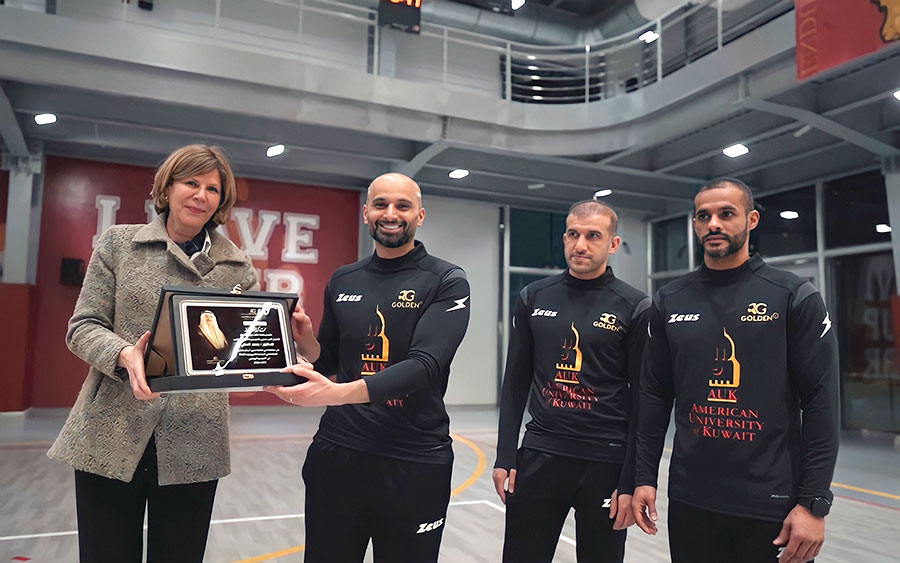
The opening ceremony of the padel court commenced with an official inauguration which included a ribbon-cutting ceremony by the president of the Kuwait Olympic Committee and AUK alumnus, Shaikh Fahad Nasser Sabah Al-Ahmad Al-Sabah and AUK president, Dr. Rawda Awwad. A plaque of appreciation was presented by Dr. Awwad to Shaikh Fahad Nasser Sabah Al-Ahmad Al-Sabah for attending the official ceremony. The ceremony was organized by the Office of Student Life and the Office of Public Relations and Marketing in collaboration with the organizers of the Shaikh Nasser Sabah Al-Ahmad Al-Sabah Golden Award.
Following the inauguration, a padel match played by two of Kuwait’s most popular national football players, Bashar Abdullah and Bader Al Mutawa against Shaikh Fahad Nasser Sabah Al-Ahmad Al-Sabah and Shaikh Ali Abdullah Sabah Al Salem Al Sabah. The next game included AUK alumnus, Najeeb Al Awadi against AUK student, Mohammed Abdal. The event was filled with traditional Kuwaiti music, a photobooth, snacks, and fresh drinks.
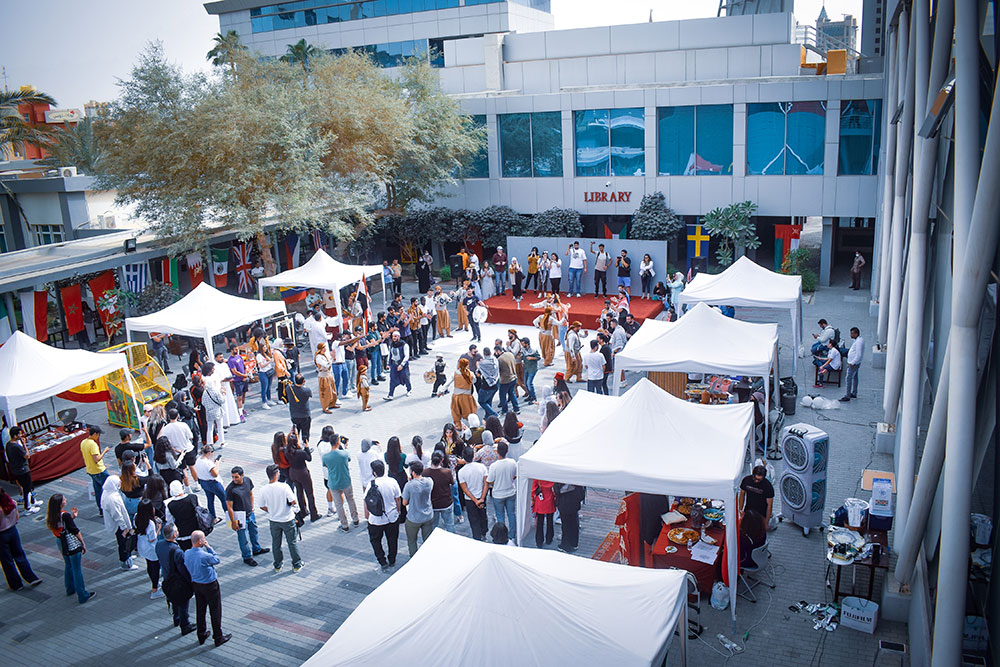
Alongside the padel court opening were an exciting variety of activities and functions organized by AUK student clubs and organizations which included an old Kuwaiti souk theme, live traditional music by Kuwaiti bands, authentic Kuwaiti food, and several games and booths for the campus community to enjoy.
Commenting on the court opening ceremony and National & Liberation Day celebrations, Ms. Hala Al Abdulrazzaq, dean of Student Affairs said, “We are delighted with the festive National and Liberation Day activities and of the prestigious inauguration of the padel court. It was an honor to host our VIP guests and professional athletes. There are many exciting functions planned for the future and we look forward to providing our students with many more fun opportunities.”
The opening ceremony of the padel court commenced with an official inauguration which included a ribbon-cutting ceremony by the president of the Kuwait Olympic Committee and AUK alumnus, Shaikh Fahad Nasser Sabah Al-Ahmad Al-Sabah and AUK president, Dr. Rawda Awwad. A plaque of appreciation was presented by Dr. Awwad to Shaikh Fahad Nasser Sabah Al-Ahmad Al-Sabah for attending the official ceremony. The ceremony was organized by the Office of Student Life and the Office of Public Relations and Marketing in collaboration with the organizers of the Shaikh Nasser Sabah Al-Ahmad Al-Sabah Golden Award.
Following the inauguration, a padel match played by two of Kuwait’s most popular national football players, Bashar Abdullah and Bader Al Mutawa against Shaikh Fahad Nasser Sabah Al-Ahmad Al-Sabah and Shaikh Ali Abdullah Sabah Al Salem Al Sabah. The next game included AUK alumnus, Najeeb Al Awadi against AUK student, Mohammed Abdal. The event was filled with traditional Kuwaiti music, a photobooth, snacks, and fresh drinks.
Alongside the padel court opening were an exciting variety of activities and functions organized by AUK student clubs and organizations which included an old Kuwaiti souk theme, live traditional music by Kuwaiti bands, authentic Kuwaiti food, and several games and booths for the campus community to enjoy.
Commenting on the court opening ceremony and National & Liberation Day celebrations, Ms. Hala Al Abdulrazzaq, dean of Student Affairs said, “We are delighted with the festive National and Liberation Day activities and of the prestigious inauguration of the padel court. It was an honor to host our VIP guests and professional athletes. There are many exciting functions planned for the future and we look forward to providing our students with many more fun opportunities.”
Images from the event
17, Feb 2022
AUK Strategic Partner of Sheikh Nasser Sabah Al-Ahmad Award for Player of the Season
The fourth consecutive season of the Sheikh Nasser Sabah Al-Ahmad Award for best domestic athlete has launched with the American University of Kuwait (AUK) as its strategic partner. The Award launched in 2018 and annually names athletes as the recipients of the award for their athleticism and positive influence on sports.
Supported by the two renowned national soccer team players Bashar Abdullah and Bader Al-Mutawa, the award this year involves a myriad of activities to promote sports and exercise among youth. The activities include friendly sporting games including Teqball, padel, and soccer where the two players will compete against AUK players at the University courts.
Among other activities of the Award is an exclusive radio show hosted by Marina FM, featuring national team players Bashar Abdullah and Bader Al-Mutawa. The show also includes guests such as coaches, sports enthusiasts, and local sports committee members.
During the inaugurate Teqball match held last week at AUK, Dr. Rawda Awwad, President of AUK, stated that the University is always keen to support initiatives that promote active involvement in sports and wellness as an integral part of its educational mission to produce well-rounded, balanced individuals.
Additionally, Mr. Mansour Sinan, founder of the Award, affirmed the significance of AUK’s partnership with the Award, stating that the University’s support for the youth and sports is invaluable.
By the end of the season the Award will conclude its activities with a ceremony held at AUK’s campus whereby the winner of the Award will be announced. The Award aims to support and promote sports within Kuwait’s local youth and athletic community, emphasizing sportsmanship, teamwork, and talent.
Supported by the two renowned national soccer team players Bashar Abdullah and Bader Al-Mutawa, the award this year involves a myriad of activities to promote sports and exercise among youth. The activities include friendly sporting games including Teqball, padel, and soccer where the two players will compete against AUK players at the University courts.
Among other activities of the Award is an exclusive radio show hosted by Marina FM, featuring national team players Bashar Abdullah and Bader Al-Mutawa. The show also includes guests such as coaches, sports enthusiasts, and local sports committee members.
During the inaugurate Teqball match held last week at AUK, Dr. Rawda Awwad, President of AUK, stated that the University is always keen to support initiatives that promote active involvement in sports and wellness as an integral part of its educational mission to produce well-rounded, balanced individuals.
Additionally, Mr. Mansour Sinan, founder of the Award, affirmed the significance of AUK’s partnership with the Award, stating that the University’s support for the youth and sports is invaluable.
By the end of the season the Award will conclude its activities with a ceremony held at AUK’s campus whereby the winner of the Award will be announced. The Award aims to support and promote sports within Kuwait’s local youth and athletic community, emphasizing sportsmanship, teamwork, and talent.
From Left: Dr Rawda Awwad, Dr Mohammad Al Safi, Bashar Abdullah, and Bader AlMutawa
Showing
10 Articles
of 1528
14, Feb 2022
AUK Signs MoU with ABC Center for Early Intervention
In a formal signing ceremony, The American University of Kuwait (AUK) and the ABC Center for Early Intervention, a leading center in the field of early intervention and Applied Behavior Analysis – ABA, signed a Memorandum of Understanding (MOU) to facilitate collaboration between the two parties on a wide spectrum of resources, programs, and activities.
The MOU was signed by AUK President Dr. Rawda Awwad, and Co-founder & Executive Chairman of ABC Kuwait, Dr. Abdullah Al Ali.
The partnership agreement aims to provide an integrated cooperation system that effectively trains and equips AUK students specializing in Social & Behavioral Sciences (SBSA) to be ABA therapists that manage and assist individuals with autism spectrum disorders. The partnership supports both parties’ efforts in providing appropriate and suitable support to individuals on the autism spectrum, and their families, by making the science of ABA accessible to students in local universities and facilitating access to the best possible care and training in the region based on the best international practices.
Dr. Rawda Awwad welcomed the MOU with ABC Center for Early Intervention and stated that “Collaborative partnerships such as these are central to our AUK mission in aiming to improve the lives of individuals in our communities through our students who have the academic strength and intellect, as well as the compassion, and who seek to acquire the specialization necessary to make a substantive difference.”
In this regard Dr. Abdullah AlAli, ABC’s Co-Founder, stated: “ABA intervention program transformed the lives of children on the spectrum. However, in Kuwait there is a lack of ABA service provision by dedicated specialists and there isn’t an ABA program being offered in any local university. Therefore, the inception of the idea of collaborating with AUK came to light, to create an ABA program through their Department of Social and Behavioral Sciences in order to raise awareness on ABA and provide employment opportunities for their students in this fast-growing field. This will not only improve the economic stature of our country by providing more employment opportunities to students. But it will also provide children with autism with professionals that can help them change their lives.” Dr. Abdullah AlAli also added: “Today, with great enthusiasm and pleasure we signed the MOU with AUK as we believe this is the first step of a promising journey in which we will witness the benefit of this partnership reaping for everyone in society and most importantly these children.”
Autism spectrum disorder – ASD affects the development of the brain in children. It specifically affects their ability to communicate, socially interact, and their overall behavior. However, through Applied Behavior Analysis – ABA early intervention, these children’s lives are transformed and they are able to acquire the necessary skills to lead an independent life, build meaningful relationships, and become an integral part of society.
About ABC:
ABC was established in 2011 providing the highest level of intervention services to children with autism and related disorders and offering evidence-based ABA programs, which has transformed the lives of over hundreds of children.
Today ABC has the 2nd largest team of ABA specialists in the Middle East and North Africa, with 10 BCBAs, 17 BCBAs in training, and is being led by a senior management that have a collective 40 years of experience.
The MOU was signed by AUK President Dr. Rawda Awwad, and Co-founder & Executive Chairman of ABC Kuwait, Dr. Abdullah Al Ali.
The partnership agreement aims to provide an integrated cooperation system that effectively trains and equips AUK students specializing in Social & Behavioral Sciences (SBSA) to be ABA therapists that manage and assist individuals with autism spectrum disorders. The partnership supports both parties’ efforts in providing appropriate and suitable support to individuals on the autism spectrum, and their families, by making the science of ABA accessible to students in local universities and facilitating access to the best possible care and training in the region based on the best international practices.
Dr. Rawda Awwad welcomed the MOU with ABC Center for Early Intervention and stated that “Collaborative partnerships such as these are central to our AUK mission in aiming to improve the lives of individuals in our communities through our students who have the academic strength and intellect, as well as the compassion, and who seek to acquire the specialization necessary to make a substantive difference.”
In this regard Dr. Abdullah AlAli, ABC’s Co-Founder, stated: “ABA intervention program transformed the lives of children on the spectrum. However, in Kuwait there is a lack of ABA service provision by dedicated specialists and there isn’t an ABA program being offered in any local university. Therefore, the inception of the idea of collaborating with AUK came to light, to create an ABA program through their Department of Social and Behavioral Sciences in order to raise awareness on ABA and provide employment opportunities for their students in this fast-growing field. This will not only improve the economic stature of our country by providing more employment opportunities to students. But it will also provide children with autism with professionals that can help them change their lives.” Dr. Abdullah AlAli also added: “Today, with great enthusiasm and pleasure we signed the MOU with AUK as we believe this is the first step of a promising journey in which we will witness the benefit of this partnership reaping for everyone in society and most importantly these children.”
Autism spectrum disorder – ASD affects the development of the brain in children. It specifically affects their ability to communicate, socially interact, and their overall behavior. However, through Applied Behavior Analysis – ABA early intervention, these children’s lives are transformed and they are able to acquire the necessary skills to lead an independent life, build meaningful relationships, and become an integral part of society.
About ABC:
ABC was established in 2011 providing the highest level of intervention services to children with autism and related disorders and offering evidence-based ABA programs, which has transformed the lives of over hundreds of children.
Today ABC has the 2nd largest team of ABA specialists in the Middle East and North Africa, with 10 BCBAs, 17 BCBAs in training, and is being led by a senior management that have a collective 40 years of experience.
Images from the MoU signing event featuring AUK President Dr. Rawda Awwad, and Co-founder & Executive Chairman of ABC Kuwait, Dr. Abdullah Al Ali; along with their teams.

03, Feb 2022
AUK Begins the Spring 2022 Semester with a Virtual Orientation and Welcome Week Activities
AUK welcomed new students for the spring 2022 semester through a virtual orientation followed by week-long virtual and on-campus activities attended by new and returning students.
Organized and presented by the Office of Student Life, Division of Student Affairs, the new student orientation event—which takes place at the start of each new academic year and at the beginning of the spring semester—prepared students to effectively shift into university life. The students were introduced to services from the Campus Services Department, Office of Scholarship & Financial Aid, IT Department, the library, the Writing & Tutoring Center, Counseling Center, and Office of Student Life. The session gave students the tools and information needed to become academically prepared, socially successful, and comfortable in AUK. The presentations were followed by online games in breakout rooms with smaller groups to encourage students to socialize and meet new friends.
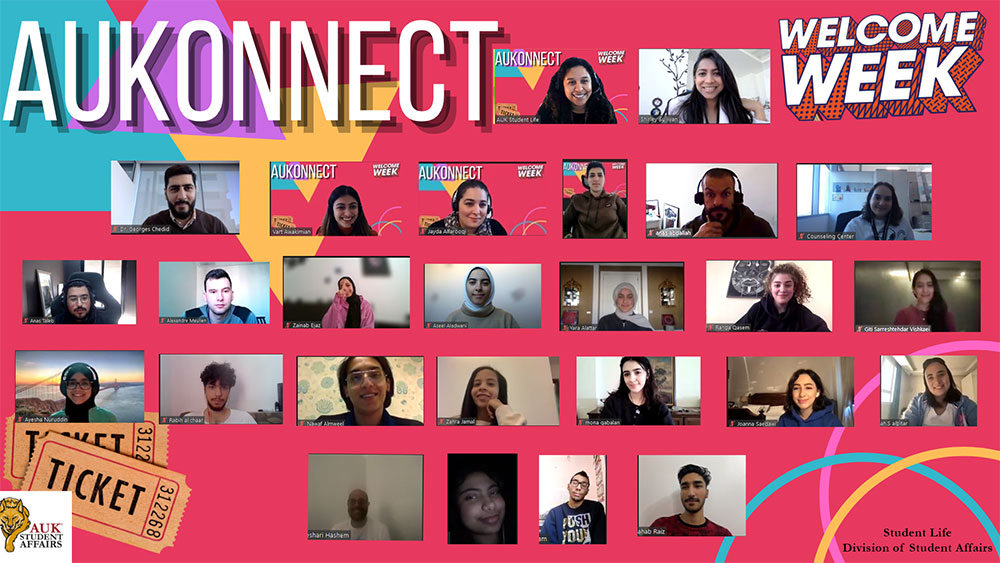
Welcome Week was held during the first week of the spring semester to encourage new and returning students to get involved in activities outside the classroom. Activities included an array of games as well as opportunities to foster new friendships and for students to be familiar with the Division of Student Affairs staff and services, as well as a movie night, clubs fair, and sporting events. Both orientation and Welcome Week events concluded with prizes given to students who participated and won games.
Commenting on the orientation and Welcome Week, the dean of student affairs, Ms. Hala Al-Abdulrazzaq said, “We are honored to welcome the class of 2026 to the new student orientation and our returning students to a joyous and social welcome week this semester. The entire AUK community has been eager to return to campus. We are delighted to see such positive student engagement, and we wish all students the best of luck in their studies in AUK.”
Organized and presented by the Office of Student Life, Division of Student Affairs, the new student orientation event—which takes place at the start of each new academic year and at the beginning of the spring semester—prepared students to effectively shift into university life. The students were introduced to services from the Campus Services Department, Office of Scholarship & Financial Aid, IT Department, the library, the Writing & Tutoring Center, Counseling Center, and Office of Student Life. The session gave students the tools and information needed to become academically prepared, socially successful, and comfortable in AUK. The presentations were followed by online games in breakout rooms with smaller groups to encourage students to socialize and meet new friends.
Welcome Week was held during the first week of the spring semester to encourage new and returning students to get involved in activities outside the classroom. Activities included an array of games as well as opportunities to foster new friendships and for students to be familiar with the Division of Student Affairs staff and services, as well as a movie night, clubs fair, and sporting events. Both orientation and Welcome Week events concluded with prizes given to students who participated and won games.
Commenting on the orientation and Welcome Week, the dean of student affairs, Ms. Hala Al-Abdulrazzaq said, “We are honored to welcome the class of 2026 to the new student orientation and our returning students to a joyous and social welcome week this semester. The entire AUK community has been eager to return to campus. We are delighted to see such positive student engagement, and we wish all students the best of luck in their studies in AUK.”
Division of Student Affairs staff and students engaging in different activities during welcome week
31, Jan 2022
The Library at the American University of Kuwait Among First Users of the OHMS Application in the Arab World
The Library at the American University of Kuwait (AUK) has started utilizing the latest application for the indexing and archiving of oral history interviews. The application has been launched by the libraries of the University of Kentucky in the United States of America, which facilitates the synchronization of the recorded audio and the written transcript of the interview, which in turn makes it easier for researchers to locate any subject or audio excerpt without the need to listen to the entire interview or move across hours of the recording on the seek bar. The application is available for free, as it is intended to support libraries and research centers in their quest for sustainability. The libraries at the University of Kentucky have received a special grant from the Institute of Museum and Library Services in the United States for the purpose of creating this application to help users and researchers find the recorded information they seek more efficiently.
As AUK librarian, Ms. Asma Al-Kanan, explains, “The library at the American University of Kuwait is among the first users of this new system in the Arab world, known as ‘OHMS’ which serves as an Oral History Metadata Synchronizer. The library’s efforts and communications with the University of Kentucky Libraries have led to improving some of the features that support Arabic Language, which will make it easier for other institutions in the Arab world to use the system for oral history documentation in Arabic.”
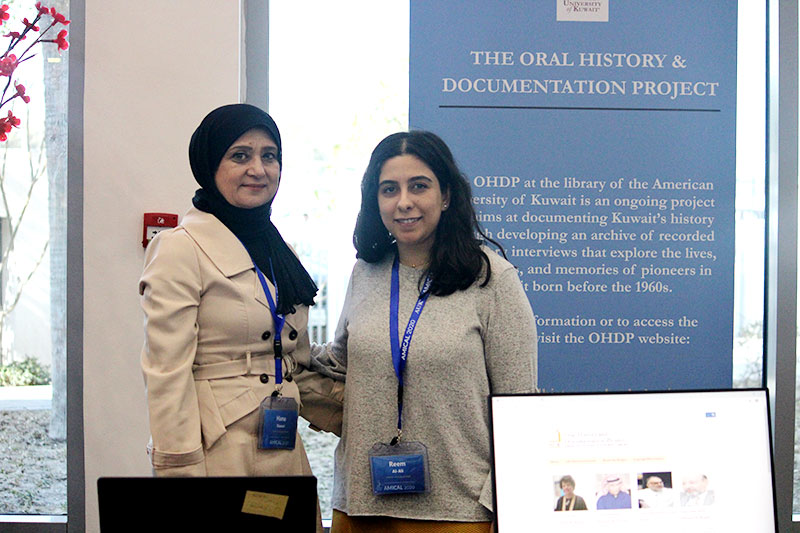
The Oral History and Documentation Project (OHDP) at the Library of the American University of Kuwait has recently added a number of new interviews to its archive. The collection of recorded interviews, which can be accessed on the project’s website, includes interviews with Ambassador Abdullah Bishara, Ms. Louloua Al-Mulla, Mr. Abdulatif Al-Hamad, Ms. Claudia Al-Rashoud, Dr. Adnan Shihab-Eldin, among others. The project continues with its main objective of building an archive of recorded interviews that acts as a valuable resource for researchers, students, and all members of society, with the aim of preserving the history of Kuwait and documenting the testimonies of pioneers and older generations through these recorded interviews. The Oral History and Documentation Project has also received funding from Kuwait Projects Company (KIPCO) since its launch in 2020.
To access the interviews and to learn more about the OHDP visit our website:
https://oralhistory.auk.edu.kw
As AUK librarian, Ms. Asma Al-Kanan, explains, “The library at the American University of Kuwait is among the first users of this new system in the Arab world, known as ‘OHMS’ which serves as an Oral History Metadata Synchronizer. The library’s efforts and communications with the University of Kentucky Libraries have led to improving some of the features that support Arabic Language, which will make it easier for other institutions in the Arab world to use the system for oral history documentation in Arabic.”
The Oral History and Documentation Project (OHDP) at the Library of the American University of Kuwait has recently added a number of new interviews to its archive. The collection of recorded interviews, which can be accessed on the project’s website, includes interviews with Ambassador Abdullah Bishara, Ms. Louloua Al-Mulla, Mr. Abdulatif Al-Hamad, Ms. Claudia Al-Rashoud, Dr. Adnan Shihab-Eldin, among others. The project continues with its main objective of building an archive of recorded interviews that acts as a valuable resource for researchers, students, and all members of society, with the aim of preserving the history of Kuwait and documenting the testimonies of pioneers and older generations through these recorded interviews. The Oral History and Documentation Project has also received funding from Kuwait Projects Company (KIPCO) since its launch in 2020.
To access the interviews and to learn more about the OHDP visit our website:
https://oralhistory.auk.edu.kw
AUK Library staff exhibiting about the Oral History Project
16, Jan 2022
Ambassador Nabeela Al Mulla, distinguished Lecturer at AUK, joins the UN Advisory Board on Disarmament Matters
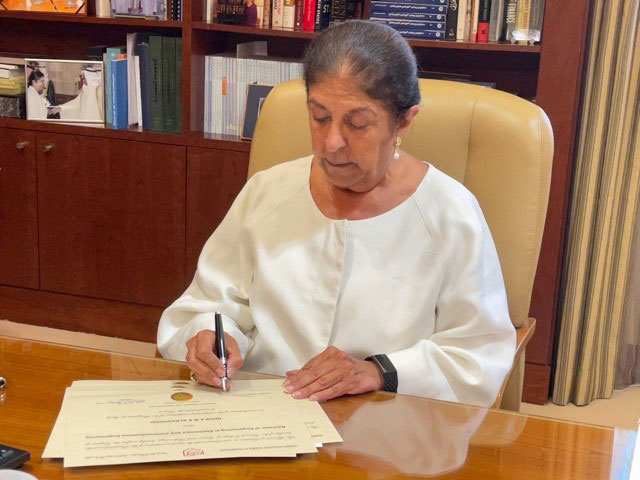
By invitation and appointment of the United Nations Secretary-General, António Guterres, Ambassador Nabeela Al Mulla will serve as member of the Advisory Board on Disarmament Matters (ABDM) and a member of the Board of Trustees of the United Nations Institute for Disarmament Research (UNIDIR) for two years starting in 2022.
The fifteen Board members serve in their personal capacity and do not represent their respective governments.
The historical gender composition of the membership has been predominantly male, but continuous efforts are made to promote gender balance amongst its fifteen members. Ambassador Al Mulla joins seven other women Board members to continue her trailblazing legacy of breaking glass ceiling for women from the Middle East, such as when she became the first Kuwait woman ambassador, the first woman from the Middle East to serve as Chairman of the Board of Governors of the IAEA, and the first Arab woman to head a Permanent mission to the UN in NY.
In addition to her diplomatic experience, she is a distinguished lecturer at the American University of Kuwait (AUK) and chairman of the Board of Trustees at the Kuwait College of Science & Technology (KCST).
The ABDM was established in 1978 pursuant to a decision of the Special Session of the General Assembly on Disarmament. Its main functions include advising the Secretary-General on matters within the area of arms limitation and disarmament, including on studies and research under the auspices of the United Nations or institutions within the United Nations system as well as on the implementation of the United Nations Disarmament Information Programme.
In its role as Board of Trustees of UNIDIR, the ABDM reviews reports of the work of the Institute, including completed and ongoing projects, personnel and financial matters, and future plans.
As the UN Secretary-General’s Agenda for Disarmament, “Securing Our Common Future”, enters its fourth year, the role of the ABDM is an ever more crucial body in supporting efforts to ensure that implementation of this agenda, which plays a key role in safeguarding humanity and saving lives.
The fifteen Board members serve in their personal capacity and do not represent their respective governments.
The historical gender composition of the membership has been predominantly male, but continuous efforts are made to promote gender balance amongst its fifteen members. Ambassador Al Mulla joins seven other women Board members to continue her trailblazing legacy of breaking glass ceiling for women from the Middle East, such as when she became the first Kuwait woman ambassador, the first woman from the Middle East to serve as Chairman of the Board of Governors of the IAEA, and the first Arab woman to head a Permanent mission to the UN in NY.
In addition to her diplomatic experience, she is a distinguished lecturer at the American University of Kuwait (AUK) and chairman of the Board of Trustees at the Kuwait College of Science & Technology (KCST).
The ABDM was established in 1978 pursuant to a decision of the Special Session of the General Assembly on Disarmament. Its main functions include advising the Secretary-General on matters within the area of arms limitation and disarmament, including on studies and research under the auspices of the United Nations or institutions within the United Nations system as well as on the implementation of the United Nations Disarmament Information Programme.
In its role as Board of Trustees of UNIDIR, the ABDM reviews reports of the work of the Institute, including completed and ongoing projects, personnel and financial matters, and future plans.
As the UN Secretary-General’s Agenda for Disarmament, “Securing Our Common Future”, enters its fourth year, the role of the ABDM is an ever more crucial body in supporting efforts to ensure that implementation of this agenda, which plays a key role in safeguarding humanity and saving lives.
H.E. Ms. Nabeela Al-Mulla, former Ambassador of the State of Kuwait and distinguished lecturer at AUK
16, Jan 2022
AUK Hosts Lecture by Dr. Khalid Mahdi
The College of Business and Economics at AUK invited Dr. Khalid Mahdi to speak about the social and economic outlook of Kuwait. The lecture is in support of the implementation of a more balanced social, economic, and environmental strategic plan that addresses not only the concerns of the region, but also issues that plague the poorer regions of the world.
According to Kuwait’s Vision 2035, the economy aims to transform itself into a regional financial and trade hub. To achieve this long-term ambitious plan, the role of the government needs to change from being the primary operator of economic activities and the main employer of national manpower to essentially acting as the country’s regulator and policymaker. Dr. Khaled guided the audience through this agenda and showcased the pitfalls and opportunities awaiting Kuwait in the long process towards a more sustainable, diversified, and growth-enabling Kuwait.
Global economic developments and key reforms necessary to better prepare Kuwait to tackle the resulting challenges, taking into consideration the Covid-19 pandemic, were put into context. Kuwait has made some progress in transitioning and recovering from the double shock of the global Covid-19 crisis and the drop in oil prices in 2020.
Dr. Khaled Mahdi is the Secretary-General of the Supreme Council for Planning and Development in Kuwait and the Program Director of the Country Plan Action Program of UNDP in Kuwait. He is a member on several government boards and high-level committees. These, include among others, the Public Authority for Industries, Kuwait Institute for Scientific Research, Public Housing Authority, the Economic and Fiscal Reform, Kuwait Masterplan 2040, and many others. Dr. Mahdi is also an associate professor in the College of Engineering and Petroleum at Kuwait University where he taught 30 different engineering and management courses. He received the best teaching award, co-authored more than 65 publications in different fields and co-founded Synergy a complex system research group. Dr. Mahdi serves as an advisor for Kuwait University strategic office and the Minister of Planning and Development Affairs office. He engaged in training of more than 1,300 professionals and engineers. He also sits on several local and regional corporate boards. He is on the Advisory Board of the College of Business and Economics at AUK.
According to Kuwait’s Vision 2035, the economy aims to transform itself into a regional financial and trade hub. To achieve this long-term ambitious plan, the role of the government needs to change from being the primary operator of economic activities and the main employer of national manpower to essentially acting as the country’s regulator and policymaker. Dr. Khaled guided the audience through this agenda and showcased the pitfalls and opportunities awaiting Kuwait in the long process towards a more sustainable, diversified, and growth-enabling Kuwait.
Global economic developments and key reforms necessary to better prepare Kuwait to tackle the resulting challenges, taking into consideration the Covid-19 pandemic, were put into context. Kuwait has made some progress in transitioning and recovering from the double shock of the global Covid-19 crisis and the drop in oil prices in 2020.
Dr. Khaled Mahdi is the Secretary-General of the Supreme Council for Planning and Development in Kuwait and the Program Director of the Country Plan Action Program of UNDP in Kuwait. He is a member on several government boards and high-level committees. These, include among others, the Public Authority for Industries, Kuwait Institute for Scientific Research, Public Housing Authority, the Economic and Fiscal Reform, Kuwait Masterplan 2040, and many others. Dr. Mahdi is also an associate professor in the College of Engineering and Petroleum at Kuwait University where he taught 30 different engineering and management courses. He received the best teaching award, co-authored more than 65 publications in different fields and co-founded Synergy a complex system research group. Dr. Mahdi serves as an advisor for Kuwait University strategic office and the Minister of Planning and Development Affairs office. He engaged in training of more than 1,300 professionals and engineers. He also sits on several local and regional corporate boards. He is on the Advisory Board of the College of Business and Economics at AUK.
16, Jan 2022
AUK Represents Kuwait in AIESEC’s Regional Youth Speak Forum 2021
AUK recently represented Kuwait and the Middle East at AISEC’s Regional Youth Speak Forum Middle East & Africa 2021 in Dubai. This year’s forum centered around the topic: The Future of Work Post COVID-19. It was attended by AUK-nominated student participants Amnah Derdab, Fatemah Ashkanani, and Layan Al-Ayoubi, and supervised by senior student life coordinator, Fay Al-Humoud, and the president of AIESEC in Kuwait, Maysoon Al-Attar.
The Youth Speak Forum’s main goal is to empower youth to understand how students can contribute to sustainable development goals through a series of lectures and workshops to build on skills and self-development. AIESEC in the Middle East and Africa boasts the diversity and togetherness to young people to develop themselves, connect, and interact with other youth across the region to “Empower, Engage and Commit”. The Youth Speak Forum included many speakers from different fields who helped enhance the knowledge in technology and artificial intelligence, and communication skills—which are all essential skills for the progressive future. The questions were related to work post-Covid and how to overcome certain requirements when looking for a job.
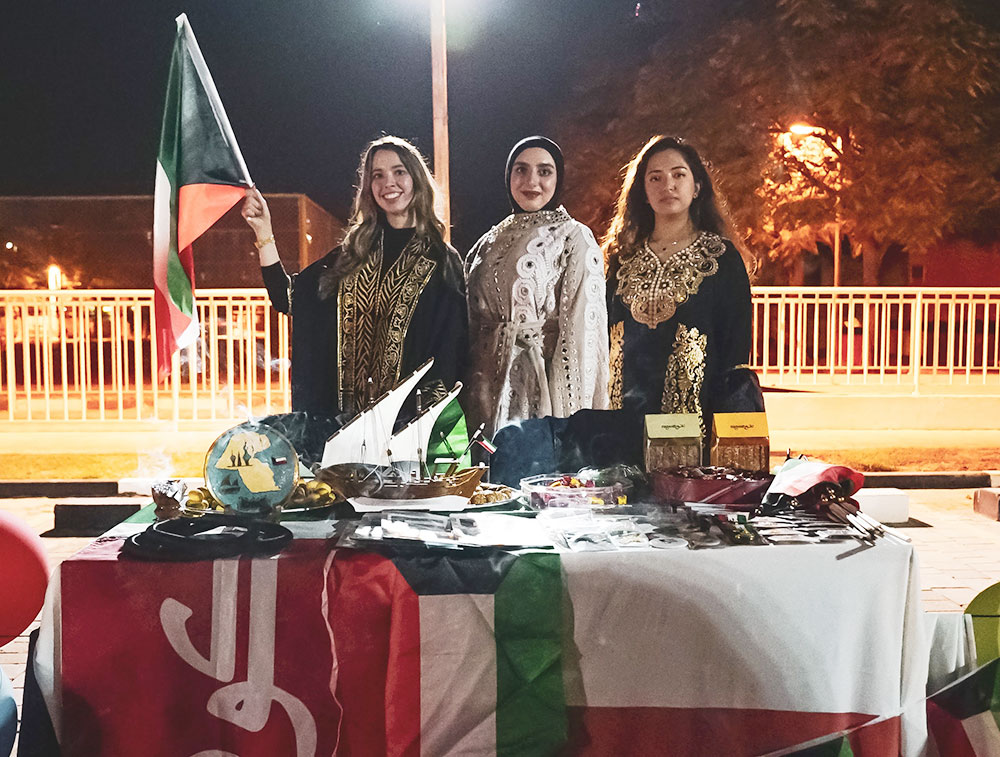
The Forum’s Global Village included participation from 16 different countries, and over 20 nationalities, all coming together to showcase and represent their cultures. This was to promote appreciation of the uniqueness of other cultures through food, music, dance, and knowledge. A booth for Kuwait was set up with a collection of souvenirs, flags, and incense. It also featured Kuwaiti sweets and gifts related to the Kuwaiti culture. The Kuwaiti booth successfully tied 1st place with Ghana and won 2nd place in different categories.
The forum’s organizing team invited Fay Al-Humoud to be a panelist during the panel discussion alongside other prestigious and inspiring individuals, representing AUK and Kuwait on the topic of “Designing the Future of Work in Middle East & Africa”, which was held on the first day of the conference.
Commenting on the forum, Fay Al-Humoud said, “This experience brought people of different cultures together despite age, race, and nationality, we all were united seeking to achieve the same goal.”
“To have a delegation that included these diverse, strong, independent, and bright young women representing Kuwait was an inspiration on its own. They may have been a “small” delegation, but their impact was powerful, and they most definitely brought pride to Kuwait and AUK. They were a perfect reminder of the potential Kuwaiti youth have when they are given the opportunity,” added Maysoon Al-Attar, national president of AIESEC in Kuwait.
The forum was successful in providing a space for students to exchange ideas with others from the MENA region to connect with, delegate, and break boundaries.
The Youth Speak Forum’s main goal is to empower youth to understand how students can contribute to sustainable development goals through a series of lectures and workshops to build on skills and self-development. AIESEC in the Middle East and Africa boasts the diversity and togetherness to young people to develop themselves, connect, and interact with other youth across the region to “Empower, Engage and Commit”. The Youth Speak Forum included many speakers from different fields who helped enhance the knowledge in technology and artificial intelligence, and communication skills—which are all essential skills for the progressive future. The questions were related to work post-Covid and how to overcome certain requirements when looking for a job.
The Forum’s Global Village included participation from 16 different countries, and over 20 nationalities, all coming together to showcase and represent their cultures. This was to promote appreciation of the uniqueness of other cultures through food, music, dance, and knowledge. A booth for Kuwait was set up with a collection of souvenirs, flags, and incense. It also featured Kuwaiti sweets and gifts related to the Kuwaiti culture. The Kuwaiti booth successfully tied 1st place with Ghana and won 2nd place in different categories.
The forum’s organizing team invited Fay Al-Humoud to be a panelist during the panel discussion alongside other prestigious and inspiring individuals, representing AUK and Kuwait on the topic of “Designing the Future of Work in Middle East & Africa”, which was held on the first day of the conference.
Commenting on the forum, Fay Al-Humoud said, “This experience brought people of different cultures together despite age, race, and nationality, we all were united seeking to achieve the same goal.”
“To have a delegation that included these diverse, strong, independent, and bright young women representing Kuwait was an inspiration on its own. They may have been a “small” delegation, but their impact was powerful, and they most definitely brought pride to Kuwait and AUK. They were a perfect reminder of the potential Kuwaiti youth have when they are given the opportunity,” added Maysoon Al-Attar, national president of AIESEC in Kuwait.
The forum was successful in providing a space for students to exchange ideas with others from the MENA region to connect with, delegate, and break boundaries.
Images from the event
04, Jan 2022
AUK Professor Clark Stoeckley Holds First Solo Exhibition
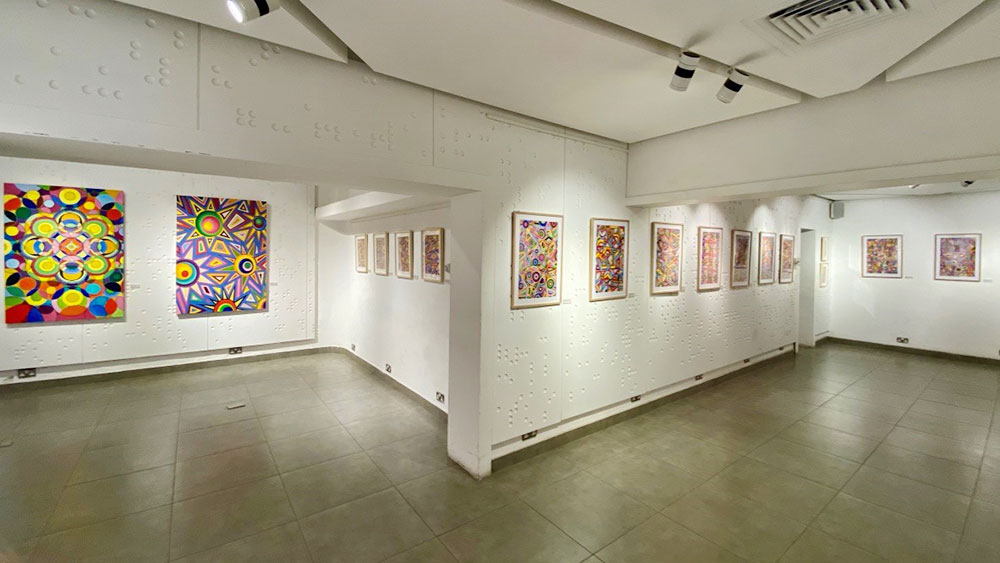
Assistant professor of art & graphic design, Clark Stoeckley recently held his first solo exhibition at the HUB Gallery in Kuwait. The show, titled “Thoughts & Prayers”, featured Stoeckley’s geometric abstract drawings and paintings completed over the past two years of the pandemic. He drew his designs first with Copic ink markers and finished them with Prismacolor colored pencils. Later, selected drawings were scaled up to oil paintings on canvas and murals on walls.
Professor Stoeckley said that through meditational drawing, he sought to save his own psychological and spiritual well-being and transmit joy and bliss to others. His goal was to discover harmony from chaotic asymmetry, rhythmic disruptions, and disparate influences. He blended and distorted imagery inspired by an amalgamation of motifs such as stained glass, psychedelia, science, street art, and sacred geometry. These synesthesia-stimulated drawings depict the kaleidoscopic phantasmagoria of his lucid subconscious and divine introspective explorations.
Professor Stoeckley said that through meditational drawing, he sought to save his own psychological and spiritual well-being and transmit joy and bliss to others. His goal was to discover harmony from chaotic asymmetry, rhythmic disruptions, and disparate influences. He blended and distorted imagery inspired by an amalgamation of motifs such as stained glass, psychedelia, science, street art, and sacred geometry. These synesthesia-stimulated drawings depict the kaleidoscopic phantasmagoria of his lucid subconscious and divine introspective explorations.
Images from the event
15, Dec 2021
AUK Hosts Second Global Migration Film Festival
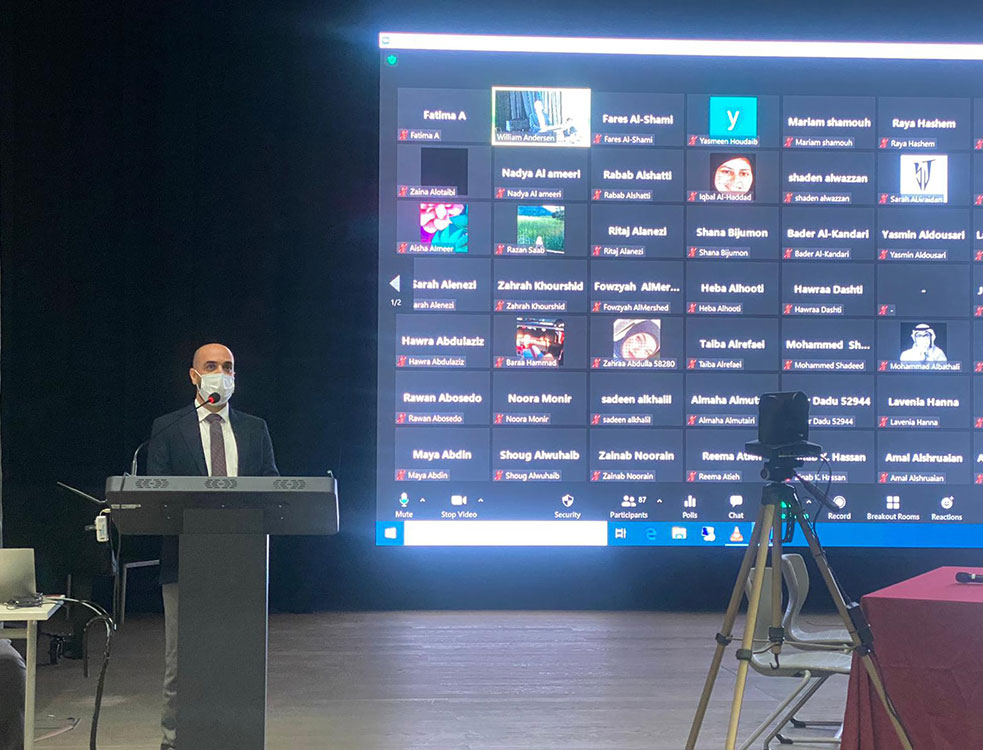
The Department of Art & Graphic Design at the American University Kuwait (AUK) hosted the International Organization for Migration (IOM) Global Migration Film Festival (GMFF). The event began with Dr. William Andersen, chair of the Department of Art & Graphic Design introducing Mazen AboulHosn, Chief of Mission-UN Migration (United Nations), IOM Kuwait who explained IOM's objectives and the goals of the GMFF.
The celebration continued with a screening of Psychology of Migration, a short documentary film by Turkish director Ferhat Atik. After the film screening, AUK students engaged in a panel discussion and Q&A session. The panelists included members of AUK’s faculty—associate professor of psychology, Dr. Juliet Dinkha; assistant professor of graphic design, Ms. Claire Giddings; assistant professor of anthropology, Dr. Marion Breteau; and assistant professor of political science, Dr. Shareefa Al-Adwani. Chief of Mission AboulHosn stated that the panel discussion was very reflective and enriching and looked forward to continuous collaborations with AUK.
Established in 1951, the International Organization for Migration (IOM) is the leading intergovernmental organization in the field of migration and is committed to the principle that humane and orderly migration benefits migrants and society. IOM is part of the United Nations system, as a related organization.
The celebration continued with a screening of Psychology of Migration, a short documentary film by Turkish director Ferhat Atik. After the film screening, AUK students engaged in a panel discussion and Q&A session. The panelists included members of AUK’s faculty—associate professor of psychology, Dr. Juliet Dinkha; assistant professor of graphic design, Ms. Claire Giddings; assistant professor of anthropology, Dr. Marion Breteau; and assistant professor of political science, Dr. Shareefa Al-Adwani. Chief of Mission AboulHosn stated that the panel discussion was very reflective and enriching and looked forward to continuous collaborations with AUK.
Established in 1951, the International Organization for Migration (IOM) is the leading intergovernmental organization in the field of migration and is committed to the principle that humane and orderly migration benefits migrants and society. IOM is part of the United Nations system, as a related organization.
Images from the event