


News
28, Jun 2021
AUK Launches Office for Research and Grants (ORG)
To continue building research capacity at AUK, the Board of Trustees have approved a resolution to launch AUK’s Office for Research and Grants (ORG) that aims at building research capacity at AUK. The ORG will provide our faculty with research funding and resources, research related engagement opportunities, and appropriate training to support research and scholarly related activities and production. It is founded on the premise that investing our resources into our faculty, staff, and students, not only cultivates talent from within, but energizes a creation of knowledge that is bold, innovative, and impactful.
The Office for Research and Grants (ORG) will ensure compliance with funding guidelines, rules, and regulations and upholding ethical, scientific, and fiscal integrity concerning research and grant activities; assist faculty in their acquisition of external funding; build partnerships with faculty, students, and administrators so that our various research and funding agendas are supported and advanced to move the institution forward; foster industry and academia partnership; and conduct outreach and engagement with local and international research bodies.
The President of AUK, Dr. Rawda Awwad, has appointed Dr. Iyad Abo Doush, Associate Professor of Computer Science in the College of Engineering and Applied Sciences, as the founding Director of the Office for Research and Grants (ORG).
"The Office of Research and Grants is a pivotal step towards demonstrating the potential of the American University as a research institution, which is an urgent necessity for the university's growth and institutional maturity as one of the pioneers of Kuwait’s private education industry. In addition to supporting the faculty research activity, the Office will promote student research participation and give them opportunities to present and publish their research with the help of the faculty,” said Dr. Abo Doush
ORG’s most immediate plan of action is to encourage the development of research clusters; identify performance indicators; and continuously update policies to promote AUK’s research culture and that are also aligned with evolving international standards. ORG will also be responsible for strengthening undergraduate student research and publications, and faculty/student research collaborations. While operational needs are a focus, ORG will also explore ways in developing the research infrastructure supported through partnerships and research based collaborative agreements that are strategic and long term.
President Rawda Awwad stated: “Our Board of Trustees have always recognized the importance of research and scholarly production. The launching of ORG marks a renewed commitment to getting serious about making AUK’s research and scholarly production matter by ensuring that it has the desirable social impact that we are aiming for.”
The Office for Research and Grants (ORG) will ensure compliance with funding guidelines, rules, and regulations and upholding ethical, scientific, and fiscal integrity concerning research and grant activities; assist faculty in their acquisition of external funding; build partnerships with faculty, students, and administrators so that our various research and funding agendas are supported and advanced to move the institution forward; foster industry and academia partnership; and conduct outreach and engagement with local and international research bodies.
The President of AUK, Dr. Rawda Awwad, has appointed Dr. Iyad Abo Doush, Associate Professor of Computer Science in the College of Engineering and Applied Sciences, as the founding Director of the Office for Research and Grants (ORG).
"The Office of Research and Grants is a pivotal step towards demonstrating the potential of the American University as a research institution, which is an urgent necessity for the university's growth and institutional maturity as one of the pioneers of Kuwait’s private education industry. In addition to supporting the faculty research activity, the Office will promote student research participation and give them opportunities to present and publish their research with the help of the faculty,” said Dr. Abo Doush
ORG’s most immediate plan of action is to encourage the development of research clusters; identify performance indicators; and continuously update policies to promote AUK’s research culture and that are also aligned with evolving international standards. ORG will also be responsible for strengthening undergraduate student research and publications, and faculty/student research collaborations. While operational needs are a focus, ORG will also explore ways in developing the research infrastructure supported through partnerships and research based collaborative agreements that are strategic and long term.
President Rawda Awwad stated: “Our Board of Trustees have always recognized the importance of research and scholarly production. The launching of ORG marks a renewed commitment to getting serious about making AUK’s research and scholarly production matter by ensuring that it has the desirable social impact that we are aiming for.”
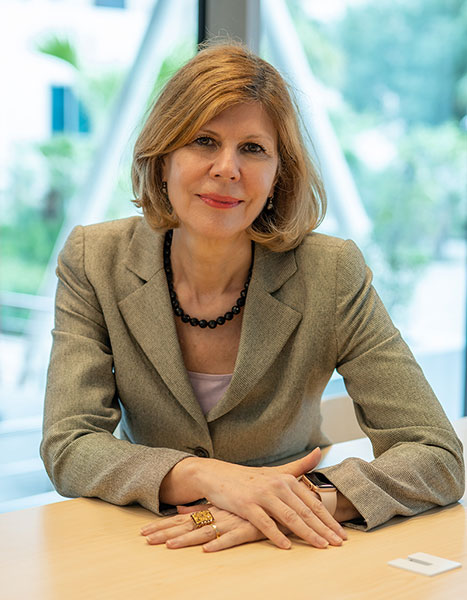
President of AUK, Dr. Rawda Awwad
Dr. Iyad Abo Doush, Associate Professor of Computer Science in the College of Engineering and Applied Sciences
28, Jun 2021
AUK Successfully Provides Virtual Guidance Throughout the Academic Year
AUK has successfully provided guidance and support for AUK students throughout the academic year, as it effectively adapted to online learning, and as part of its ongoing commitment to supporting students, most programs and services have been moved online, especially with regards to student advising & registration, tutoring, counseling, and career guidance.
The Writing and Tutoring Center has continued to provide learning support to students throughout their academic journey, serving almost 500 students in over 1200 virtual writing and tutoring sessions. The Center’s staff also visited classrooms at faculty’s request to present its services to students. In collaboration with the Holistic Student Experience, first-year students were encouraged to seek the Center's assistance, and staff visited their classrooms to conduct writing workshops. The Center also supported faculty in offering workshops and small group sessions tailored to meet students' needs.
The Academic Advising Center has been committed to ensuring that all students were well-informed and prepared, and apart from advising services, the Center offered various workshops throughout the year to assist students, such as How to Calculate your GPA, How to Access Degree Works, and What Can I Do with My Major. The Academic Advising Center advised a total of 1104 students throughout the academic year.
Career guidance saw a rise in numbers with a total of 599 students /alumni; this increase also comes with enhanced new departmental practices such as the AUK Alumni Portal to reach alumni and collaborations with prominent external constituencies.
The Counseling Center continued to offer its support and guidance through online counseling sessions, as well as a variety of workshops such as When to Seek Help, Personal Well-Being Checklist, A tiny Journal of Expression, and Thoughts in Lines.
“One of the most essential factors of Student Affairs is to make sure our students are well-supported and guided, and the current pandemic has required that we boost our services to ensure everyone is included, well, and confident academically and outside the classroom. The AUK community is a family, and we are committed to our continued enhancement of support services for our Wolpack. We are proud of our various achievements and how well our students have performed throughout the year,” said Dr. Hanan Muzaffar, Vice President for Student Affairs.
The Writing and Tutoring Center has continued to provide learning support to students throughout their academic journey, serving almost 500 students in over 1200 virtual writing and tutoring sessions. The Center’s staff also visited classrooms at faculty’s request to present its services to students. In collaboration with the Holistic Student Experience, first-year students were encouraged to seek the Center's assistance, and staff visited their classrooms to conduct writing workshops. The Center also supported faculty in offering workshops and small group sessions tailored to meet students' needs.
The Academic Advising Center has been committed to ensuring that all students were well-informed and prepared, and apart from advising services, the Center offered various workshops throughout the year to assist students, such as How to Calculate your GPA, How to Access Degree Works, and What Can I Do with My Major. The Academic Advising Center advised a total of 1104 students throughout the academic year.
Career guidance saw a rise in numbers with a total of 599 students /alumni; this increase also comes with enhanced new departmental practices such as the AUK Alumni Portal to reach alumni and collaborations with prominent external constituencies.
The Counseling Center continued to offer its support and guidance through online counseling sessions, as well as a variety of workshops such as When to Seek Help, Personal Well-Being Checklist, A tiny Journal of Expression, and Thoughts in Lines.
“One of the most essential factors of Student Affairs is to make sure our students are well-supported and guided, and the current pandemic has required that we boost our services to ensure everyone is included, well, and confident academically and outside the classroom. The AUK community is a family, and we are committed to our continued enhancement of support services for our Wolpack. We are proud of our various achievements and how well our students have performed throughout the year,” said Dr. Hanan Muzaffar, Vice President for Student Affairs.
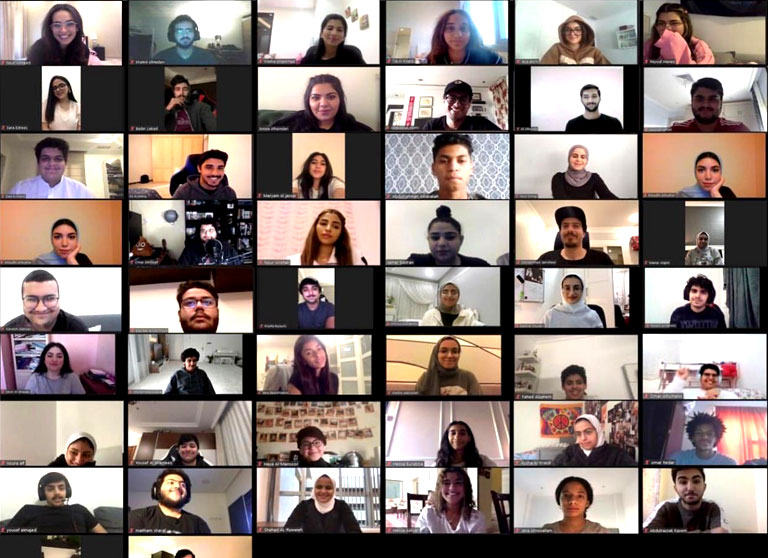
Student Orientation - Fall 2020
Showing
10 Articles
of 1528
28, Jun 2021
AUK’s Student Affairs Provides Virtual Year-Long Activities for Its Community
AUK has successfully provided a series of engaging events and activities for the AUK community throughout the academic year—successfully adapting to online learning and virtual events, as part of its commitment to engaging students outside the classroom, and in honoring outstanding members of the community. The year of online activities culminated last week with Awards Night and Student Employment Recognition Night.
University president, Dr. Rawda Awwad gave the opening remarks for both events, reminding students of the importance of empathy and compassion, and speaking of her own meetings with a group of students throughout the year and sensing the distinction of AUK students. The events then ended with closing remarks by Vice President for Student Affair Hanan Muzaffar who acknowledged the sense of community obvious in the students who remained part of life at AUK during the last challenging year.
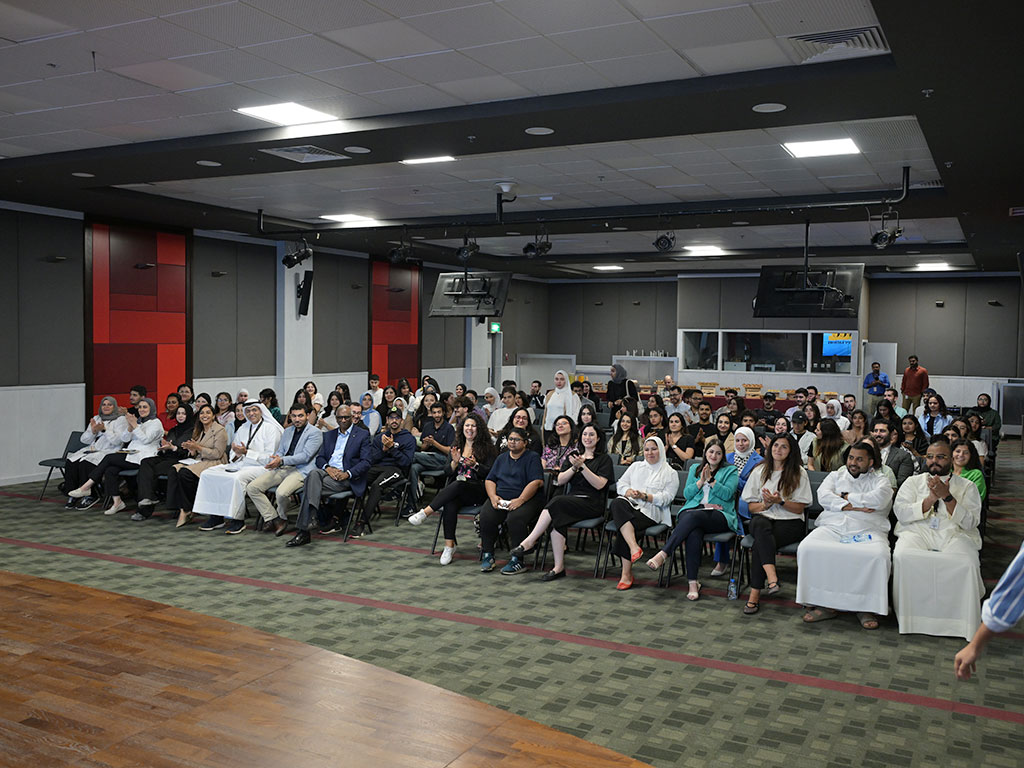
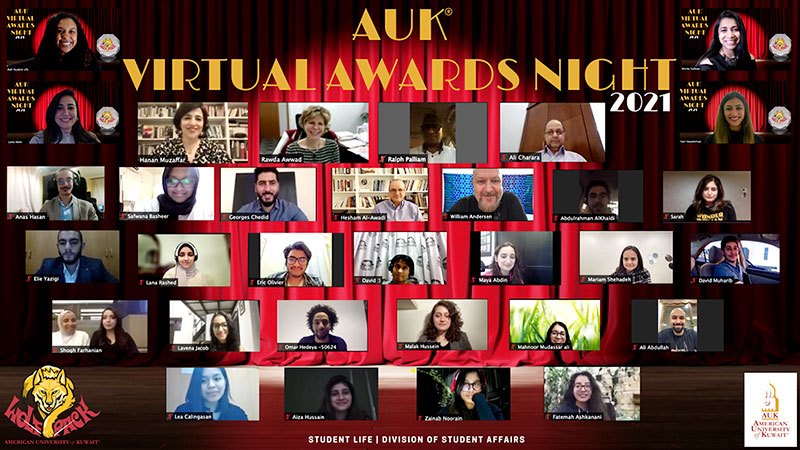
The Annual Awards Night that celebrates student engagement in the campus events and activities was conducted via Zoom this year. It was a lively celebration to honor and award outstanding students for their achievements and ongoing engagement throughout the year. The 12 clubs active this year were acknowledged and received a number of awards such as Club of the Year Award, Most Innovative Club Award, and Exceptional Club Member Award. In addition, members of Voice—AUK’s student magazine, and Student Council, were also recognized for their hard work. Finally, participants in Student Life’s leadership program, LEAD at AUK received their certificates of attendance, and students who have shown great engagement in campus events were also acknowledged. Awards Night concludes the events and activities hosted by Student Life through the year, including a Talent Show, International Week, Club Involvement Fairs, and other events.
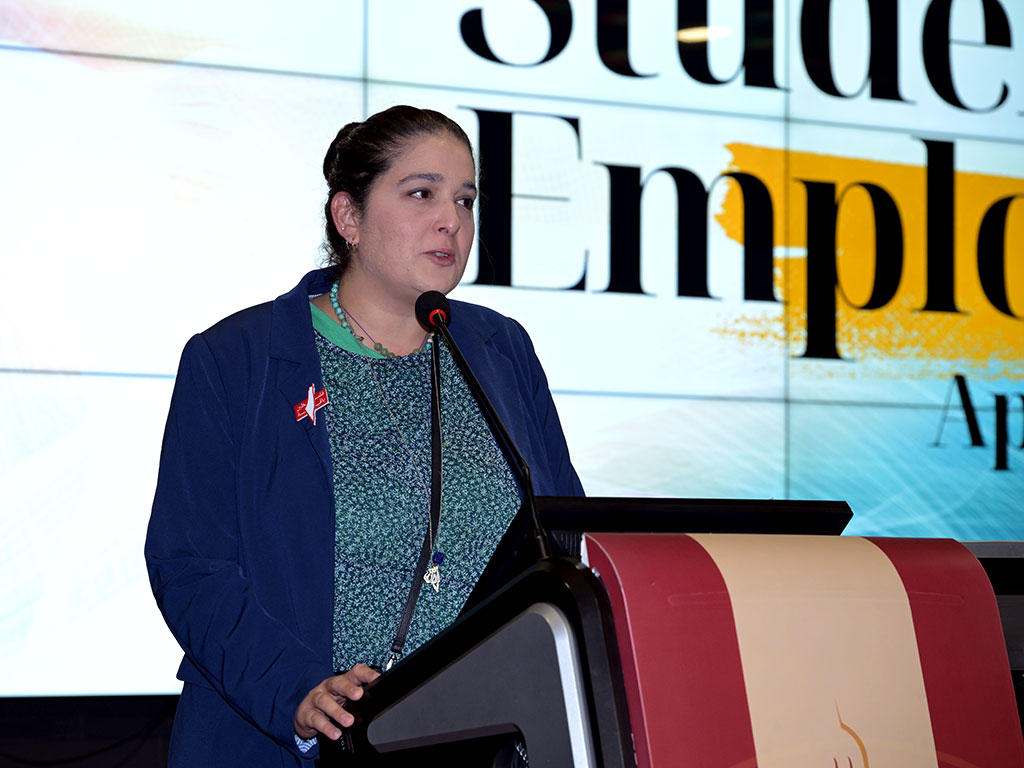
The Student Employment Recognition Night was a night of appreciation for AUK student employees who served as peer tutors and writing consultants during the e-learning experience, in addition to other students who supported some of our AUK departments as graphic designers and in other positions. The event was organized by the Office of Alumni Affairs and Career Development as the final event of the year that included a Career Fair hosted in collaboration with Khibra.com, an Alumni Reunion that had one of AUK graduates, comedian Shaikha AlKhaldi as a guest, and the Senior Launch to honor our students who will be graduating soon.
“Each year, we strive to provide our students and the AUK community with a wide array of activities and events to engage and inspire our community. We are proud to have successfully adapted to online learning and to have offered various events to ensure our commitment to engaging our fellow Wolfpack continues throughout the years. We are also truly honored to have such a wonderful group of students and alumni who reminds us of the true Wolfpack spirit—of what it is to be an AUK student,” said Dr. Hanan Muzaffar, Vice President for Student Affairs.
University president, Dr. Rawda Awwad gave the opening remarks for both events, reminding students of the importance of empathy and compassion, and speaking of her own meetings with a group of students throughout the year and sensing the distinction of AUK students. The events then ended with closing remarks by Vice President for Student Affair Hanan Muzaffar who acknowledged the sense of community obvious in the students who remained part of life at AUK during the last challenging year.
The Annual Awards Night that celebrates student engagement in the campus events and activities was conducted via Zoom this year. It was a lively celebration to honor and award outstanding students for their achievements and ongoing engagement throughout the year. The 12 clubs active this year were acknowledged and received a number of awards such as Club of the Year Award, Most Innovative Club Award, and Exceptional Club Member Award. In addition, members of Voice—AUK’s student magazine, and Student Council, were also recognized for their hard work. Finally, participants in Student Life’s leadership program, LEAD at AUK received their certificates of attendance, and students who have shown great engagement in campus events were also acknowledged. Awards Night concludes the events and activities hosted by Student Life through the year, including a Talent Show, International Week, Club Involvement Fairs, and other events.
The Student Employment Recognition Night was a night of appreciation for AUK student employees who served as peer tutors and writing consultants during the e-learning experience, in addition to other students who supported some of our AUK departments as graphic designers and in other positions. The event was organized by the Office of Alumni Affairs and Career Development as the final event of the year that included a Career Fair hosted in collaboration with Khibra.com, an Alumni Reunion that had one of AUK graduates, comedian Shaikha AlKhaldi as a guest, and the Senior Launch to honor our students who will be graduating soon.
“Each year, we strive to provide our students and the AUK community with a wide array of activities and events to engage and inspire our community. We are proud to have successfully adapted to online learning and to have offered various events to ensure our commitment to engaging our fellow Wolfpack continues throughout the years. We are also truly honored to have such a wonderful group of students and alumni who reminds us of the true Wolfpack spirit—of what it is to be an AUK student,” said Dr. Hanan Muzaffar, Vice President for Student Affairs.
AUK Virtual Awards Night
Student Employee Recognition Night
23, Jun 2021
AUK Signs Agreement With Ministry Of Defense
The American University of Kuwait (AUK) signed an agreement with the Ministry of Defense—the Military Education that ensures the cooperation between both parties in future academic collaborations.
Through this contract, academic cooperation within the legal framework will be established between AUK and the Ministry of Defense. It allows the Ministry to benefit from the experiences, specialties, scientific and technological programs that AUK offers, whether in establishing training courses, preparing academic syllabi, or consultations.
Both parties are set to plan annual joint activities to implement this agreement in terms of finances and scholarship preparations, including setting criteria and categories in which these scholarships will be offered.
To ensure ease of coordination, ambassadors will be appointed from both sides to form a joint committee that ensures the coordination and execution of the signed agreement and any necessary follow-ups that will be required.
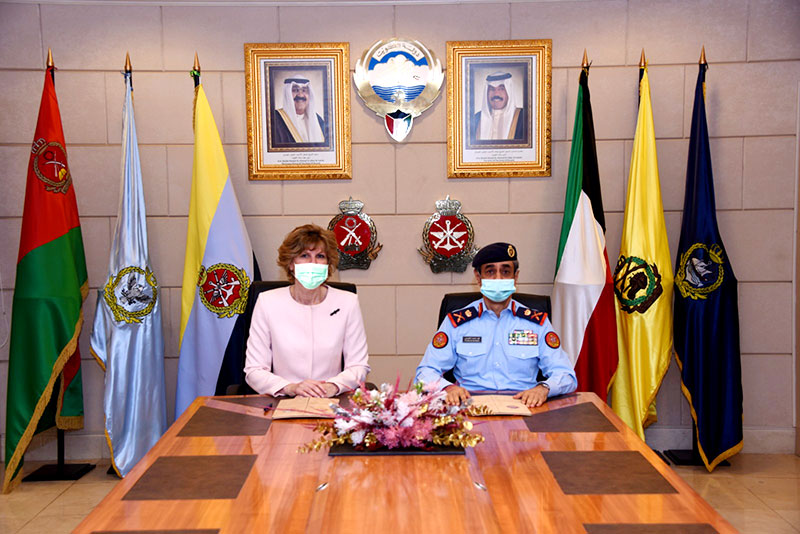
Signed by Major General Fahad Al-Turaiji, head of the Military Education Sector, and AUK president Dr. Rawda Awwad, the contract between AUK and the Ministry of Defense is valid for 5 years and is renewable for the same period of time.
Supported by this agreement, the Ministry can utilize AUK’s unique liberal arts model of education for a holistic and valuable academic experience.
Through this contract, academic cooperation within the legal framework will be established between AUK and the Ministry of Defense. It allows the Ministry to benefit from the experiences, specialties, scientific and technological programs that AUK offers, whether in establishing training courses, preparing academic syllabi, or consultations.
Both parties are set to plan annual joint activities to implement this agreement in terms of finances and scholarship preparations, including setting criteria and categories in which these scholarships will be offered.
To ensure ease of coordination, ambassadors will be appointed from both sides to form a joint committee that ensures the coordination and execution of the signed agreement and any necessary follow-ups that will be required.
Signed by Major General Fahad Al-Turaiji, head of the Military Education Sector, and AUK president Dr. Rawda Awwad, the contract between AUK and the Ministry of Defense is valid for 5 years and is renewable for the same period of time.
Supported by this agreement, the Ministry can utilize AUK’s unique liberal arts model of education for a holistic and valuable academic experience.
Major General Fahad Al-Turaiji, head of the Military Education Sector, and AUK president Dr. Rawda Awwad
02, Jun 2021
EU Ambassadors Mark Europe Day with AUK Community
Celebrating the EU as a promoter of global peace and sustainable development
AUK hosted a distinguished talk on the European Union (EU) with the AUK community to celebrate Europe Day, which marks the founding of the EU as the most successful peace project in the world.
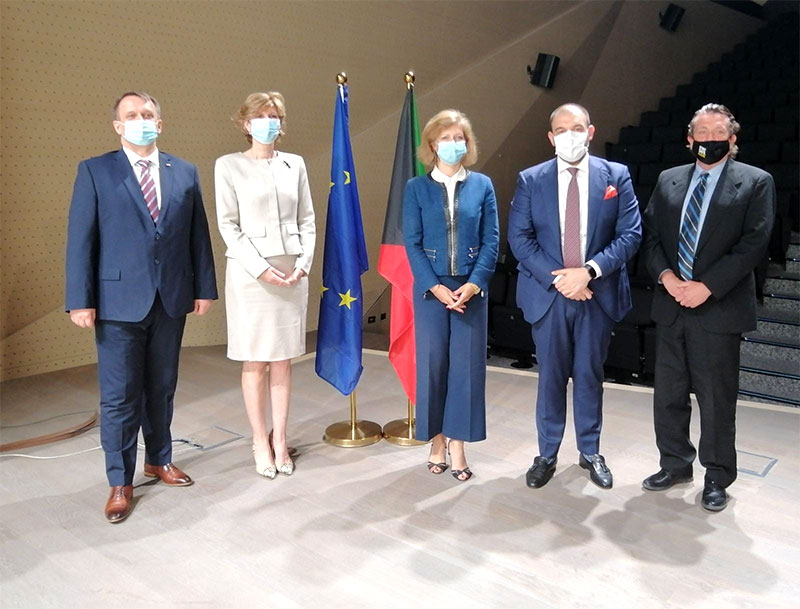
Hosted by the AUK president Dr. Rawda Awwad, the hybrid event focused on the EU as a promoter of global peace and champion of sustainable development, the EU-Kuwait relations and the positive impact of EU enlargement on its 27 member states, bringing together the EU Ambassador to Kuwait and Qatar, H.E. Dr. Cristian Tudor; the Ambassador of Poland to Kuwait and Bahrain, H.E. Paweł Lechowicz; and the Ambassador of France to Kuwait, H.E. Anne-Claire Legendre.
Welcoming the European Ambassadors, President Awwad said, “AUK adheres to its liberal arts principles where conversations, dialog, and opportunities for an exchange of ideas are at the core of university life and experience. The more we can engage with each other and the world, the better we have a chance at improved relations and cooperation and creating long-term constructive solutions to the world’s most pressing issues and concerns.”
Each Ambassador talked about the European Union and what it stands for, including how multilateralism—a concept that advocates for multiple countries pursuing a common and shared goal, is one of its key features.
Showcasing the transformative power of the EU to its nearly 500 million citizens, Ambassador Lechowicz, said, “Poland joined the European Union on 1 May 2004, alongside nine other countries. In doing so, it entered one of the largest free trade, single market and customs unions in the world, which positively changed the political, economic and social life of millions of citizens. Living with open borders and freedom of movement, millions of EU citizens pursued personal career development elsewhere in the EU, making it a dream come true for an entire generation. The EU accession also reinvigorated ‘older’ member states and enhanced security across Europe and enabled the EU to better tackle global challenges such as climate change, migration and poverty through a common approach.”
The EU inaugurated its Delegation to Kuwait in July 2019, in recognition of the increasing importance of Kuwait as a partner of the European Union and Kuwait’s distinguished role in the region. Speaking of the EU-Kuwait relations, Ambassador Tudor said: “Kuwait is a natural partner for the EU as we both strive for more peace and stability in the region through diplomatic means, mediation and dialogue. We also share a strong humanitarian and development focus in our external relations.”
Addressing bilateral ties in the field of education, he then added: “The EU has a number of outstanding programmes such as Erasmus+ and Jean Monnet Actions that aim to facilitate student and academic mobility, promote the exchange of best practices and excellence in teaching and research, all open to universities in Kuwait and the region. Europe is a world-class destination for education, science and innovation and as the first EU Ambassador to Kuwait, I look forward to strengthening bilateral ties in the academic field through study abroad programmes and scientific collaboration with prominent academic institutions in Kuwait.”
Further discussing the global dimension of the EU, Ambassador Legendre added, “The European Union has become the largest donor in development and humanitarian aid globally, the boldest player when it comes to climate action and a fervent supporter of a reformed multilateralism for the 21st century. Kuwait and the European Union share the fundamental conviction that differences should be solved through cooperation and peaceful dialog, and I look forward to discussing with the students how together we can work further into this direction.”
The event was attended by AUK students, faculty members, researchers and partners, as well as representatives from EU services and EU member states, who activity participated in a Q&A session, addressing topical issues and sharing ideas on global cooperation around shared challenges.
AUK hosted a distinguished talk on the European Union (EU) with the AUK community to celebrate Europe Day, which marks the founding of the EU as the most successful peace project in the world.
Hosted by the AUK president Dr. Rawda Awwad, the hybrid event focused on the EU as a promoter of global peace and champion of sustainable development, the EU-Kuwait relations and the positive impact of EU enlargement on its 27 member states, bringing together the EU Ambassador to Kuwait and Qatar, H.E. Dr. Cristian Tudor; the Ambassador of Poland to Kuwait and Bahrain, H.E. Paweł Lechowicz; and the Ambassador of France to Kuwait, H.E. Anne-Claire Legendre.
Welcoming the European Ambassadors, President Awwad said, “AUK adheres to its liberal arts principles where conversations, dialog, and opportunities for an exchange of ideas are at the core of university life and experience. The more we can engage with each other and the world, the better we have a chance at improved relations and cooperation and creating long-term constructive solutions to the world’s most pressing issues and concerns.”
Each Ambassador talked about the European Union and what it stands for, including how multilateralism—a concept that advocates for multiple countries pursuing a common and shared goal, is one of its key features.
Showcasing the transformative power of the EU to its nearly 500 million citizens, Ambassador Lechowicz, said, “Poland joined the European Union on 1 May 2004, alongside nine other countries. In doing so, it entered one of the largest free trade, single market and customs unions in the world, which positively changed the political, economic and social life of millions of citizens. Living with open borders and freedom of movement, millions of EU citizens pursued personal career development elsewhere in the EU, making it a dream come true for an entire generation. The EU accession also reinvigorated ‘older’ member states and enhanced security across Europe and enabled the EU to better tackle global challenges such as climate change, migration and poverty through a common approach.”
The EU inaugurated its Delegation to Kuwait in July 2019, in recognition of the increasing importance of Kuwait as a partner of the European Union and Kuwait’s distinguished role in the region. Speaking of the EU-Kuwait relations, Ambassador Tudor said: “Kuwait is a natural partner for the EU as we both strive for more peace and stability in the region through diplomatic means, mediation and dialogue. We also share a strong humanitarian and development focus in our external relations.”
Addressing bilateral ties in the field of education, he then added: “The EU has a number of outstanding programmes such as Erasmus+ and Jean Monnet Actions that aim to facilitate student and academic mobility, promote the exchange of best practices and excellence in teaching and research, all open to universities in Kuwait and the region. Europe is a world-class destination for education, science and innovation and as the first EU Ambassador to Kuwait, I look forward to strengthening bilateral ties in the academic field through study abroad programmes and scientific collaboration with prominent academic institutions in Kuwait.”
Further discussing the global dimension of the EU, Ambassador Legendre added, “The European Union has become the largest donor in development and humanitarian aid globally, the boldest player when it comes to climate action and a fervent supporter of a reformed multilateralism for the 21st century. Kuwait and the European Union share the fundamental conviction that differences should be solved through cooperation and peaceful dialog, and I look forward to discussing with the students how together we can work further into this direction.”
The event was attended by AUK students, faculty members, researchers and partners, as well as representatives from EU services and EU member states, who activity participated in a Q&A session, addressing topical issues and sharing ideas on global cooperation around shared challenges.
EU Ambassadors celebrating Europe Day at AUK
01, Jun 2021
AUK’s Center for Continuing Education Graduates Diplomat Trainees
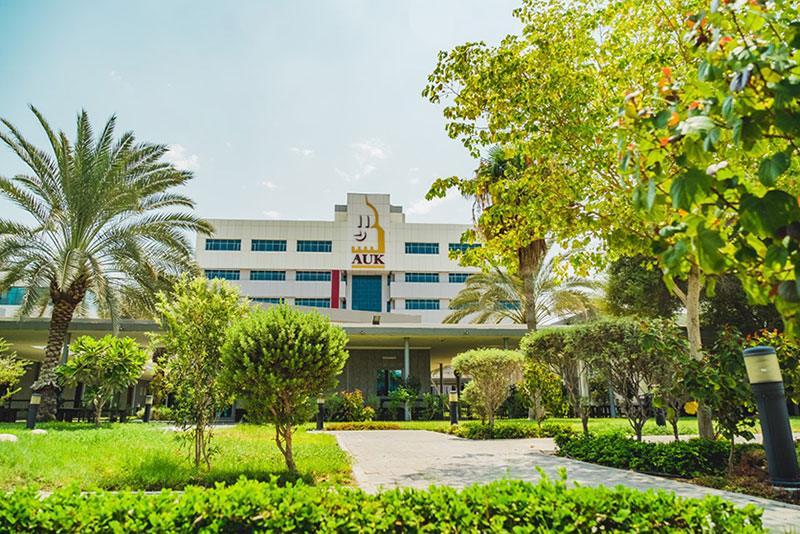
The Center for Continuing Education (CCE) at AUK graduated a group of trainees from the Soud Nasser AlSabah Kuwait Diplomatic Institute—Kuwait Ministry of Foreign Affairs; the trainees successfully completed the General English for Diplomats Certificate Program—a customized curriculum planned and delivered throughout 5 months.
Commenting on CCE’s conduction of the program during the current pandemic, Ms. Nehal ElShafei, director of CCE said, “With the impact of COVID-19 in Kuwait, CCE-AUK has successfully made learning convenient through end-to-end virtual classroom solutions for all its training programs. We remain committed to serve our clients with the best quality of our training services.”
The program was delivered via Microsoft Teams by internationally-certified and qualified language experts from Kuwait and abroad. The participants were trained to interact confidently in the diplomatic world while enhancing their speaking, listening, reading, and writing skills.
Commenting on CCE’s conduction of the program during the current pandemic, Ms. Nehal ElShafei, director of CCE said, “With the impact of COVID-19 in Kuwait, CCE-AUK has successfully made learning convenient through end-to-end virtual classroom solutions for all its training programs. We remain committed to serve our clients with the best quality of our training services.”
The program was delivered via Microsoft Teams by internationally-certified and qualified language experts from Kuwait and abroad. The participants were trained to interact confidently in the diplomatic world while enhancing their speaking, listening, reading, and writing skills.
29, May 2021
AUK Launches its Faculty Speaker Series with a Talk About Theater in the GCC
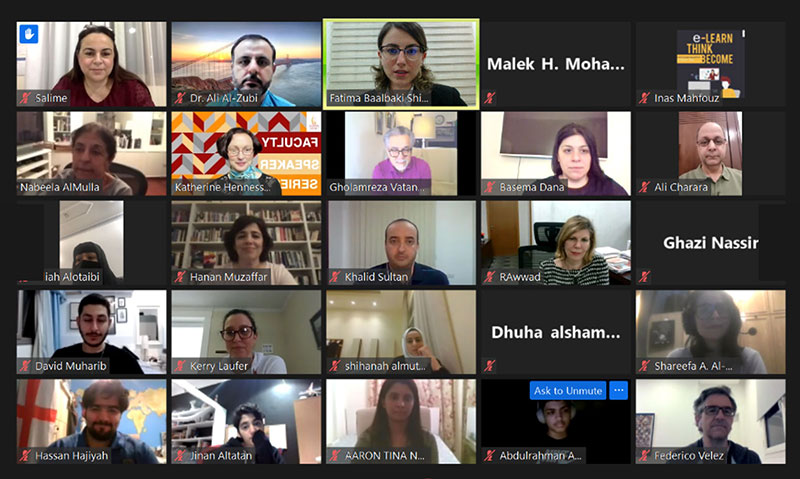
AUK launched its newly introduced Faculty Speaker Series with a talk entitled “Why Theatre Matters: Three Scenes from the Arabian Peninsula”, by Dr. Katherine Hennessey, AUK Assistant Professor of English and National Endowment for the Humanities Fellow. The talk delved deep into the sociopolitical sphere as it pertains to theater, and conveyed the significance of such understanding at the individual level and broader society.
The talk expressed Dr. Hennessey’s dismay at the current state of theater in the Arab world, describing how it has become synonymous with absurdity and ridiculousness. This understanding of theater minimizes its importance and manifests itself by being absent from culture. Dr. Hennessey proved the significance of paying attention to theater using three key examples from the Arabian Peninsula that focus on sociopolitical content.
As she analyzed “Four O’clock,” a play by Talal Mahmoud, she proved that theater assumes the role of an educator. The play frames the issue of Obsessive-Compulsive Disorder in a humorous manner, dismantling the stigma associated with it in Arabia. As Dr. Hennessey put it, the medium of theater is unique to any other, in so far as it embodies culture and relays messages in a digestible manner.
Her second analysis focused on the Kuwaiti play “A Bite,” an adaptation of Antoine Chekhov’s “The Chameleon.” The play directed by Abdullah Al-Turkmani amusingly spotlights the injustice citizens and residents of Kuwait face regarding “wasta” and favoritism across all aspects of society. Dr. Hennessey stressed the importance of using metaphors and speaking by similitudes to relay an idea and create shared empathy, without fear of censorship. “Theater is a genre to which we should be paying some attention for its incisive ability to comment on contemporary sociopolitical issues, to evade the strictures of censorship, and above all for its ability to create and to model new forms of community and communal interaction,” she explained.
Finally, Dr. Hennessey shifted the attention to war torn Yemen and expressed how the political climate, rife with turbulence and conflict was depicted on the stage in “Salvation.” Her emphasis on materializing sociopolitical contentions was made apparent through the play. As she explained, the prisoner represented the people of Yemen bound by chains, stuck between two guards that symbolized the power struggle within the state. Dr. Hennessey maintained that this play would have been censored had the creators not used imaginative adaptation as a means of circumventing restrictions.
The lecture ended with a Q&A where attendees got a chance to have a one-on-one with Dr. Hennessey. A total of 54 attendees including President Dr. Rawda Awwad, AUK faculty, staff, and students were present.
The Faculty Speaker Series is a public talk series that aims to broadcast and showcase faculty research, outlooks, and intellectual capabilities through educating both faculty and student body members on an assortment of varied topics. The upcoming talk will take place on May 31st featuring professor Gholamreza Vatandoust, Professor of Near Eastern Studies and History at AUK.
To receive the Zoom link to attend this lecture, please sign up by sending an email to Facultyspeakerseries@auk.edu.kw.
The talk expressed Dr. Hennessey’s dismay at the current state of theater in the Arab world, describing how it has become synonymous with absurdity and ridiculousness. This understanding of theater minimizes its importance and manifests itself by being absent from culture. Dr. Hennessey proved the significance of paying attention to theater using three key examples from the Arabian Peninsula that focus on sociopolitical content.
As she analyzed “Four O’clock,” a play by Talal Mahmoud, she proved that theater assumes the role of an educator. The play frames the issue of Obsessive-Compulsive Disorder in a humorous manner, dismantling the stigma associated with it in Arabia. As Dr. Hennessey put it, the medium of theater is unique to any other, in so far as it embodies culture and relays messages in a digestible manner.
Her second analysis focused on the Kuwaiti play “A Bite,” an adaptation of Antoine Chekhov’s “The Chameleon.” The play directed by Abdullah Al-Turkmani amusingly spotlights the injustice citizens and residents of Kuwait face regarding “wasta” and favoritism across all aspects of society. Dr. Hennessey stressed the importance of using metaphors and speaking by similitudes to relay an idea and create shared empathy, without fear of censorship. “Theater is a genre to which we should be paying some attention for its incisive ability to comment on contemporary sociopolitical issues, to evade the strictures of censorship, and above all for its ability to create and to model new forms of community and communal interaction,” she explained.
Finally, Dr. Hennessey shifted the attention to war torn Yemen and expressed how the political climate, rife with turbulence and conflict was depicted on the stage in “Salvation.” Her emphasis on materializing sociopolitical contentions was made apparent through the play. As she explained, the prisoner represented the people of Yemen bound by chains, stuck between two guards that symbolized the power struggle within the state. Dr. Hennessey maintained that this play would have been censored had the creators not used imaginative adaptation as a means of circumventing restrictions.
The lecture ended with a Q&A where attendees got a chance to have a one-on-one with Dr. Hennessey. A total of 54 attendees including President Dr. Rawda Awwad, AUK faculty, staff, and students were present.
The Faculty Speaker Series is a public talk series that aims to broadcast and showcase faculty research, outlooks, and intellectual capabilities through educating both faculty and student body members on an assortment of varied topics. The upcoming talk will take place on May 31st featuring professor Gholamreza Vatandoust, Professor of Near Eastern Studies and History at AUK.
To receive the Zoom link to attend this lecture, please sign up by sending an email to Facultyspeakerseries@auk.edu.kw.
Group photo of attendees
Assistant Professor of English, and National Endowment for the Humanities Fellow, Dr. Katherine Hennessey
27, May 2021
Trustees' Resolution Commends 'Tremendous Resolve' Of AUK Community
Convened and presided over by Shaikha Dana Nasser Sabah Al-Ahmed Al-Sabah, founder and chair of the Board of Trustees at the American University of Kuwait (AUK), the Board held their biannual meeting where members of the board discussed the University’s efforts to address the challenges imposed by the pandemic since March, 2020 as well as the academic and administrative developments.
During the virtual meeting the AUK Board of Trustees resolved to unanimously commend the senior administration of the American University of Kuwait—and its faculty and staff—for facilitating a decisive team-based response to address the pandemic situation and devise a robust business continuity plan.
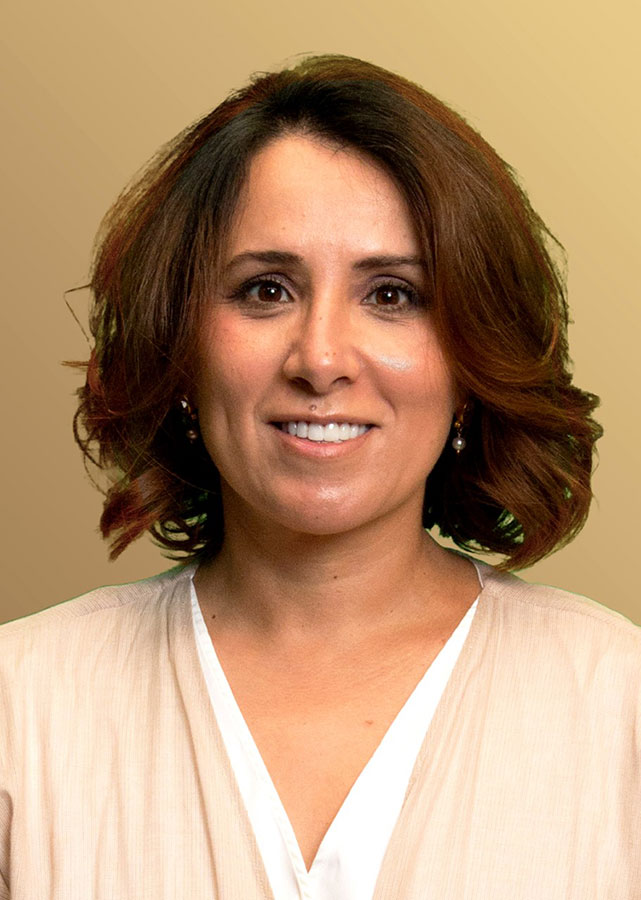
“I would like to start the meeting by extending gratitude and appreciation to the AUK faculty and staff for their ability to respond and adjust during a time of mounting uncertainty,” said Shaikha Dana Al-Sabah. “The pandemic has brought about challenges that the world had never encountered before—some that require efficient mitigation at all levels. The AUK community has demonstrated exceptional resilience during this rapidly evolving situation. Their agility, proactive approach, and commitment to the AUK mission reflects the true spirit of a liberal arts community”, she continued.
Within its agenda, the AUK Board of Trustees also discussed the report generated by the Academic Affairs Committee of the Board, the institutional development plans for the coming period, and post-pandemic plans and procedures.
The Board of Trustees is AUK's governing body. The Board's terms of reference are outlined in the AUK By-Laws. The self-perpetuating and self-governing Board is currently composed of 11 members, in addition to the university president and the Dartmouth College Relationship Coordinator (Director) as an ex-officio member. The Board of Trustees meets twice a year in AUK's Salmiya campus.
The Board of Trustees is comprised of the following members: Shaikha Dana Nasser Sabah Al-Ahmed Al-Sabah, Founder and Chair of AUK; Mr. Meshal Ali, Co-Founder; Mr. Wael Abdul-Ghafoor, Board Member; Mr. Faisal Al-Ayyar, Board Member; Mr. Samer Khanachet, Board
Member; Thomas Bartlett, Ph.D., Board Member; Dale F. Eickelman, Ph.D. Director of the Dartmouth College-American University of Kuwait Program (Ex-officio Member); H.E. Ambassador Abdullah Y. Bishara, Board Member; Mohammad Jawad Behbehani, DMD, D.M.Sc.OB, FICD, Board Member; and Saeeda M. H. Jaffar, Ph.D., Board Member; Rawda H. Awwad, Ph.D., University President.
During the virtual meeting the AUK Board of Trustees resolved to unanimously commend the senior administration of the American University of Kuwait—and its faculty and staff—for facilitating a decisive team-based response to address the pandemic situation and devise a robust business continuity plan.
“I would like to start the meeting by extending gratitude and appreciation to the AUK faculty and staff for their ability to respond and adjust during a time of mounting uncertainty,” said Shaikha Dana Al-Sabah. “The pandemic has brought about challenges that the world had never encountered before—some that require efficient mitigation at all levels. The AUK community has demonstrated exceptional resilience during this rapidly evolving situation. Their agility, proactive approach, and commitment to the AUK mission reflects the true spirit of a liberal arts community”, she continued.
Within its agenda, the AUK Board of Trustees also discussed the report generated by the Academic Affairs Committee of the Board, the institutional development plans for the coming period, and post-pandemic plans and procedures.
The Board of Trustees is AUK's governing body. The Board's terms of reference are outlined in the AUK By-Laws. The self-perpetuating and self-governing Board is currently composed of 11 members, in addition to the university president and the Dartmouth College Relationship Coordinator (Director) as an ex-officio member. The Board of Trustees meets twice a year in AUK's Salmiya campus.
The Board of Trustees is comprised of the following members: Shaikha Dana Nasser Sabah Al-Ahmed Al-Sabah, Founder and Chair of AUK; Mr. Meshal Ali, Co-Founder; Mr. Wael Abdul-Ghafoor, Board Member; Mr. Faisal Al-Ayyar, Board Member; Mr. Samer Khanachet, Board
Member; Thomas Bartlett, Ph.D., Board Member; Dale F. Eickelman, Ph.D. Director of the Dartmouth College-American University of Kuwait Program (Ex-officio Member); H.E. Ambassador Abdullah Y. Bishara, Board Member; Mohammad Jawad Behbehani, DMD, D.M.Sc.OB, FICD, Board Member; and Saeeda M. H. Jaffar, Ph.D., Board Member; Rawda H. Awwad, Ph.D., University President.
Shaikha Dana Nasser Sabah Al-Ahmed Al-Sabah
Founder and Chair, Board of Trustees, American University of Kuwait
Founder and Chair, Board of Trustees, American University of Kuwait
23, May 2021
German Ambassador Visits AUK To Discuss Education In Kuwait
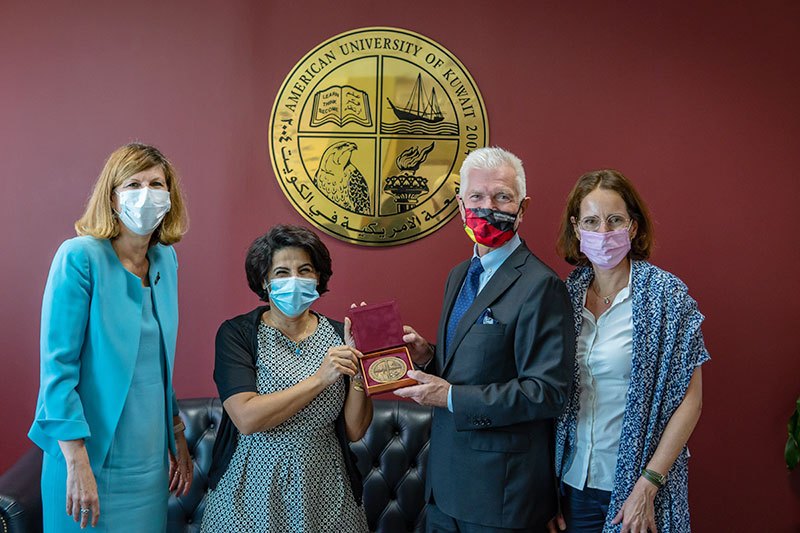
AUK President, Dr. Rawda Awwad and Executive Vice President, Amal Al-Binali welcomed the German Ambassador to Kuwait, H.E. Stefan Möbs and the Head of Cultural Affairs of Press and Protocol, Ruth Brodesser to the University’s campus to explore elements related to education in Kuwait.
Academic, research, and outreach-related opportunities of mutual interest were discussed, in addition to the current and future of education in Kuwait was highlighted in these discussions. Moreover, the importance of a continued and broader dialog regarding students’ intellectual and emotional needs was emphasized, including its incorporation to the social and cultural growth of Kuwait and the region.
Referring to the German Ambassador’s visit to AUK, Dr. Rawda stated, “Broader foreign language choices and a more holistic approach to foreign language acquisition through curriculum, internships and student exchange strengthen students’ understanding of culture and the importance of diversity and encourages—in the long-term—a globally-informed approach to local and regional development. We are excited to move forward with our institutional agenda, one step at a time.”
Over the years, AUK has been working closely with embassies and committed to consistent meetings to sustain the relationships and support mutual scholastic opportunities.
Academic, research, and outreach-related opportunities of mutual interest were discussed, in addition to the current and future of education in Kuwait was highlighted in these discussions. Moreover, the importance of a continued and broader dialog regarding students’ intellectual and emotional needs was emphasized, including its incorporation to the social and cultural growth of Kuwait and the region.
Referring to the German Ambassador’s visit to AUK, Dr. Rawda stated, “Broader foreign language choices and a more holistic approach to foreign language acquisition through curriculum, internships and student exchange strengthen students’ understanding of culture and the importance of diversity and encourages—in the long-term—a globally-informed approach to local and regional development. We are excited to move forward with our institutional agenda, one step at a time.”
Over the years, AUK has been working closely with embassies and committed to consistent meetings to sustain the relationships and support mutual scholastic opportunities.
German Ambassador to Kuwait, H.E. Stefan Möbs and Head of Cultural Affairs of Press and Protocol, Ruth Brodesser receiving a gift from AUK Executive Vice President, Amal Al-Binali and President Dr. Rawda Awwad
23, May 2021
Indian Ambassador Visits AUK
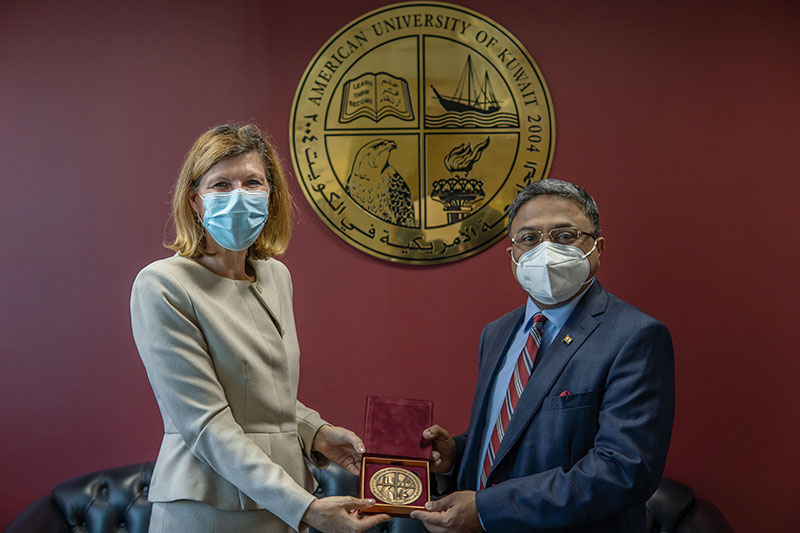
AUK President, Dr. Rawda Awwad welcomed Indian Ambassador to Kuwait, H.E. Sibi George and First Secretary, Dr. Vinod Gaikwad to the University’s campus to discuss the diverse educational needs of students on a local and international level in the post-pandemic world. Outreach opportunities for the Indian community in Kuwait were also thoroughly discussed.
“The pandemic has compelled post-secondary institutions to re-imagine their priorities. The educational welfare of all our local communities, therefore, continue to matter. As such, AUK will remain committed to extending its reach to support the academic and intellectual needs and development of all segments of our society here in Kuwait,” stated Dr. Rawda.
Over the years, AUK has been working closely with embassies and committed to consistent meetings to sustain the relationships and support mutual scholastic opportunities.
“The pandemic has compelled post-secondary institutions to re-imagine their priorities. The educational welfare of all our local communities, therefore, continue to matter. As such, AUK will remain committed to extending its reach to support the academic and intellectual needs and development of all segments of our society here in Kuwait,” stated Dr. Rawda.
Over the years, AUK has been working closely with embassies and committed to consistent meetings to sustain the relationships and support mutual scholastic opportunities.
Indian Ambassador to Kuwait, H.E. Sibi George receiving a gift from AUK President, Dr. Rawda Awwad