


News
In celebration of Kuwait's National and Liberation Day, AUK students organized a series of activities to mark the special occasion. The AUK campus celebrations were covered by KTV2, through which AUK students delivered statements of greetings to the Kuwaiti community and His Highness the Amir of Kuwait.
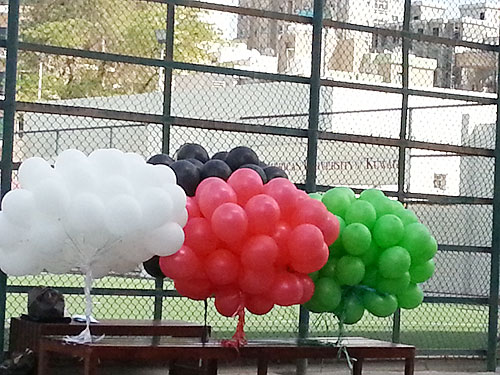
The kickoff event of the day was the Student Government Association's (SGA) "National Anthem" gathering. AUK students gathered in the garden area to sing in unity the national anthem of Kuwait. The event was a call to take a moment of reflection on the meanings and connotations of the national anthem. With the last verse, students released helium balloons carrying the colors of Kuwait's flag (black, green, red and white) in cheerful atmosphere. "The event was well-managed and efforts of planning were evident. I definitely look forward to more events celebrating Kuwait's patriotism," said AUK student and entrepreneur Abdulrahman Al-Sultan. In the meantime, Fouz Al Khunaini, AUK student and SGA Secretary, thought that "The national anthem is a nation icon without which the celebrations would not be complete; the feelings that filled the place as the students sang in one voice were overwhelming."
Images from the National Anthem event
On another corner, the AUK Finance Club celebrated the occasion through bringing the history and traditions of Kuwait to life. Their event, "Kuwaitna", included a historical timeline of key events in Kuwait's history, live traditional music, and a "diwania" style corner set-up under a huge flag of Kuwait. The atmosphere attracted many students who gathered around a huge wall banner to write their comments, greetings, and thoughts of the day.
Farah Majed Al Ajeel, President of the Finance Club expressed her "warmest wishes for a happy Liberation Day to all the Kuwaiti people and to the students of AUK." She added, "On this occasion I'd like to highlight our pride with this youthful energy that lies within the young generation that contributed to the success of this event. I would also like to thank Dr. Farah Al-Nakib, without whom this event wouldn't have been a success"
Images from the Finance Club event
The AUK community has always been keen to create a festive atmosphere throughout the month of February through campus events, flag decorations, and student themed activities. "I think that Kuwaitis should be proud of their country and their non-jingoistic love of their country; they bring a refreshingly healthy and balanced pride of their country. It puts a smile on my face," said AUK faculty member and newcomer to Kuwait, Steven MacAulay.
Released by the Office of Public Affairs on the 21st February 2013
Photography by the Office of Public Affairs (C) 2013
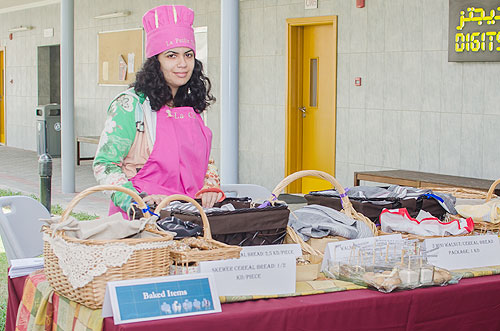
The Career Services and Wellness Center at AUK held its Annual Entrepreneurship Fair at AUK central hallway on February 19th.
The annual fair is a platform to nurture students' entrepreneurship skills through promoting their business ideas and selling their products. Items on display ranged from handmade jewelry to clothing and organic products.
"It is the best opportunity that students can use to showcase their talents and implement their business skills," said Abir Itani, Career and Personal Counselor at the Career and Wellness Center.
The Entrepreneurship fair helps students develop their capacity to innovate and think creatively, assets that "can then be transferred and applied to real life," according to Itani. Through this type of activities, students learn to utilize their hobbies and passions and turn them into marketable business ideas.
Released by the Office of Public Affairs on the 21st February 2013
Photography by the Office of Public Affairs (C) 2013
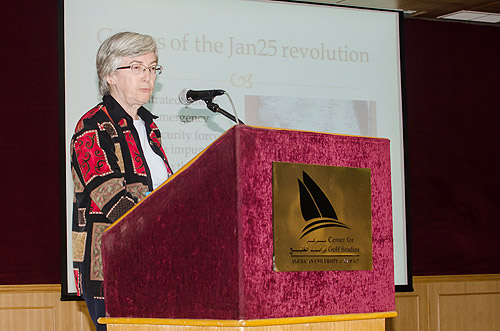
The Center for Gulf Studies (CGS) at AUK held a lecture last week about the transformation of the political landscape in Egypt and its challenges to adapt to the changes caused by the revolution.
The talk was presented by Dr. Ann Lesch, professor of Political Science and the Associate Provost of International at the American University of Cairo (AUC). During her discussion, Dr. Lesch provided an analysis of the present political situation and the future challenges in Egypt.
According to Dr. Lesch, there were several main drivers that led to the eventual downfall of Hosni Mubarak on February of 2011. The circumstances leading up to the Egyptian revolution of 2011 were characterized by a deteriorating economic situation for the majority of Egyptians since the Gamal Abdul Nasser era. This, coupled with a gradual erosion of public services and frustration regarding regional issues such as Palestine, led to several public protests taking place in the first decade of the 2000s. The torture and killing of Khalid Said in June, 2010 by Egyptian police as well as the popular revolution in Tunisia proved to be among the major catalysts that ignited the mass protests against Hosni Mubarak.
Turning to Egypt's present political situation, Dr. Lesch discussed the main positive and negative realities that exist today. Among the negatives, Dr. Lesch described the threat of growing sectarian tensions and a reduction in security, as well as a grim outlook for the economy. However, the positives she described included the growth in grassroots organizing to bring change on a community level, the ability to vote, freedom of speech, and a growth in cultural creativity. The key actors in today's Egypt include the Muslim Brotherhood, the Salafi movements, non-religious political parties, the Revolutionary Youth, the Supreme Council for the Armed Forces (SCAF), and civil society.
Dr. Lesch concluded her lecture by addressing possibilities for Egypt's political future. The Muslim Brotherhood enjoyed an increase in political influence after the revolution. However, will this influence decline as the economic situation continues to deteriorate and be exploited by other political actors such as the Salafist movements? Or will the Brotherhood's ability to mobilize and capitalize on successes such as Egypt's role in ending the Gaza war of 2012 allow them to maintain their political prominence? According to Dr. Lesch, the political future of Egypt remains unpredictable, with key issues unaddressed such as the role of the SCAF in Egyptian politics, and the continued lack of accountability for those who committed crimes against civilians during the 2011 protests.
Dr. Lesch acquired her doctorate from Columbia University and joined AUC as Dean of Humanities and Social Sciences in 2004. As co-founder of the Palestinian American Research Center, Dr. Lesch's research interests cover Palestinian, Egyptian, and Sudanese politics. Dr. Lesch has published 60 academic articles and book chapters, and authored 10 books that focus on the Arab-Israeli conflict and inter-Arab relations. The lecture will highlight and address the struggles and obstacles faced by the Egyptian people and the region's attempts to transition.
The Center for Gulf Studies (CGS) at the American University of Kuwait aims to promote greater cultural understanding of and increased intellectual interest in the Gulf, by facilitating free and open academic discourse on a range of issues that both shape and challenge this critical region of the world. The goal of CGS is to enable scholars as well as political and civil society actors both within and outside the region to contribute and add value to the burgeoning field of Gulf Studies, while at the same time informing and engaging the general public. To this end, the CGS encourages, supports, and cultivates interesting and original research on the Gulf, while regularly organizing a variety of public academic events such as lectures, roundtable discussions, and conferences.
Released by the Office of Public Affairs on the 20th February 2013
Photography by the Office of Public Affairs (C) 2013
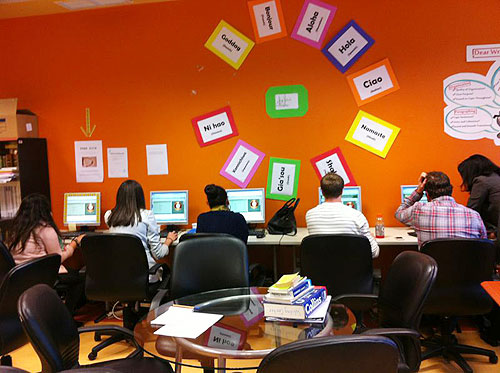
The Writing Center began the Spring Semester with a fun, educational competition open to the entire AUK community. Participants played an interactive English vocabulary game in which each correct answer resulted in the donation of 10 grains of rice to the United Nations World Food Program. Excitement built up as students, staff, and faculty tested their vocabulary to the limit as they progressed from Level 1-60. Feedback from players included comments such as, "This was a very enlightening game - it broadened my horizons and I learned new words for my vocabulary," "I made a huge, big list of new words that I will use," and "This was the best AUK event ever!"
But can 10 grains of rice really make a difference?
According the Freerice figures, it takes approximately 4,500 grains of rice to feed one person for one meal. The AUK community raised over 161,700 grains of rice during the duration of the two-week competition, which equates to providing a meal for 36 people! While this number pales to insignificance when compared to the number of starving people around the world, every grain of rice makes a difference to a hungry person. The enthusiastic response to this Writing Center initiative from the AUK community highlighted the spirit of giving - over 52 students visited the Writing Center in Room A207 to give generously of their time and brainpower. Staff and faculty participated as well. Everyone who took part in this competition is a winner who helped eradicate world hunger.
The top 3 student winners of the Free Rice Competition were Luke Rangel, Mark Rangel Mark Rangel, and Hanan Al-Awadhi, respectively. In the Faculty category, it was a tie between Dr. Kathy Nixon and Dr. Ken Downs, while in the Staff category, Dr. Kathy Kleypas was the sole winner.
Freerice (www.freerice.com) is a non-profit website that is owned by and supports the United Nations World Food Program headquartered in Rome, Italy. Their two-fold goal is to provide free education for everyone and help alleviate hunger by providing free rice to the needy.
The actual rice is paid for by the generosity of the sponsors who advertise on the Free Rice website. Linking education to the issue of world hunger is a means to help others while simultaneously helping yourself. In the words of Free Rice, "Whether you are CEO of a large corporation or a street child in a poor country, improving your education can improve your life. It is a great investment in yourself." The categories include such diverse subjects as English, Art, Geography, Math, Languages, and Science. So, the possibilities to incorporate this concept into curriculums around the world are just a click away. Kudos to AUK for helping feed the world!
Released by the Office of Public Affairs on the 19th February 2013
Photography by the Office of Public Affairs (C) 2013
His Excellency the Ambassador of The Netherlands Nicholaas Beets addressed an assembly of AUK students and faculty in a lecture held last week at AUK about freedom of expression in the Netherlands. The event was organized by the International Relations Department.
In his speech, Ambassador Nicolaas Beets spoke about the origins of Dutch freedoms and the limits of freedom of speech. As a staunch defender and advocate of free speech, the Netherlands has a long tradition of supporting political and religious freedom that dates back to the 18th century.
Over the last decade, however, public upheaval erupted in the Netherlands in response to the assassination of Dutch filmmaker Theodoor Van Gogh for his contentious film about Islamic culture, in 2004. The filmmaker had also sparked reaction in the Muslim world which prompted calls for government repression of Islam in The Netherlands. The incident posed a challenge and a limit to the freedom of expression in The Netherlands.
The centerpiece of the lecture placed emphasis on a call for tolerance and stressed the importance of freedom of expression. To conclude the talk, HE the Ambassador cited the 18th century French philosopher, Voltaire, who said, "I do not agree with what you have to say, but I'll defend to the death your right to say it."
Ambassador Beets entered the Netherlands Foreign Service in 1979 and has worked as a junior diplomat at the Netherlands Embassies in Paramaribo, Jakarta, Khartoum, and at the Ministry of Foreign Affairs in The Hague. Between 2004 and 2008, he served as Netherlands' Ambassador to the Kingdom of Saudi Arabia. Last year, he was appointed as the Netherlands' Ambassador to the State of Kuwait and the Kingdom of Bahrain. Ambassador Beets is currently living in Kuwait.
Released by the Office of Public Affairs on the 14th February 2013
Photography by the Office of Public Affairs (C) 2013
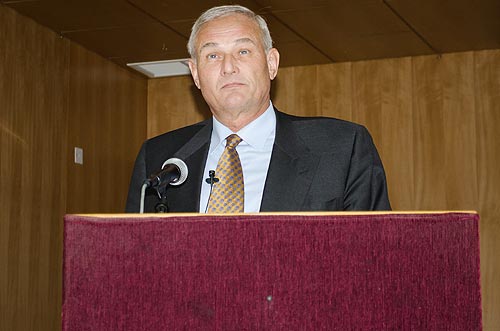
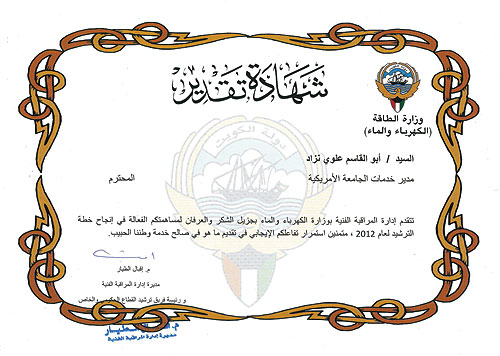
For the 5th consecutive year, the American University of Kuwait (AUK) receives the Ministry of Electricity and Water (MEW) Award for Energy Conservation. AUK has been receiving MEW awards since 2008 on their collaborative efforts with the ministry on energy conservation.
Abolghasem Alavinejad, Director of Campus Services at AUK, commented on this achievement saying "It is a great professional pleasure to be in line with MEW guidelines of energy conservation."
The MEW relationship with AUK started when a team of ministry representatives visited the AUK campus in 2007 to inspect and provide advice on their energy conservation campaign. The visitors were impressed by how the Campus Services Department at AUK had already been applying energy conservation practices including, using light-emitting diodes, controlling the usage, and preventing energy loss.
In continuation of its energy conservation efforts, the campus services Department at AUK maintains collaboration with MEW by sharing experience, data, and information on energy conservation methods.
Released by the Office of Public Affairs on the 13th February 2013
Photography by the Office of Public Affairs (C) 2013
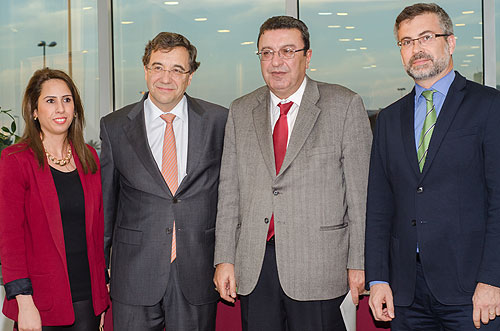
His Excellency the Ambassador of Spain to Kuwait Mr. Angel Losada Fernandez and the Deputy Head of Mission Mr. Gabriel Alou visited the AUK Library last week on a book donation event intended to promote cultural exchange.
The delegation was warmly welcomed by AUK Provost, Dr. Nizar Hamzeh and Library Director Ms. Asma Al-Kanan, whereby the two parties formally exchanged certificates to mark the donation occasion.
The donated collection consisted of books and multimedia items in Spanish, English and Arabic focusing on the history, art and culture of Spain.
During the event, Dr. Hamzeh gave a speech on behalf of the AUK President, welcoming the Ambassador and formally accepting the donation of books. From his side, HE the Ambassador delivered a speech to the attending audience of faculty and students. Concluding the event, Dr. Hamzeh and Ms. Al-Kanan acknowledged the guest with a certificate of official recognition and a gift from the AUK Library to commemorate the donation.
Released by the Office of Public Affairs on the 11th February 2013
Photography by the Office of Public Affairs (C) 2013
As another semester begins adding to the horde of textbooks that pile up over previous semesters, SGA held its first Book Trade event on February 5th. Organized by the Student Government Association (SGA), the outdoor event provided students with a venue for an easy, free, and direct book exchange.
SGA President, Mohammad Al Abdalrazzaq, introduced this event in an effort to offer students an exchange of educational books with their colleagues while promoting a sense of community at AUK.
During the event, students were offered a selection of books that were displayed on table stalls and sorted by subject under a total of 15 categories. Students were given an outlet for donating their textbooks from past courses that were counted upon registering their name on a list, and then selected an equal number of books to choose from.
"The purpose of the book trade is another way of donating and fostering education while connecting students around campus," said Al-AbdalRazzaq. "Students can miss out on acquiring lots of useful educational books with valuable information. They may miss the chance to benefit from many of the books due to the hassle of purchasing them." Through this event, students were given the opportunity to quickly obtain much needed books that might otherwise be unavailable in the AUK bookstore in times of need.
In addition, Al-Abdalrazzaq hopes to continue the book exchange by further proposing a plan to the government to supply additional free books for AUK students.
Freshman representative Abrar Al-Shammari said,"The SGA was a great help in the planning and arrangement process, as well as the success of the event."
The Book Trade was shown to be very beneficial to students. The SGA plans to hold more of book trades in the coming semesters.
Released by the Office of Public Affairs on the 11th February 2013

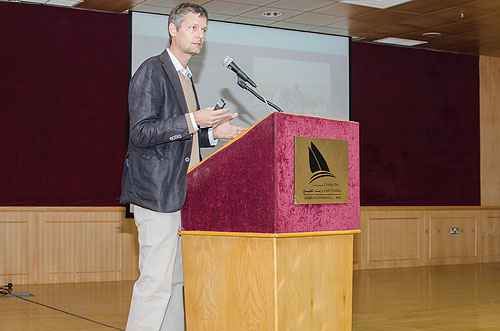
The Center for Gulf Studies (CGS) at the American University of Kuwait (AUK) hosted a public lecture entitled "A Portrait of Low Income Migrants in Qatar: New Data from a Large-Scale Survey." by Dr. Andrew M. Gardner, Associate Professor of Anthropology at the University of Puget Sound.
In his talk, Dr. Gardner outlined the details of his comprehensive study (funded by the Qatar National Research Fund as part of the National Priorities Research Program) on migrant, low-income laborers (classified as workers earning 2000 Qatari Riyals or less per month), the purpose of the study, and its initial findings. The study conducted used a sample of 1,189 low-income migrants. They were interviewed about a range of aspects concerning their national and cultural backgrounds, their employment, their housing, and their treatment.
The results of the survey revealed that 90 percent of migrant workers had their passports confiscated by their sponsors upon their arrival to Qatar. The low-income laborers all had to pay for their work visas to be able to work in Qatar, with an average cost of the visa amounting to $1031 USD. Other key findings were that 21 percent of those surveyed claimed they received their salaries either sometimes, rarely, or never on time. The results also suggested that small but significant percentages of the population reported having insufficient supplies of water, power, or air-conditioning.
One key purpose of the study was to analyze trends between the nationalities and religions of the low-income migrants and their overall treatment under employment in Qatar. The findings showed 'Arab' low-income migrants earned slightly higher wages, worked less hours, and shared their living spaces with fewer people than their 'South Asian' counterparts. Dr. Gardner explained that this correlation could possibly be attributed to similarities in culture and language.
The study revealed an inconsistent process of applying for visas outside of Qatar, allowing for exploitation and misinformation to occur. The study also revealed areas where there is room for improvement, specifically in the treatment of the migrant workers, and the respect of their basic human rights, as is the case with the confiscation of their passports.
The Center for Gulf Studies (CGS) at the American University of Kuwait aims to promote greater cultural understanding of and increased intellectual interest in the Gulf, by facilitating free and open academic discourse on a range of issues that both shape and challenge this critical region of the world. The goal of CGS is to enable scholars as well as political and civil society actors both within and outside the region to contribute and add value to the burgeoning field of Gulf Studies, while at the same time informing and engaging the general public. To this end, the CGS encourages, supports, and cultivates interesting and original research on the Gulf, while regularly organizing a variety of public academic events such as lectures, roundtable discussions, and conferences.
Released by the Office of Public Affairs on the 7th February 2013
Photography by the Office of Public Affairs (C) 2013
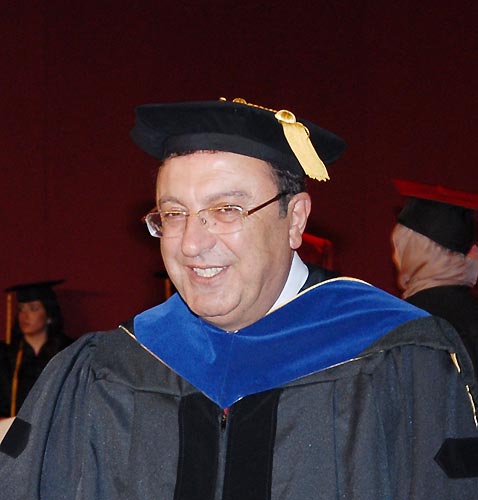
Following an extensive international search, AUK President, Dr. Winfred Thompson, announced the appointment of Professor Nizar Hamzeh as University Provost, effective this Spring Semester.
Hamzeh, who joined AUK in 2005, is an expert on Middle East politics, Islamic movements, international law, research methodology, and Western and Islamic political theory. He served at AUK as Associate Professor of Political Science, Head of the Social Sciences Division, and Director of the Gulf Studies Center until August 2006. In May 2007, Hamzeh was promoted to Full Professor based on reviews by an external Advisory Committee, which was created in the United States with assistance from Dartmouth College. He was appointed Dean of the College of Arts & Sciences at AUK in the same year. In 2011, Hamzeh was appointed Acting Vice President for Academic Affairs.
"I am pleased to appoint Dr. Hamzeh to his new position, which recognizes not only his long and distinguished service to the university but also the increased responsibilities he has assumed. I look forward to working with him in his new role," said President Thompson.
Prior to joining AUK, Hamzeh was a lecturer at the University of Southern California from 1987 to 1989, Assistant Professor and Associate Professor from 1989 to 2004 at the American University of Beirut, and Chair of the Political Science Department 1990 to 1999, member of the AUB Senate from 1997-1999, and Acting Dean of Student Affairs from 1999 to 2000.
As a 1979 graduate of the Lebanese University Faculty of Law, Hamzeh pursued graduate studies at the University of Southern California, Los Angeles receiving his M.A. and Ph.D. degrees in Political Science in 1982 and 1986, respectively. Building on his dissertation, Conflict in Lebanon: A Survey of Opinions and Attitudes, Hamzeh has become an internationally recognized authority on the culture and politics of Lebanon, with special focus on the development of Hizbullah and Islamist movements across the Middle East. Hamzeh is the author of In the Path of Hezbullah, published by Syracuse University Press, December 2004, a work that received the U.S. Choice Magazine Outstanding Academic Book Award for 2005. He has co-authored two other volumes on Lebanese Politics, and his articles appear in scholarly international referred journals such as International Journal of the Middle East (IJMES), Third World Quarterly, and Middle East Quarterly. His research work is also published by the Center for Strategic and International Studies (CSIS), Washington D.C.
"I am honored to be appointed to this new post. I look forward to continue serving the students of the American University of Kuwait to the best of their interest and future," said Hamzeh. He added, "I also look forward to working closely with the University President, Dr. Win Thompson, AUK BOT, faculty and administrative colleagues, and our Dartmouth partners, to enhance the academic programs that sustain AUK's distinctive intellectual environment".
The AUK Provost is the chief academic officer of the university, responsible for the academic and administrative functions of the Colleges of Arts & Sciences and Business & Economics and oversees all other academic support units and centers, such as the Registrar, the Library, the Writing Center, the Academic Advising Center and the Center for Gulf Studies. With oversight of curriculum development and implementation; faculty recruitment, development, and evaluation; policy development; and budgetary and outreach supervision, the Provost works closely with the President and serves as a member of his leadership cabinet.
Released by the Office of Public Affairs on the 5th February 2013
Photography by the Office of Public Affairs (C) 2013