


News
03, Apr 2008
AUK Participates in the Saudi Janadriya Festival
American University of Kuwait professor and students awarded grant to research Saudi traditional music
Musicology professor and Head of the Humanities and Arts Division, Dr. Lisa Urkevich and five AUK students were invited as distinguished guests of the Saudi government to participate in cultural research during the women's days of the Saudi Janadriya Festival (March 17-20). The students, who are part of a class that studies Arabian culture, excel academically and are noted for their dedication to Arabian Heritage; they were chosen from hundreds to receive this special grant.
The annual Janadriya Heritage Festival is a two week cultural event featuring artisans, food, costumes, wedding rituals, and traditional music and dance of the Kingdom. The last few days of the festival are dedicated exclusively to women. During this time, the AUK students were taken behind the scenes to interview the craftspeople and artists and get a glimpse of traditional customs rarely seen. Remote regions of Saudi Arabia, including the isolated mountains of Hijaz, were especially intriguing. As Journalism major Shomoukh Al-Mesaid recalled, "I was fascinated by so much rich tradition that I had never seen before."
Students were especially pleased to meet many different people from such a large country. Junior at AUK, Dalal Al Sabah described her experience:
"I not only had a chance to experience the different cultures of Saudi Arabia, I also made a lot of friends from the various regions who added so many perspectives and personalized the culture we were viewing."
Although before departing Kuwait, the students had extensively studied Saudi culture, the experience of being with the Saudi women and sharing their heritage was invaluable.
Shahed Al-Tammar noted that "attending the Janadriya festival was truly a remarkable experience. It has revived and strengthened my cultural heritage and ethnic background. I was honored to be among the chosen ones, for this trip was a magnificent learning experience about the profound culture of our neighboring country, Saudi Arabia."
"Janadriya was an enriching cultural exchange extravaganza" added AUK senior Noufa Al-Sabah.
Accounting major, Nada Al Yahia called it "a memorable experience that took us back into exploring the wonders of ancient Saudi Arabia."
Dr. Urkevich was delighted by the success of the trip:
"I am thrilled with all that our students learned during this Study Abroad class. We are fortunate to have such good friends in the Saudi Embassy and Ambassador Abdul Aziz Alfayz and Dr. Saleh Al Sagri, who worked so hard to facilitate this visit. This Saudi-Kuwaiti union is a great success, and I am proud of our students and the way they represented AUK and Kuwait."
Musicology professor and Head of the Humanities and Arts Division, Dr. Lisa Urkevich and five AUK students were invited as distinguished guests of the Saudi government to participate in cultural research during the women's days of the Saudi Janadriya Festival (March 17-20). The students, who are part of a class that studies Arabian culture, excel academically and are noted for their dedication to Arabian Heritage; they were chosen from hundreds to receive this special grant.
The annual Janadriya Heritage Festival is a two week cultural event featuring artisans, food, costumes, wedding rituals, and traditional music and dance of the Kingdom. The last few days of the festival are dedicated exclusively to women. During this time, the AUK students were taken behind the scenes to interview the craftspeople and artists and get a glimpse of traditional customs rarely seen. Remote regions of Saudi Arabia, including the isolated mountains of Hijaz, were especially intriguing. As Journalism major Shomoukh Al-Mesaid recalled, "I was fascinated by so much rich tradition that I had never seen before."
Students were especially pleased to meet many different people from such a large country. Junior at AUK, Dalal Al Sabah described her experience:
"I not only had a chance to experience the different cultures of Saudi Arabia, I also made a lot of friends from the various regions who added so many perspectives and personalized the culture we were viewing."
Although before departing Kuwait, the students had extensively studied Saudi culture, the experience of being with the Saudi women and sharing their heritage was invaluable.
Shahed Al-Tammar noted that "attending the Janadriya festival was truly a remarkable experience. It has revived and strengthened my cultural heritage and ethnic background. I was honored to be among the chosen ones, for this trip was a magnificent learning experience about the profound culture of our neighboring country, Saudi Arabia."
"Janadriya was an enriching cultural exchange extravaganza" added AUK senior Noufa Al-Sabah.
Accounting major, Nada Al Yahia called it "a memorable experience that took us back into exploring the wonders of ancient Saudi Arabia."
Dr. Urkevich was delighted by the success of the trip:
"I am thrilled with all that our students learned during this Study Abroad class. We are fortunate to have such good friends in the Saudi Embassy and Ambassador Abdul Aziz Alfayz and Dr. Saleh Al Sagri, who worked so hard to facilitate this visit. This Saudi-Kuwaiti union is a great success, and I am proud of our students and the way they represented AUK and Kuwait."
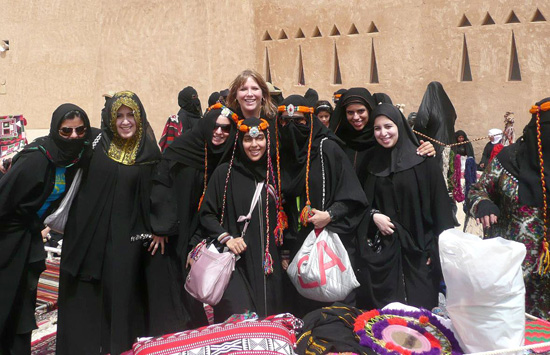
Dr. Lisa and AUK students Noufa Al-Sabah, Nada Al-Yahya, Shomoukh Al-Mesaid, Shahed Al-Tammar, and Dalal Al-Sabah with their new friends from Qaseem, Saudi Arabia
Dr. Lisa, Dalal Al-Sabah, Noufa Al-Sabah, Shomoukh Al-Mesaid, and Nada Al-Yahya before a mural of Ibn Saud, the first King of Saudi Arabia
02, Apr 2008
Library Spring Break Hours
The Library working hours during Spring Break will be as the following:
Sunday April 6th to Thursday April 10th 8 am - 4 pm
Friday April 11th Closed
Saturday April 12th 12 noon -5 pm
View More
Sunday April 6th to Thursday April 10th 8 am - 4 pm
Friday April 11th Closed
Saturday April 12th 12 noon -5 pm
Showing
10 Articles
of 1531
13, Mar 2008
American News Coverage of the Middle East
The American University of Kuwait held a talk as part of its American Corner lecture series, titled "American News Coverage of the Middle East"
The U.S Embassy in Kuwait sponsored the lecture, which was attended by AUK community members as well as guests, focused on the theme of American media coverage of the Middle East and was conducted by Columbia University professor Peter Spielmann, who is visiting AUK as a Senior Fulbright Specialist and is teaching a course in journalism.
Spielmann said he hoped the event would shed some light on the reasons for the declining and one-sided coverage of the Arab world in America.
"Most Americans are poorly informed regarding making decisions involving the War in Iraq, Iran's nuclear program, and whether the Israel/Palestine peace process has any hope for progress," said Spielmann, who is also an editor at the North America Desk at the Associated Press news wire agency.
Spielmann further added that it is the shrinking of international sections in most major media outlets in America, due to costs of maintaining foreign bureaus and correspondents and audience and reader demands, which leads to the narrow exposure to Gulf countries like Kuwait.
"With Middle East coverage, news-gathering favors violence over development, conflict over cooperation, the shrill over the subtle and local news over international events, leaving most Americans confused about the Middle East," he said.
During the informational session, members of the audience asked if there were studies indicating whether Americans really want to read about violence rather than news stories that reflect peace and prosperity in Arab countries. Spielmann said that most media outlets seem to judge a story based on the impact it would have on their readers and viewers, and that those are usually stories that focus on violence and terrorism.
Spielmann pointed to the growing coverage of entertainment stories, which are starting to dominate news in the United States, as another challenge to balanced reporting on the Middle East.
"We hope the talk will open more dialogue on how Kuwait and other Arab countries can help improve the media coverage that the United States receives about this region," said AUK Journalism Instructor Charles Mitchell, who moderated the event.
The U.S Embassy in Kuwait sponsored the lecture, which was attended by AUK community members as well as guests, focused on the theme of American media coverage of the Middle East and was conducted by Columbia University professor Peter Spielmann, who is visiting AUK as a Senior Fulbright Specialist and is teaching a course in journalism.
Spielmann said he hoped the event would shed some light on the reasons for the declining and one-sided coverage of the Arab world in America.
"Most Americans are poorly informed regarding making decisions involving the War in Iraq, Iran's nuclear program, and whether the Israel/Palestine peace process has any hope for progress," said Spielmann, who is also an editor at the North America Desk at the Associated Press news wire agency.
Spielmann further added that it is the shrinking of international sections in most major media outlets in America, due to costs of maintaining foreign bureaus and correspondents and audience and reader demands, which leads to the narrow exposure to Gulf countries like Kuwait.
"With Middle East coverage, news-gathering favors violence over development, conflict over cooperation, the shrill over the subtle and local news over international events, leaving most Americans confused about the Middle East," he said.
During the informational session, members of the audience asked if there were studies indicating whether Americans really want to read about violence rather than news stories that reflect peace and prosperity in Arab countries. Spielmann said that most media outlets seem to judge a story based on the impact it would have on their readers and viewers, and that those are usually stories that focus on violence and terrorism.
Spielmann pointed to the growing coverage of entertainment stories, which are starting to dominate news in the United States, as another challenge to balanced reporting on the Middle East.
"We hope the talk will open more dialogue on how Kuwait and other Arab countries can help improve the media coverage that the United States receives about this region," said AUK Journalism Instructor Charles Mitchell, who moderated the event.
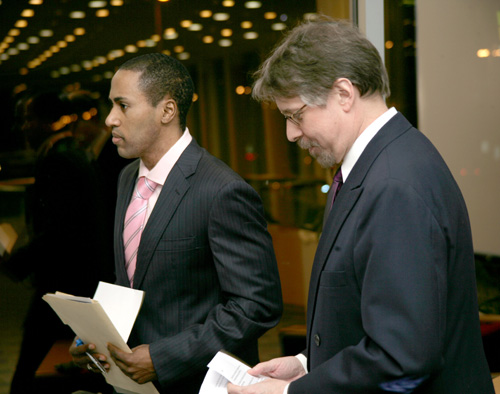
Senior Fulbright specialist professor Peter Spielmann is being introduced by AUK Journalism Instructor Charles Mitchell
Columbia University professor Peter Spielmann
13, Mar 2008
AUK at Educare 2008
The American University of Kuwait participated in Educare 2008 for the 5th consecutive year, as both an exhibitor and a main sponsor.
The annual education and career development exhibition was held at the Kuwait International Fair (KIF) fairgrounds from 10-13 March, 2008.
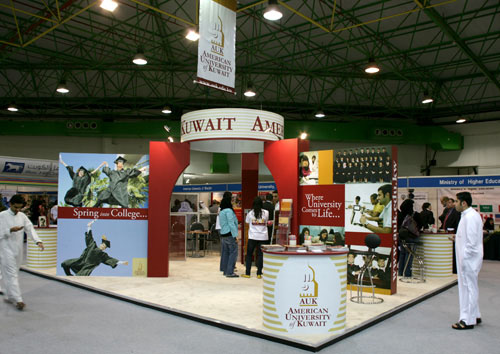
AUK admissions staff was available at the AUK Booth in the fairgrounds to offer information and answer questions about the admissions process, campus life, and the different academic programs available at the university.
Representatives from The Center for Continuing Education at AUK were also available at the exhibition to inform visitors about the extensive catalog of courses and programs the center has to offer.
The booth was visited by a large number of visitors, and AUK looks forward to being part of this important event in successive years.
The annual education and career development exhibition was held at the Kuwait International Fair (KIF) fairgrounds from 10-13 March, 2008.
AUK admissions staff was available at the AUK Booth in the fairgrounds to offer information and answer questions about the admissions process, campus life, and the different academic programs available at the university.
Representatives from The Center for Continuing Education at AUK were also available at the exhibition to inform visitors about the extensive catalog of courses and programs the center has to offer.
The booth was visited by a large number of visitors, and AUK looks forward to being part of this important event in successive years.
The Ministry of Education Undersecretary Ali Muhammad Al Barrak at the AUK booth
04, Mar 2008
AUK Goes to Harvard
The Model United Nations of the American University of Kuwait (MUNAUK) @ The Harvard National Model United Nations Conference (HNMUN)
Under the generous patronage of the Deputy Prime Minister and Minister of Foreign Affairs, Sheikh Dr. Mohammad Sabah Al-Salim Al-Sabah, six students and two faculty advisors took off to Boston, Massachusetts in the United States of America on 11 February 2008 to participate in the 54th Harvard National Model United Nations Conference (HNMUN) from 14-17 February.
HNMUN is the oldest and most prestigious MUN conference and has participants from all over the world. This year, over 3,000 participants, from 170 different participating universities from over 35 countries took part representing 192 countries in 24 committees over four days. The American University of Kuwait was the first university from Kuwait to participate in the history of American Model United Nations conferences. AUK was one of three Arab delegations to take part this year; the other two being from Morocco and Iraq.
Model United Nations is a simulation of the functional dynamics of the well-known international organization, the United Nations. Each student represents the foreign policy of an assigned state and applies this towards various topics in certain committees.
For this conference, the Model United Nations at the American University of Kuwait team was assigned by the Harvard conference administration to represent the countries of Namibia and Grenada in four committees. The following students participated in the conference:
The students were accompanied by Faculty Advisor and Assistant to the President of AUK, Ms. Shareefa Al-Adwani, and Assistant Professor of History, Dr. Christopher Ohan.
Prior to the HNMUN conference, MUNAUK was eager to meet up with Kuwait's Ambassador to the United States Sheikh Salim Al-Jabir Al-Abdullah Al-Sabah in Washington, D.C., as well as with Kuwait's Ambassador to the United Nations Abdullah Al-Murad in New York.
Sheikh Salim, Kuwait's Ambassador to the United States, listened to the MUNAUK member's topics to be discussed at the conference and stressed that the key to successful diplomacy was extensive lobbying to garner the support of people. He also emphasized creating a comprehensive argument with feasible solutions for the topic at hand with regards to the assigned state's interest.
Ambassador Abdullah Al-Murad spoke to MUNAUK about Kuwait's role in the United Nations and its workings with other regional organizations, primarily the Gulf Cooperation Council (GCC), the Arab League and the Organization of Islamic Countries (OIC).
Both Ambassadors warmly received the MUNAUK members and advised the members on a number of items to remember, primarily, the key traits required of a successful diplomat: to be hard working, determined to succeed, willing to make sacrifices, and to have discipline.
Also, Kuwait's Cultural Attache Dr. Fatima Nazar, warmly welcomed MUNAUK at the Cultural Division of the Kuwaiti Embassy in Washington DC and engaged in fruitful discussions on our future career paths and Kuwaiti politics. Her encouragement and support of Kuwaiti students provided to be positive motivation for students seeking higher education as well as positions in diplomatic arenas.
In addition, MUNAUK also took tours of the United Nations building in New York as well as of the Capitol building and the Congressional gallery in Washington, D.C.
After several months of preparation including participating in the Bahrain Universities Model United Nations (BUMUN) December 2007, confidence was high and unwavering as the MUNAUK members stepped into the committees.
The double delegation of Yusuf Al-Rashed and Norah Al-Hilaly representing Grenada in the Organization of American States (OAS) saw them discuss the sensitive topic of drug trafficking and its relation with terrorism with both Yusuf and Norah engaging in behind the scenes negotiations with 34 other double delegations to pass several important clauses in the final resolution and an amendment.
In the African Union, composed of over 40 delegates, Dana Shamlawi represented Namibia and was very active in collaborating with other African States on some major issues, and was most notable for leading debate on the topic of empowering women in African societies. Her focus was on importance of women's education and the ample social and economic opportunities that come out of education, and was able to pass a clause on that notion.
In the United Nations Higher Commission for Refugees, Farah Al-Shamali represented Namibia and was very active in finding common ground with other delegates on the very sensitive issue of the plight of Iraqi refugees following the 2003 Iraq War, proposing that neighboring countries taking in these refugees must be aided by the international community. She passed several amendments on the issue.
The World Trade Organization had both Fahad Mohammad and Fahad Al-Tukhaim representing Namibia and Grenada respectively as they negotiated and debated with over 100 other delegates on the topic of Trade and development. Fahad Al-Tukhaim led the Caribbean interests with regards to development and trade, noting that it is impossible to continue on the path of development when Caribbean nations are prone to suffer from natural disasters. He was successful in passing a clause that ensured an insurance policy with regards to natural disasters on loans taken by Caribbean nations and successfully lobbied for the International Monetary Fund and World Bank to ease their agreements on those nations that are prone to natural disasters.
Fahad Mohammad, representing Namibia, was successful in writing up a working paper that became one of the pillars of the final WTO resolution, arguing that less developed nations require much economic diversity, more foreign direct investment in the fields of logistics, telecommunications, and communications and much more concerted technical and financial assistance in order to alleviate the poverty and unemployment in the third world. Collaborating with the EU and the US, their resolution passed with a vote of 56 for, 13 against and 6 abstaining. For his diplomatic skill, Fahad Mohammad was awarded the Best Delegate in the World Trade Organization becoming the first Kuwaiti to win the highest award.
All MUNAUK members emerged from those four days with stronger negotiating skills and increased diplomatic experience as well as a greater belief in their abilities to make a change for the future. Through compromise and collaboration, students had to put aside their preconceived notions and instead listened earnestly to others while still holding on to the assigned states principles and interests in order to come up with feasible resolutions, clauses and agreements.
Numerous goals set out by the MUNAUK members were achieved. First of all, MUNAUK was able to represent the youth of Kuwait positively. It was able to put the American University of Kuwait on the academic map as it competed against the most prestigious American and international universities. The trip was proof that once students are given the opportunity to practice what was learned and platform to pragmatically exercise education, they can accomplish grand things and challenge the best of the best.
It was an accomplishment to participate in the biggest and most prestigious MUN conference after only 15 months after MUNAUK's founding. It was satisfying to see three founding members of MUNAUK, Fahad Mohammed, Fahad Al-Tukhaim, and Ms. Shareefa Al-Adwani enjoy the fruit of their hard work so soon.
Under the generous patronage of the Deputy Prime Minister and Minister of Foreign Affairs, Sheikh Dr. Mohammad Sabah Al-Salim Al-Sabah, six students and two faculty advisors took off to Boston, Massachusetts in the United States of America on 11 February 2008 to participate in the 54th Harvard National Model United Nations Conference (HNMUN) from 14-17 February.
HNMUN is the oldest and most prestigious MUN conference and has participants from all over the world. This year, over 3,000 participants, from 170 different participating universities from over 35 countries took part representing 192 countries in 24 committees over four days. The American University of Kuwait was the first university from Kuwait to participate in the history of American Model United Nations conferences. AUK was one of three Arab delegations to take part this year; the other two being from Morocco and Iraq.
Model United Nations is a simulation of the functional dynamics of the well-known international organization, the United Nations. Each student represents the foreign policy of an assigned state and applies this towards various topics in certain committees.
For this conference, the Model United Nations at the American University of Kuwait team was assigned by the Harvard conference administration to represent the countries of Namibia and Grenada in four committees. The following students participated in the conference:
| Name | Country Representing | Committee |
| Fahad Mohammed (President of MUNAUK and Head Delegate) |
Namibia | World Trade Organization |
| Fahad Al-Tukhaim (Vice President of MUNAUK) |
Grenada | World Trade Organization |
| Yusuf Al-Rashed | Grenada | Organization of American States |
| Norah Al-Hilaly | Grenada | Organization of American States |
| Dana Shamlawi | Namibia | African Union |
| Farah Al-Shamali | Grenada | United Nations Higher Commissions for Refugees |
The students were accompanied by Faculty Advisor and Assistant to the President of AUK, Ms. Shareefa Al-Adwani, and Assistant Professor of History, Dr. Christopher Ohan.
Prior to the HNMUN conference, MUNAUK was eager to meet up with Kuwait's Ambassador to the United States Sheikh Salim Al-Jabir Al-Abdullah Al-Sabah in Washington, D.C., as well as with Kuwait's Ambassador to the United Nations Abdullah Al-Murad in New York.
Sheikh Salim, Kuwait's Ambassador to the United States, listened to the MUNAUK member's topics to be discussed at the conference and stressed that the key to successful diplomacy was extensive lobbying to garner the support of people. He also emphasized creating a comprehensive argument with feasible solutions for the topic at hand with regards to the assigned state's interest.
Ambassador Abdullah Al-Murad spoke to MUNAUK about Kuwait's role in the United Nations and its workings with other regional organizations, primarily the Gulf Cooperation Council (GCC), the Arab League and the Organization of Islamic Countries (OIC).
Both Ambassadors warmly received the MUNAUK members and advised the members on a number of items to remember, primarily, the key traits required of a successful diplomat: to be hard working, determined to succeed, willing to make sacrifices, and to have discipline.
Also, Kuwait's Cultural Attache Dr. Fatima Nazar, warmly welcomed MUNAUK at the Cultural Division of the Kuwaiti Embassy in Washington DC and engaged in fruitful discussions on our future career paths and Kuwaiti politics. Her encouragement and support of Kuwaiti students provided to be positive motivation for students seeking higher education as well as positions in diplomatic arenas.
In addition, MUNAUK also took tours of the United Nations building in New York as well as of the Capitol building and the Congressional gallery in Washington, D.C.
After several months of preparation including participating in the Bahrain Universities Model United Nations (BUMUN) December 2007, confidence was high and unwavering as the MUNAUK members stepped into the committees.
The double delegation of Yusuf Al-Rashed and Norah Al-Hilaly representing Grenada in the Organization of American States (OAS) saw them discuss the sensitive topic of drug trafficking and its relation with terrorism with both Yusuf and Norah engaging in behind the scenes negotiations with 34 other double delegations to pass several important clauses in the final resolution and an amendment.
In the African Union, composed of over 40 delegates, Dana Shamlawi represented Namibia and was very active in collaborating with other African States on some major issues, and was most notable for leading debate on the topic of empowering women in African societies. Her focus was on importance of women's education and the ample social and economic opportunities that come out of education, and was able to pass a clause on that notion.
In the United Nations Higher Commission for Refugees, Farah Al-Shamali represented Namibia and was very active in finding common ground with other delegates on the very sensitive issue of the plight of Iraqi refugees following the 2003 Iraq War, proposing that neighboring countries taking in these refugees must be aided by the international community. She passed several amendments on the issue.
The World Trade Organization had both Fahad Mohammad and Fahad Al-Tukhaim representing Namibia and Grenada respectively as they negotiated and debated with over 100 other delegates on the topic of Trade and development. Fahad Al-Tukhaim led the Caribbean interests with regards to development and trade, noting that it is impossible to continue on the path of development when Caribbean nations are prone to suffer from natural disasters. He was successful in passing a clause that ensured an insurance policy with regards to natural disasters on loans taken by Caribbean nations and successfully lobbied for the International Monetary Fund and World Bank to ease their agreements on those nations that are prone to natural disasters.
Fahad Mohammad, representing Namibia, was successful in writing up a working paper that became one of the pillars of the final WTO resolution, arguing that less developed nations require much economic diversity, more foreign direct investment in the fields of logistics, telecommunications, and communications and much more concerted technical and financial assistance in order to alleviate the poverty and unemployment in the third world. Collaborating with the EU and the US, their resolution passed with a vote of 56 for, 13 against and 6 abstaining. For his diplomatic skill, Fahad Mohammad was awarded the Best Delegate in the World Trade Organization becoming the first Kuwaiti to win the highest award.
All MUNAUK members emerged from those four days with stronger negotiating skills and increased diplomatic experience as well as a greater belief in their abilities to make a change for the future. Through compromise and collaboration, students had to put aside their preconceived notions and instead listened earnestly to others while still holding on to the assigned states principles and interests in order to come up with feasible resolutions, clauses and agreements.
Numerous goals set out by the MUNAUK members were achieved. First of all, MUNAUK was able to represent the youth of Kuwait positively. It was able to put the American University of Kuwait on the academic map as it competed against the most prestigious American and international universities. The trip was proof that once students are given the opportunity to practice what was learned and platform to pragmatically exercise education, they can accomplish grand things and challenge the best of the best.
It was an accomplishment to participate in the biggest and most prestigious MUN conference after only 15 months after MUNAUK's founding. It was satisfying to see three founding members of MUNAUK, Fahad Mohammed, Fahad Al-Tukhaim, and Ms. Shareefa Al-Adwani enjoy the fruit of their hard work so soon.
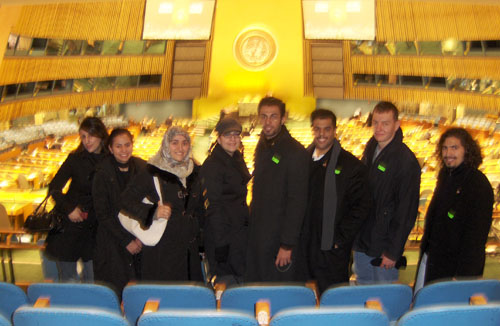
MUNAUK students at the General Assembly of the United Nations in New York
The three founders of MUNAUK, Faculty advisor Shareefa Al-Adwani, President Fahad Mohammad and Vice President Fahad Al-Tukhaim meeting the Deputy Prime Minister and Minister of Foreign Affairs his Excellency Sheikh Dr. Mohammad Sabah Al-Salim Al Sabah in his office prior to their trip to Harvard
Meeting the Kuwaiti Ambassador to the United States His Excellency Ambassador Sheikh Salim Al-Abdullah Al-Jaber Al-Sabah along with the Cultural Attache Dr. Fatima Nazar in Washington DC
Meeting the Permanent Representative of Kuwait to the United Nations His Excellency Ambassador Abdullah Al-Murad in New york
MUNAUK students hard at work on their speeches and Arguments
MUNAUK students with their certificates of Participation from Harvard National Model United Nations (HNMUN)
02, Mar 2008
All Classes are Canceled for Today
Classes are canceled today and will resume tomorrow, Monday the 3rd of March.
23, Feb 2008
AUK Design Team Participates in Qatar Event
Two American University of Kuwait professors and their students took part in a major conference held in Qatar this week.
Graphic Design professors Maryam Hosseinnia, Marcella Kulchitsky and 12 AUK undergraduates were invited to participate in a four-day graphic design event at the Virginia Commowealth University School of the Arts in Qatar (VCUQ), in Doha from March 3-6. The conference was entitled 'Design at the Cross Roads: The Interaction of Change and the Future.' The theme of the gathering addressed the transformations observed in traditional Bedouin art when their culture interacts with modern big city life.
"The VCUQ design program has been a beacon in the Middle East and it was great to see them draw speakers, students and academics from around the world to Qatar," Kulchitsky said.
The event attracted more than 12 design professionals from countries around the world, including the United States, South Korea and Kuwait. The occasion also provided academics and students the opportunity to take in design exhibitions, presentations and panel discussions from prominent experts and scholars.
One notable guest speaker, Amsterdam based graphic designer Irma Boom, explained in her talk how the role of the graphic artist is evolving:
"The designer has become more of an author. They don't just serve a commissioner's needs, they are part of the total creative process and raise new questions and look for unusual answers."
For many students this was their first exposure to professionals in the interdisciplinary field of design. The students at VCUQ provided private tours of their studio space and shared their classroom projects with the AUK undergraduates.
Hosseinnia and Kulchitsky said they were pleased with the experience, noting the trip was a great opportunity and opened up a world of ideas for the American University of Kuwait.
"At AUK we are very excited to have the graphic design program now as a major. The program has grown with the support of the community and one day we hope to organize a similar design conference in Kuwait," Kulchitsky said.
Graphic Design professors Maryam Hosseinnia, Marcella Kulchitsky and 12 AUK undergraduates were invited to participate in a four-day graphic design event at the Virginia Commowealth University School of the Arts in Qatar (VCUQ), in Doha from March 3-6. The conference was entitled 'Design at the Cross Roads: The Interaction of Change and the Future.' The theme of the gathering addressed the transformations observed in traditional Bedouin art when their culture interacts with modern big city life.
"The VCUQ design program has been a beacon in the Middle East and it was great to see them draw speakers, students and academics from around the world to Qatar," Kulchitsky said.
The event attracted more than 12 design professionals from countries around the world, including the United States, South Korea and Kuwait. The occasion also provided academics and students the opportunity to take in design exhibitions, presentations and panel discussions from prominent experts and scholars.
One notable guest speaker, Amsterdam based graphic designer Irma Boom, explained in her talk how the role of the graphic artist is evolving:
"The designer has become more of an author. They don't just serve a commissioner's needs, they are part of the total creative process and raise new questions and look for unusual answers."
For many students this was their first exposure to professionals in the interdisciplinary field of design. The students at VCUQ provided private tours of their studio space and shared their classroom projects with the AUK undergraduates.
Hosseinnia and Kulchitsky said they were pleased with the experience, noting the trip was a great opportunity and opened up a world of ideas for the American University of Kuwait.
"At AUK we are very excited to have the graphic design program now as a major. The program has grown with the support of the community and one day we hope to organize a similar design conference in Kuwait," Kulchitsky said.
AUK graphic design students attend one of the presentations that was held during the conference
21, Feb 2008
AUK Celebrates National Day in Pure Academic Style
The American University of Kuwait honored today the country's upcoming occasions of National Day and Liberation Day by hosting two young poets, Noha Nabeel and Majed Al-Khaldi, in the library to recite their poetry, most of which was written in a nationalistic style.
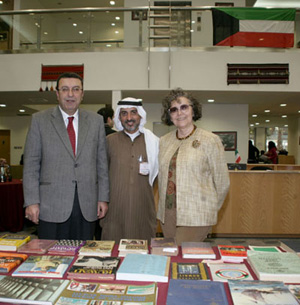
A truly impressive exhibition of rare and old books and magazines on Kuwait, as well as antique items was also on display in the AUK library. The collection is owned by Saleh Al-Mesbah, a book collector and researcher in Kuwaiti heritage.
Al-Mesbah's collection includes a National Geographic Magazine published in December 1952, which features an article titled "Boom Time in Kuwait" and another from a Reader's Digest published in 1952 titled "Croesus of Kuwait."
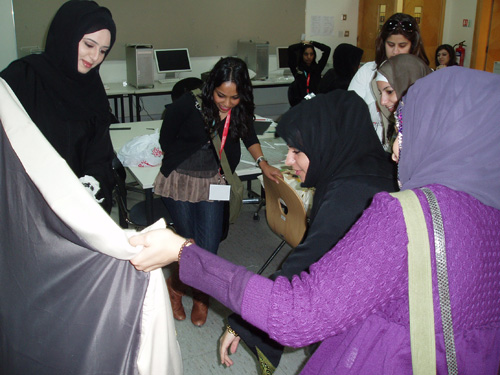
In another corner of the library sat a sadu weaver from Sadu House, who gave a live demonstration of the age-old Kuwait custom.
A truly impressive exhibition of rare and old books and magazines on Kuwait, as well as antique items was also on display in the AUK library. The collection is owned by Saleh Al-Mesbah, a book collector and researcher in Kuwaiti heritage.
Al-Mesbah's collection includes a National Geographic Magazine published in December 1952, which features an article titled "Boom Time in Kuwait" and another from a Reader's Digest published in 1952 titled "Croesus of Kuwait."
In another corner of the library sat a sadu weaver from Sadu House, who gave a live demonstration of the age-old Kuwait custom.
Right to left: The AUK President Dr. Marina Tolmacheva, Saleh Al-Mesbah, and the Dean of the College of Arts & Sciences Dr. Nizar Hamzeh
Miss Asma Yaqoub, Reference/Instruction Librarian introduces the poets for AUK community
Young poets, Noha Nabeel and Majed Al-Khaldi
19, Feb 2008
Enrollment Grows 17% in One Year
Spring semester 2008 is now underway at the American University of Kuwait, which has just completed the enrollment and registration of 295 new students, marking a healthy 17% growth rate from spring 2007.
Of the 295 new students, 178 enter the Undergraduate program while the remaining 117 students enter the Intensive English Program (IEP) at the university. This brings the total student population at AUK to 1670 registered students.
The American University of Kuwait is a liberal arts institution, based on the American model of higher education. It is dedicated to providing students with knowledge, self-awareness, and personal growth experiences that can enhance critical thinking, effective communication, and respect for diversity. AUK seeks to create leaders and life-long learners who aspire to the highest standards of moral and ethical responsibility in their societies.
Of the 295 new students, 178 enter the Undergraduate program while the remaining 117 students enter the Intensive English Program (IEP) at the university. This brings the total student population at AUK to 1670 registered students.
The American University of Kuwait is a liberal arts institution, based on the American model of higher education. It is dedicated to providing students with knowledge, self-awareness, and personal growth experiences that can enhance critical thinking, effective communication, and respect for diversity. AUK seeks to create leaders and life-long learners who aspire to the highest standards of moral and ethical responsibility in their societies.
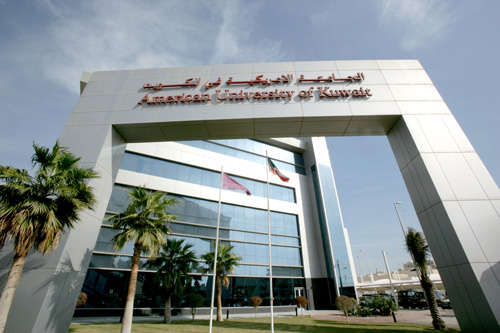
A view of the AUK arch
19, Feb 2008
Lecture by Clifford Chanin
Addressing the Goals and Challenges of Higher Education in the Gulf
Clifford Chanin, President of the Legacy Project in the United States, returns to the American University of Kuwait to present a lecture on "Goals and Challenges of Higher Education in the Gulf."
To an audience of students, academics and staff of AUK, Chanin described the issue of Higher Education as being widely seen as "the way in which societies can master the training of young people, creation of quality jobs, and the integration into the global economy."
Chanin referred to two recently published front-page articles in the New York Times about the development of higher educational options in the Gulf region to show that American Liberal Arts education in the Gulf is rising to public attention in the United States and the West and further that it's a model of education that continues to be a model that people around the world are looking to.
Some of the challenges he presented, with references to a World Bank Study titled "The Road Not Travelled: Education Reform in the Middle East and North Africa" are that there is currently a "youth bulge" that is creating social and economical problems because there are too many university graduates and not enough quality jobs.
Another significant challenge shown by the World Bank study, he said, was that nearly 80% of GCC nationals are employed in the public sector.
Furthermore, Chanin emphasized the importance of thinking about the phenomenon of higher education in the Gulf in relation to elsewhere in the Middle East, in light of the particular circumstances of the Gulf countries- higher incomes, lower population- which have the potential of solidifying a higher education model that stimulates exchange and supports development with the larger Middle East and North Africa region.
Clifford Chanin, President of the Legacy Project in the United States, returns to the American University of Kuwait to present a lecture on "Goals and Challenges of Higher Education in the Gulf."
To an audience of students, academics and staff of AUK, Chanin described the issue of Higher Education as being widely seen as "the way in which societies can master the training of young people, creation of quality jobs, and the integration into the global economy."
Chanin referred to two recently published front-page articles in the New York Times about the development of higher educational options in the Gulf region to show that American Liberal Arts education in the Gulf is rising to public attention in the United States and the West and further that it's a model of education that continues to be a model that people around the world are looking to.
Some of the challenges he presented, with references to a World Bank Study titled "The Road Not Travelled: Education Reform in the Middle East and North Africa" are that there is currently a "youth bulge" that is creating social and economical problems because there are too many university graduates and not enough quality jobs.
Another significant challenge shown by the World Bank study, he said, was that nearly 80% of GCC nationals are employed in the public sector.
Furthermore, Chanin emphasized the importance of thinking about the phenomenon of higher education in the Gulf in relation to elsewhere in the Middle East, in light of the particular circumstances of the Gulf countries- higher incomes, lower population- which have the potential of solidifying a higher education model that stimulates exchange and supports development with the larger Middle East and North Africa region.
Dr. Marina Tolmacheva, the president of the AUK welcomes AUK guests and Mr. Clifford Chanin
Dr. Marjorie Kelly, Assistant Professor of Anthropology introduces Dr.Marina Tolmacheva
An audience of students, academics and staff of AUK attended the lecture