

News
15, Jul 2022
AUK Hosts Annual Dinner
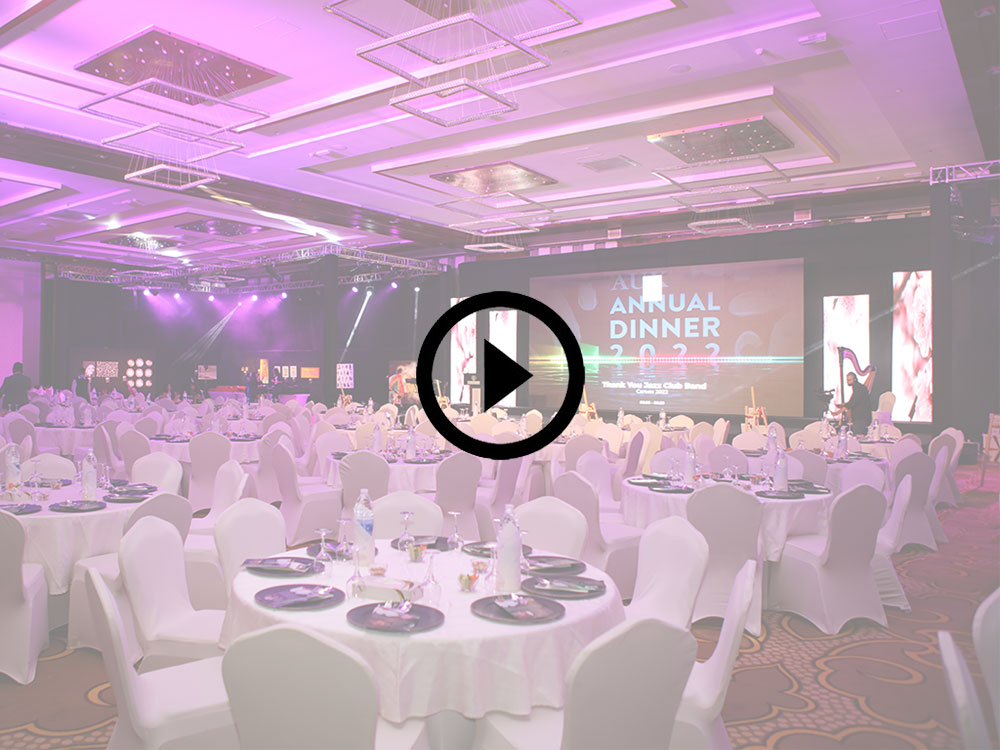
AUK hosted its Annual Dinner at the Palms Beach Hotel and Spa to celebrate the University’s administrative achievements and accomplishments. The event—organized by the University’s Human Resources Department—was attended by staff, faculty, and members of the president’s cabinet. During the event, 5, 10, and 15 years of service awards were presented to employees who completed the respective service years at AUK.
AUK president, Dr. Rawda Awwad, conveyed her gratitude towards AUK’s employees in her opening statement, “We have created a synergy that is hard to beat, built on the shoulders of you and all. That degree of energy can only be seen as authentic and personally motivated. And for that, I thank each and everyone of you for every single extra mile that you walk every day of the week, month after month, and year after year. Again, thank you for caring and for doing. For those who will be recognized this evening for the number of years of service 15, 10, and 5 respectively: I offer you my most heartfelt congratulations. That level of commitment and service, that constancy, that loyalty, is simply invaluable; and will make what is already a solid institution, stronger and better.”
This year’s theme was titled Canvas, whereby AUK staff contributed their artwork for display at the venue and were offered tokens of appreciation.
HR director, Paul Bassil, acknowledged the attendee’s service and effort, “Dear Colleagues, the AUK Canvas is already 17 Years old. Your brushes, pencils and pens helped in drawing what we are today. We are a mix of colors, we are not asking you to change your colors, we appreciate our differences, we ask you to place your colors on the right spot, in the right moment with the right density, place your fingerprints without hesitation.”
Throughout the evening, attendees enjoyed musical performances, live art, magic shows, and a raffle draw to close the event.
AUK’s strong culture of employee recognition is regularly expressed through events such as the annual dinner that highlight the contribution of faculty and staff.
AUK president, Dr. Rawda Awwad, conveyed her gratitude towards AUK’s employees in her opening statement, “We have created a synergy that is hard to beat, built on the shoulders of you and all. That degree of energy can only be seen as authentic and personally motivated. And for that, I thank each and everyone of you for every single extra mile that you walk every day of the week, month after month, and year after year. Again, thank you for caring and for doing. For those who will be recognized this evening for the number of years of service 15, 10, and 5 respectively: I offer you my most heartfelt congratulations. That level of commitment and service, that constancy, that loyalty, is simply invaluable; and will make what is already a solid institution, stronger and better.”
This year’s theme was titled Canvas, whereby AUK staff contributed their artwork for display at the venue and were offered tokens of appreciation.
HR director, Paul Bassil, acknowledged the attendee’s service and effort, “Dear Colleagues, the AUK Canvas is already 17 Years old. Your brushes, pencils and pens helped in drawing what we are today. We are a mix of colors, we are not asking you to change your colors, we appreciate our differences, we ask you to place your colors on the right spot, in the right moment with the right density, place your fingerprints without hesitation.”
Throughout the evening, attendees enjoyed musical performances, live art, magic shows, and a raffle draw to close the event.
AUK’s strong culture of employee recognition is regularly expressed through events such as the annual dinner that highlight the contribution of faculty and staff.
Click on the image to view the photo gallery
07, Jul 2022
AUK Signs Memorandum Of Understanding With LAPA
AUK signed a memorandum of understanding with LOYAC Academy of Performing Arts (LAPA) which permits AUK communication and media students to enroll in LAPA’s Al Jawhar program and earn up to 9 credit hours towards their degree.
The Al Jawhar program is divided into 3 levels—level 1 consists of 5 media workshops; level 2 consists of practical training such as vocal coaching and the development of Arabic skills in which the student will be supervised by a well-known media figure for evaluation; and level 3 is a special topics course for selected students who passed the preceding levels, consisting of a field training program in CNN Arabic headquarters in Dubai for 30 days, a 2-month podcast workshop in LOYAC/LAPA, and reporter trainee work in LOYAC/LAPA for a minimum of 3 months. It is through completing the third level that students earn an official certificate from LAPA stating the completion of a total of 9 credit hours.
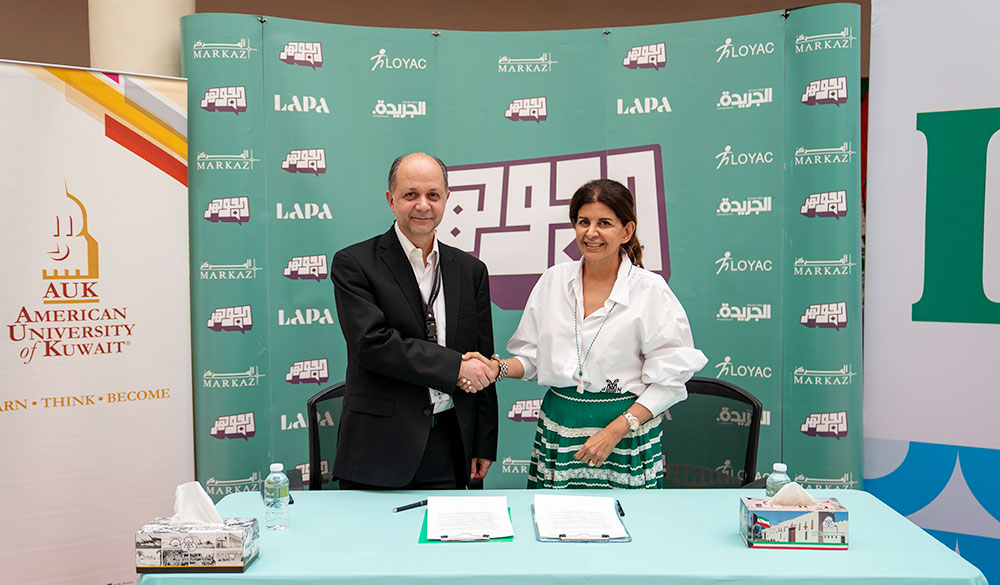
The signing ceremony took place with AUK executive vice president, Ms. Amal Al-Binali; the dean of the College of Arts and Sciences, Dr. Ali Charara; the managing director and chairperson of LOYAC and LAPA, Ms. Fareah AlSaqqaf; and TV producer and presenter, Ms. Rania Barghout, who serves as one of the industry experts supervising the students.
Dr. Ali Charara highlighted the importance of this collaboration for students’ experience at AUK, “Communication and media students can now expand their knowledge beyond the parameters of their course material. Through this memorandum, students will have the invaluable opportunity of learning from industry professionals and exploring different branches within their field. Not only will this enhance their media literacy proficiency, it will also contribute to increasing their level of expertise and experience—making them assets within Kuwait’s job market.”
Commenting on the agreement, Mrs. AlSaqqaf stated, "Our relationship with the American University of Kuwait is old and solid, based on cooperation and mutual respect since its foundation. With this agreement, the Al Jawhar program becomes a practical project for the communications and media department at AUK, providing young people with more than 400 hours of practical training, which can be completed within one year or 18 months, thus turning students into qualified media personnel capable of managing their own program.”
This agreement is a testament to AUK’s distinguished integration of liberal arts principles that allow its students to engage with their chosen fields both in theory and practice.
The Al Jawhar program is divided into 3 levels—level 1 consists of 5 media workshops; level 2 consists of practical training such as vocal coaching and the development of Arabic skills in which the student will be supervised by a well-known media figure for evaluation; and level 3 is a special topics course for selected students who passed the preceding levels, consisting of a field training program in CNN Arabic headquarters in Dubai for 30 days, a 2-month podcast workshop in LOYAC/LAPA, and reporter trainee work in LOYAC/LAPA for a minimum of 3 months. It is through completing the third level that students earn an official certificate from LAPA stating the completion of a total of 9 credit hours.
The signing ceremony took place with AUK executive vice president, Ms. Amal Al-Binali; the dean of the College of Arts and Sciences, Dr. Ali Charara; the managing director and chairperson of LOYAC and LAPA, Ms. Fareah AlSaqqaf; and TV producer and presenter, Ms. Rania Barghout, who serves as one of the industry experts supervising the students.
Dr. Ali Charara highlighted the importance of this collaboration for students’ experience at AUK, “Communication and media students can now expand their knowledge beyond the parameters of their course material. Through this memorandum, students will have the invaluable opportunity of learning from industry professionals and exploring different branches within their field. Not only will this enhance their media literacy proficiency, it will also contribute to increasing their level of expertise and experience—making them assets within Kuwait’s job market.”
Commenting on the agreement, Mrs. AlSaqqaf stated, "Our relationship with the American University of Kuwait is old and solid, based on cooperation and mutual respect since its foundation. With this agreement, the Al Jawhar program becomes a practical project for the communications and media department at AUK, providing young people with more than 400 hours of practical training, which can be completed within one year or 18 months, thus turning students into qualified media personnel capable of managing their own program.”
This agreement is a testament to AUK’s distinguished integration of liberal arts principles that allow its students to engage with their chosen fields both in theory and practice.
Dean of the College of Arts and Sciences, Dr. Ali Charara with the managing director and chairperson of LOYAC and LAPA, Ms. Fareah AlSaqqaf
(From left to right) Dean of the College of Arts and Sciences, Dr. Ali Charara; managing director and chairperson of LOYAC and LAPA, Ms. Fareah AlSaqqaf; TV producer and presenter, Ms. Rania Barghout; AUK executive vice president, Ms. Amal Al-Binali
(From left to right) Dean of the College of Arts and Sciences, Dr. Ali Charara; AUK executive vice president, Ms. Amal Al-Binali; chairperson of LOYAC and LAPA, Ms. Fareah AlSaqqaf; TV producer and presenter, Ms. Rania Barghout
Showing
10 Articles
of 1528
06, Jul 2022
AUK Participates in the 2022 PCU University Games in Belgium
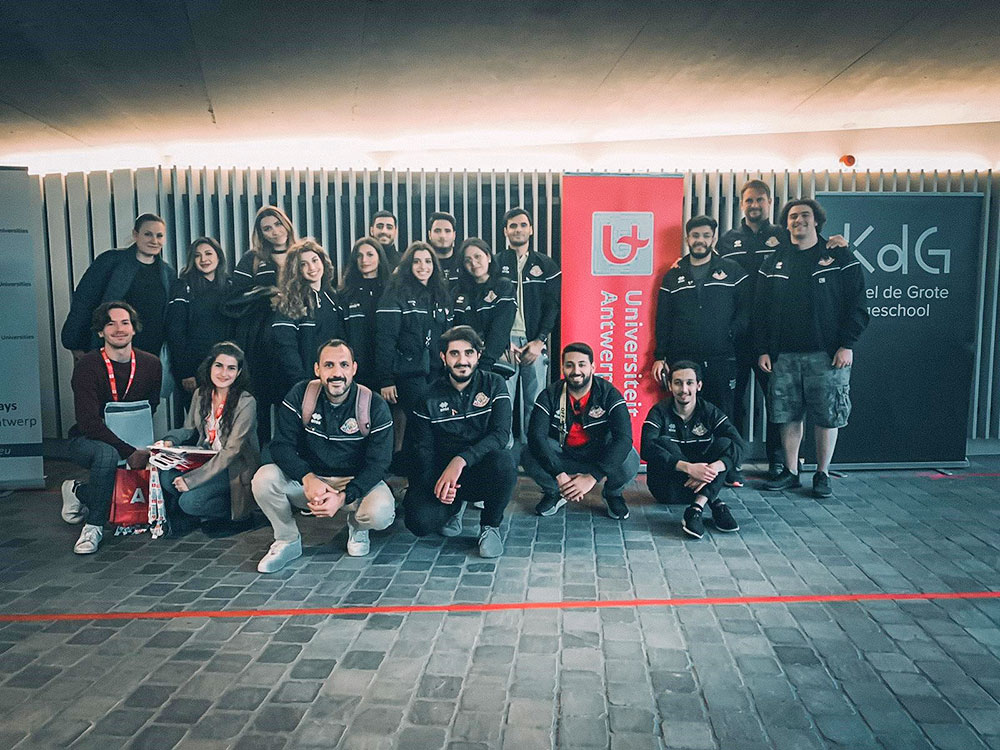
AUK athletes participated in the 23rd Panathlon Clubs of Universities (PCU) University Games in Belgium. The AUK delegation represented the only athletes from the Arab world and included 32 members of students, staff, and coaches. The four AUK sports teams that took part in the games were men’s soccer, men’s futsal, women’s volleyball, and men’s volleyball.
The three-day tournament commenced with an opening ceremony followed by a special welcome for AUK’s delegation by the PCU committee president, Mr. Peter Verboven. A series of games and meetings with PCU members and delegation heads rounded an eventful experience.
Head of the AUK delegation and senior sports coordinator at the University’s Office of Student Life, Mr. Mohammed Al-Saleh, expressed his gratitude towards AUK for providing athletes with the chance to compete abroad, “The sports trip was a great success on many levels. We thank AUK for the opportunity to compete at an international level and for exposing our athletes to new experiences. We appreciate the positive outcomes we have witnessed from this trip and look forward to many more sports events in the future.”
Ms. Hala Al Abdulrazzaq, dean of student affairs at AUK, also conveyed her pride for the athletes, “We are extremely proud of AUK sports and will continue to support our athletes and to make sure they make the best of their time at AUK. We wish them the best of luck always.”
Panathlon International was established in 1951, associates 300 Panathlon Clubs worldwide and is recognized by the International Olympic Committee. Participants of the PCU Games are automatically granted Panathlon International membership as a PCU Club.
The three-day tournament commenced with an opening ceremony followed by a special welcome for AUK’s delegation by the PCU committee president, Mr. Peter Verboven. A series of games and meetings with PCU members and delegation heads rounded an eventful experience.
Head of the AUK delegation and senior sports coordinator at the University’s Office of Student Life, Mr. Mohammed Al-Saleh, expressed his gratitude towards AUK for providing athletes with the chance to compete abroad, “The sports trip was a great success on many levels. We thank AUK for the opportunity to compete at an international level and for exposing our athletes to new experiences. We appreciate the positive outcomes we have witnessed from this trip and look forward to many more sports events in the future.”
Ms. Hala Al Abdulrazzaq, dean of student affairs at AUK, also conveyed her pride for the athletes, “We are extremely proud of AUK sports and will continue to support our athletes and to make sure they make the best of their time at AUK. We wish them the best of luck always.”
Panathlon International was established in 1951, associates 300 Panathlon Clubs worldwide and is recognized by the International Olympic Committee. Participants of the PCU Games are automatically granted Panathlon International membership as a PCU Club.
AUK athletes in Belgium
04, Jul 2022
AUK College Of Business And Economics Arranges Field Trip To Boursa Kuwait
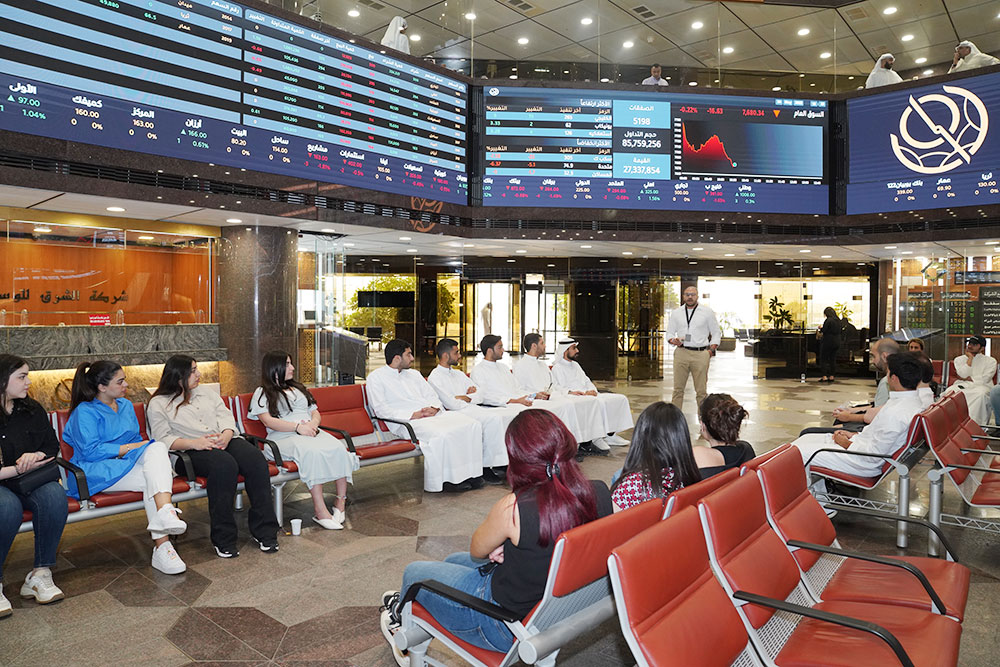
The American University of Kuwait (AUK) College of Business and Economics (CBE) arranged a field trip to the stock market, Boursa Kuwait, to enrich students’ learning experience through practical means. Dr. Wafaa Sbeiti, associate professor of finance, arranged the trip for students enrolled in the Financial Markets and Institutions and Portfolio Management courses.
Boursa Kuwait representatives spoke to the students about the company’s origins and establishment, Kuwait’s stock market history, the best operational practices used in stock markets, as well as additional information on trade practices.
Boursa Kuwait’s most recent financial developments were also discussed, including how it maintains its high international ranking. The presentation was followed by a tour where students saw clearance offices, digital screens, and brokerage firms. Students also got a tour of the new Nasser Al-Kharafi and Jassim Al-Bahr trading hall.
“Our trip to Boursa Kuwait was very beneficial since we got to learn more about the stock market and how we can open an account to buy stocks and invest. It was a pleasant experience to walk around Boursa and discover the history behind it and how the Kuwaiti stock market has evolved through time,” said one of the students.
Field trips as such give students the opportunity to expand their knowledge outside the classroom and gain experiences that will aid them in implementing their coursework material.
Boursa Kuwait representatives spoke to the students about the company’s origins and establishment, Kuwait’s stock market history, the best operational practices used in stock markets, as well as additional information on trade practices.
Boursa Kuwait’s most recent financial developments were also discussed, including how it maintains its high international ranking. The presentation was followed by a tour where students saw clearance offices, digital screens, and brokerage firms. Students also got a tour of the new Nasser Al-Kharafi and Jassim Al-Bahr trading hall.
“Our trip to Boursa Kuwait was very beneficial since we got to learn more about the stock market and how we can open an account to buy stocks and invest. It was a pleasant experience to walk around Boursa and discover the history behind it and how the Kuwaiti stock market has evolved through time,” said one of the students.
Field trips as such give students the opportunity to expand their knowledge outside the classroom and gain experiences that will aid them in implementing their coursework material.
AUK students at Boursa
Boursa representative giving a tour for the AUK group
Group photo of AUK students at Boursa
04, Jul 2022
AUK Sends Students To Dartmouth College And George Washington University
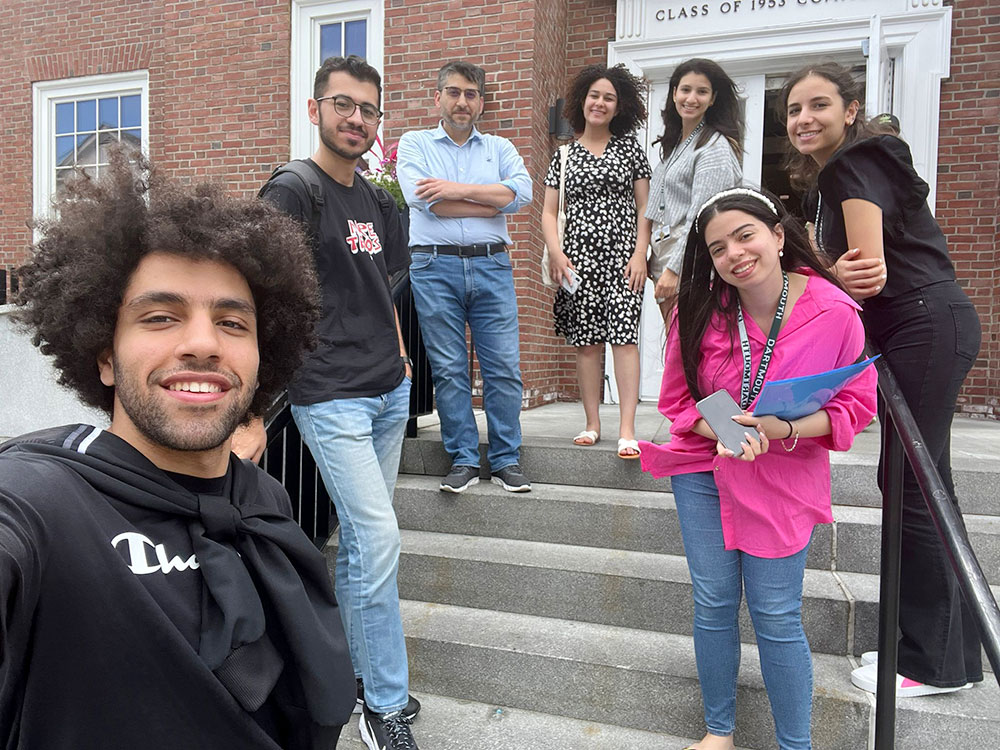
AUK sent 6 students to intern at Dartmouth College in New Hampshire, USA and 2 students to study abroad at George Washington University in Washington D.C., USA.
Interning at Dartmouth College are students Ali Darwiche, Farida Mohamed, Farah Saad, Omar Hedeya, Abeer Kablaoui, and Taibah Al-Eissa. Dartmouth and AUK have formed a partnership and worked closely together since 2003 when the two institutions signed a Memorandum of Understanding. The internship program is a part of the advisory, consultative, and cooperative projects that have been facilitated as a result of this memorandum.
Studying abroad at George Washington University are AUK students Lynn Pais and Mariam Shehadeh. The students will get the invaluable opportunity of expanding their academic and career frameworks across international borders. AUK established a Study Abroad Summer Programs Scholarship in 2016 with George Washington University (GW) that enables AUK students to take summer classes at GW.
The American University of Kuwait has several agreements with international institutions to award its students with study-abroad opportunities which foster cross-cultural and academic experiences to further expand their knowledge beyond the classroom.
Interning at Dartmouth College are students Ali Darwiche, Farida Mohamed, Farah Saad, Omar Hedeya, Abeer Kablaoui, and Taibah Al-Eissa. Dartmouth and AUK have formed a partnership and worked closely together since 2003 when the two institutions signed a Memorandum of Understanding. The internship program is a part of the advisory, consultative, and cooperative projects that have been facilitated as a result of this memorandum.
Studying abroad at George Washington University are AUK students Lynn Pais and Mariam Shehadeh. The students will get the invaluable opportunity of expanding their academic and career frameworks across international borders. AUK established a Study Abroad Summer Programs Scholarship in 2016 with George Washington University (GW) that enables AUK students to take summer classes at GW.
The American University of Kuwait has several agreements with international institutions to award its students with study-abroad opportunities which foster cross-cultural and academic experiences to further expand their knowledge beyond the classroom.
AUK interns at Dartmouth College
AUK interns at Dartmouth College
AUK students at George Washington University
04, Jul 2022
The American University of Kuwait Hosts Return of the Wolf Pack
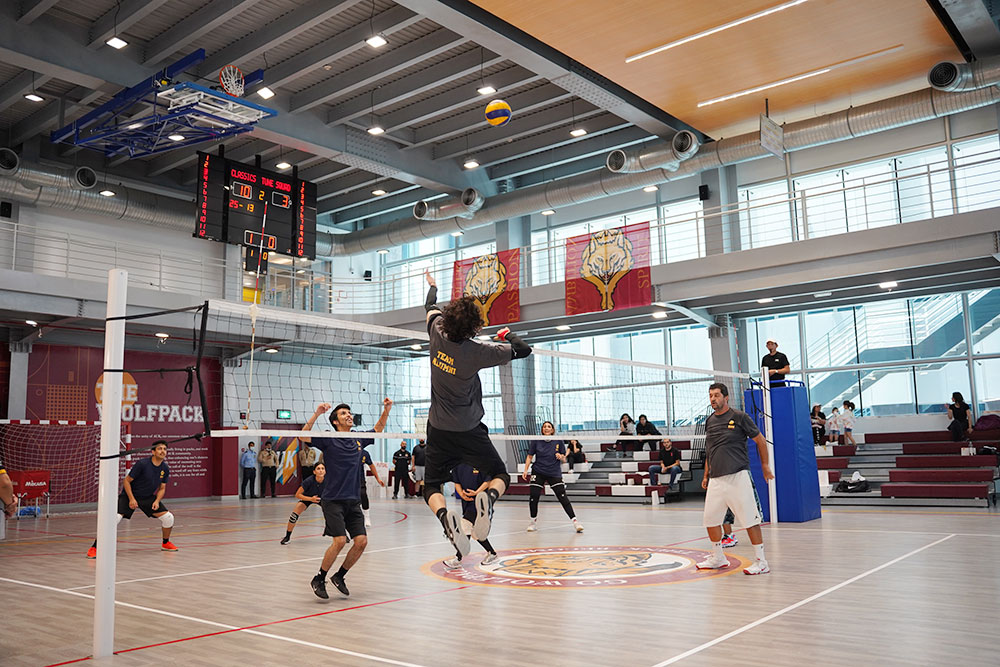
AUK hosted its first large-scale athletic event, Return of the Wolf Pack (ROW), after a two-year hiatus due to COVID-19 restrictions. The full-day event was organized by the Office of Alumni Affairs & Career Development (AACD) whereby alumni and student athletes competed against each other in the following sports: volleyball, basketball, futsal, and padel—all of which were won by the alumni teams.
This year’s ROW saw the greatest number of athletes and spectators including 120 athletes and over 200 spectators. The equipment and vouchers were sponsored by Decathlon Kuwait, and Taw9eel sponsored the prizes for the padel matches which consisted of a training bench with a rowing and cycling machine.
Many of the alumni that were in attendance contributed more than just their athletic skills; alumnus Ameen Al-Ahmad ’07 participated as an athlete and entrepreneur, providing cold refreshments as part of his business, Frullato. Alumnus Shokry Garada ’20 joined as ROW’s official host whereby he motivated both athletes and spectators to create a lively atmosphere.
The event presented alumni with the opportunity to reconnect with AUK’s community and re-establish bonds. Uros Lukic ’12 shared, “It was amazing to be back here with my fellow colleagues and to witness the changes on campus throughout these years. Several alumni even asked if the event could be done twice a year.”
Many of the participating alumni brought their family and friends for support and attendees expressed their excitement and anticipation for future events that will further enhance AUK’s Wolf Pack spirit.
This year’s ROW saw the greatest number of athletes and spectators including 120 athletes and over 200 spectators. The equipment and vouchers were sponsored by Decathlon Kuwait, and Taw9eel sponsored the prizes for the padel matches which consisted of a training bench with a rowing and cycling machine.
Many of the alumni that were in attendance contributed more than just their athletic skills; alumnus Ameen Al-Ahmad ’07 participated as an athlete and entrepreneur, providing cold refreshments as part of his business, Frullato. Alumnus Shokry Garada ’20 joined as ROW’s official host whereby he motivated both athletes and spectators to create a lively atmosphere.
The event presented alumni with the opportunity to reconnect with AUK’s community and re-establish bonds. Uros Lukic ’12 shared, “It was amazing to be back here with my fellow colleagues and to witness the changes on campus throughout these years. Several alumni even asked if the event could be done twice a year.”
Many of the participating alumni brought their family and friends for support and attendees expressed their excitement and anticipation for future events that will further enhance AUK’s Wolf Pack spirit.
Images from the event
28, Jun 2022
The American University of Kuwait Hosts its 18th Annual Awards Night Ceremony
The American University of Kuwait (AUK) hosted its 18th Annual Awards Night ceremony to celebrate the achievements of student employees, student clubs and organizations, LEAD at AUK program attendees, athletes, in addition to conferring the Wolf Pack Award and the President’s Award.
Held in the University’s auditorium, the event was attended by the president’s cabinet, college deans, and staff members from the Division of Student Affairs. Attendees were welcomed to the ceremony with a violin performance by AUK student Abdullah Khuraibet who was followed by a welcome speech from the dean of student affairs, Ms. Hala Al Abdulrazzaq. Reflecting upon the winners’ achievements, Dean Hala stated, “Awards Night brings together exceptional students to be recognized and awarded for their outstanding accomplishments and achievements. It is a night to celebrate and recognize our outstanding members of the community and to appreciate all their efforts. Congratulations to all winners!”
The 2022 awards comprised a total of 115 student employee awards, 23 club awards, five LEAD at AUK awards, former and current VOICE podcast and magazine team awards, male athlete of the year, which was awarded to Hassan Qali, female athlete of the year, which was awarded to Manarah Mohammad, and male and female outstanding coach assistants to Hamad Al-Hammadi and Tala Al-Hasibi respectively.
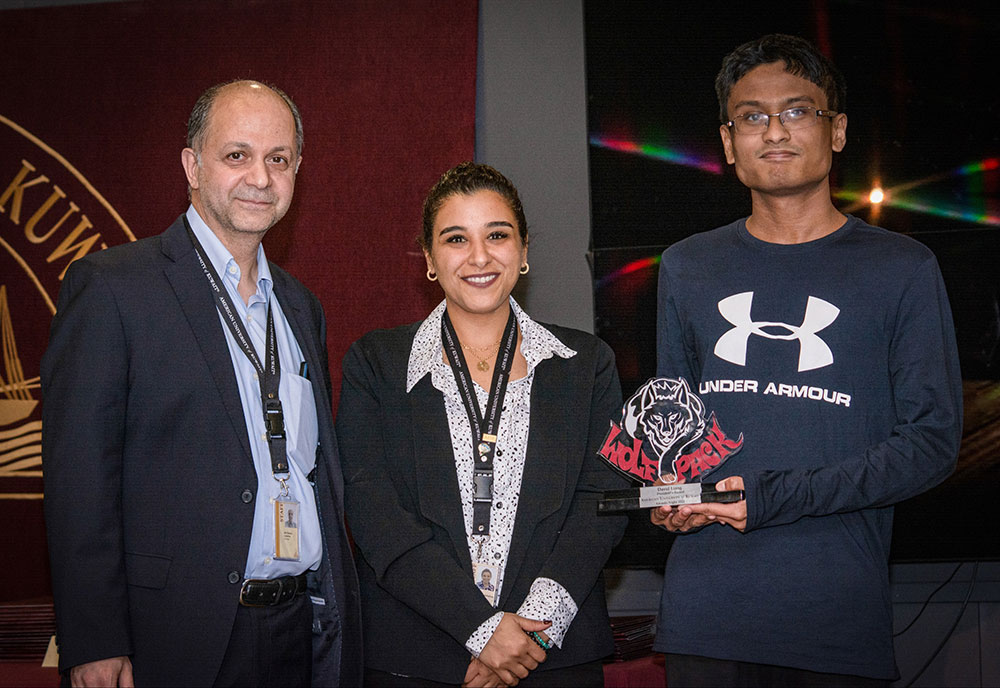
The event concluded with Dean Hala presenting the Wolf Pack Award to Sarah Al Awadhi, and the President’s Award was presented by the dean of the College of Arts & Sciences, Dr. Ali Charara on behalf of the AUK President to David Liang.
Events such as Awards Night shed light on student achievements and provide a platform for an environment of growth and support.
Held in the University’s auditorium, the event was attended by the president’s cabinet, college deans, and staff members from the Division of Student Affairs. Attendees were welcomed to the ceremony with a violin performance by AUK student Abdullah Khuraibet who was followed by a welcome speech from the dean of student affairs, Ms. Hala Al Abdulrazzaq. Reflecting upon the winners’ achievements, Dean Hala stated, “Awards Night brings together exceptional students to be recognized and awarded for their outstanding accomplishments and achievements. It is a night to celebrate and recognize our outstanding members of the community and to appreciate all their efforts. Congratulations to all winners!”
The 2022 awards comprised a total of 115 student employee awards, 23 club awards, five LEAD at AUK awards, former and current VOICE podcast and magazine team awards, male athlete of the year, which was awarded to Hassan Qali, female athlete of the year, which was awarded to Manarah Mohammad, and male and female outstanding coach assistants to Hamad Al-Hammadi and Tala Al-Hasibi respectively.
The event concluded with Dean Hala presenting the Wolf Pack Award to Sarah Al Awadhi, and the President’s Award was presented by the dean of the College of Arts & Sciences, Dr. Ali Charara on behalf of the AUK President to David Liang.
Events such as Awards Night shed light on student achievements and provide a platform for an environment of growth and support.
President’s Award- Dean of the College of Arts and Sciences, Dr. Ali Charara; Dean of Student Affairs, Ms. Hala Al Abdulrazzaq; and President’s Award winner, David Liang
Group photo of student employees and staff
26, Jun 2022
Communication and Media Students at the American University of Kuwait Visit STC
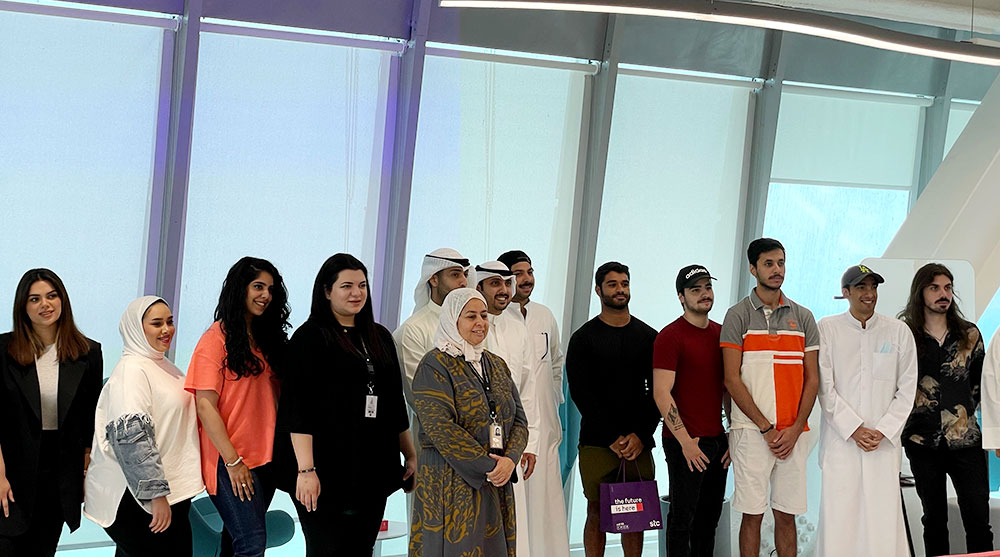
The Communication and Media Department at AUK arranged a fieldtrip to STC, a Kuwait-based telecommunications company, to familiarize students with PR departments in multi-national organizations and provide them with the opportunity to gain real-life experiences. Professor Iqbal Al-Haddad, instructor of communication, accompanied the students and planned the trip for those enrolled in her Public Relations Writing, Introduction to Mass Communication, International Case Studies in Public Relations, and PR Campaigns courses.
In his presentation to the students, the STC HR manager discussed the organization’s structure, introduced the board of directors, and discussed the roles of their executive managers. The STC PR managers also walked students through their internal and external PR and corporate social responsibility (CSR) activities. A tour of the offices was then given to the students.
“I believe that a trip of this kind adds a lot of benefit and value to the students where they can relate what they studied to the actual world. The majority were very much impressed of what they have seen and how the PR activities were implemented and executed, catering to various target audiences and for different causes,” stated Professor Al-Haddad. The students’ feedback was positive; many appreciated the opportunity to see their majors and coursework through a practical lens.
The COMM major is designed to help students become better consumers and producers of public information, strengthen their understanding of the role of communication in their personal, professional, and civic lives, and prepare them for private and public-sector leadership positions in communication-related and other fields.
To accomplish this, the communication and media program employs a flexible approach, exposing students to various branches such as advertising, journalism, public relations, and others. Laboratory courses sharpen students’ skills, lectures provide firm theoretical grounding, and internships enable students to view the profession from a variety of perspectives.
In his presentation to the students, the STC HR manager discussed the organization’s structure, introduced the board of directors, and discussed the roles of their executive managers. The STC PR managers also walked students through their internal and external PR and corporate social responsibility (CSR) activities. A tour of the offices was then given to the students.
“I believe that a trip of this kind adds a lot of benefit and value to the students where they can relate what they studied to the actual world. The majority were very much impressed of what they have seen and how the PR activities were implemented and executed, catering to various target audiences and for different causes,” stated Professor Al-Haddad. The students’ feedback was positive; many appreciated the opportunity to see their majors and coursework through a practical lens.
The COMM major is designed to help students become better consumers and producers of public information, strengthen their understanding of the role of communication in their personal, professional, and civic lives, and prepare them for private and public-sector leadership positions in communication-related and other fields.
To accomplish this, the communication and media program employs a flexible approach, exposing students to various branches such as advertising, journalism, public relations, and others. Laboratory courses sharpen students’ skills, lectures provide firm theoretical grounding, and internships enable students to view the profession from a variety of perspectives.
Group photo of AUK students at STC
16, Jun 2022
AUK College Of Engineering And Applied Sciences Holds Its First Capstone Exhibition
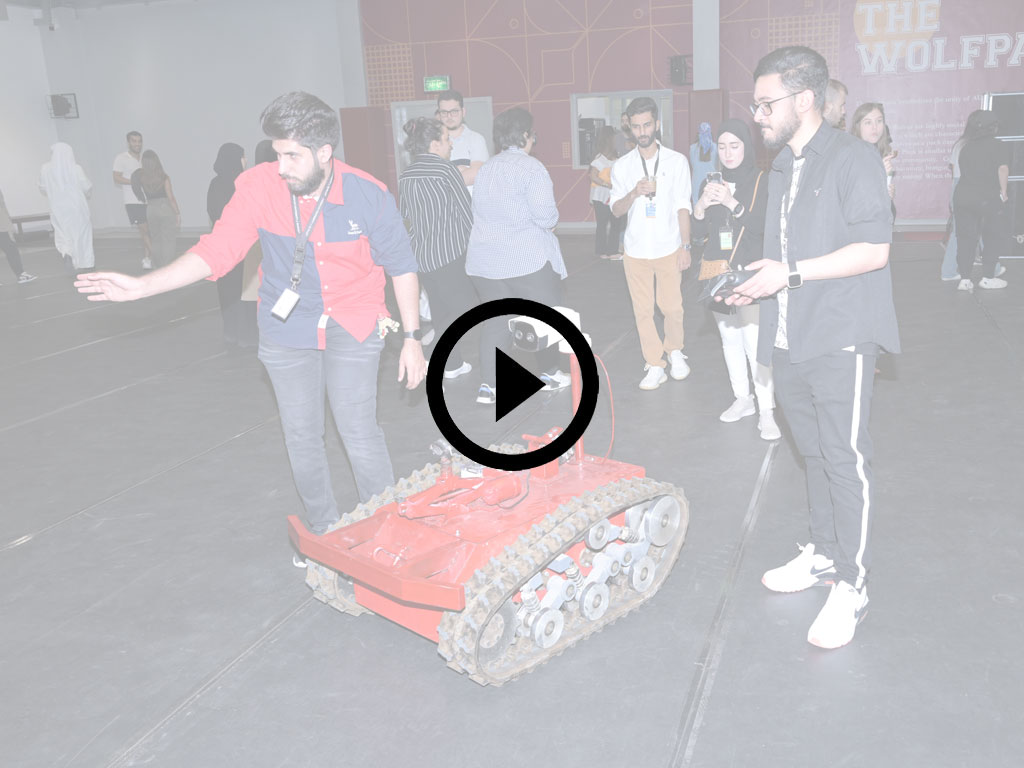
AUK College of Engineering and Applied Sciences (CEAS) held its capstone exhibition at AUK. One hundred students presented their graduation projects during the exhibition, incorporating novel prototypes that combined their hardware and software skills. The event was open to students, alumni, parents, and industry representatives.
AUK president, Dr. Rawda Awwad, emphasized the significance of CEAS capstones, “The capstone experience gives students the self-confidence necessary to problem-solve and provides them with opportunities to propagate a team spirit in service of others. Capstones are about contributing knowledge to improve lives. I’m proud of our students who have worked incredibly hard to make a difference and I’m truly grateful to the faculty and the dean of the College for their continued commitment to learning and exploration.”
A total of 26 teams of 3 and 4 members showcased their projects through informative posters, research papers, leaflets, and video displays. Supervised by faculty members of the College, students presented a wide range of prototypes such as Smart Helmets, Solar Powered Bikes, Smart Glasses, Dual Band GPS Antennas, Human Body Temperature Measuring Robots, Gesture Vocalizers and Self-parking Vehicles. Attendees were encouraged to vote for the best project through scanning QR codes allocated in each booth.
The event concluded with a closing ceremony at the AUK theater where the dean of CEAS, Dr. Amir Zeid, congratulated the students, “Today’s event showcased 26 capstone projects in different disciplines: computer and electrical engineering, computer science and information systems. We had around 100 students who have been working with their faculty supervisors for a full academic year to reach this important milestone. Congratulations to all.”
The closing ceremony also featured a keynote speech delivered by Ms. Khadija Oubala, CEO of Sultan Group, a Fulbright scholar, a recipient of the MIT Heather Smith Memorial Fellowship, and a member of Young Presidents Organization. In her speech to the attendees, she drew on her experiences to motivate students, “So, for all of you dear smart engineers, do not rely only on your intelligence alone. Put in the hours, and go above and beyond. Run that extra mile.”
A total of three winners were announced for the engineering category—the first-place winner was for project Fire-fighting Robot, by Noura Al-lahow, Dawood Boland, Shejon Alebrahim, Ali Abouzeid, and supervised by Dr. Mohammed El-Abd. The team highlighted AUK’s role in their capstone project, “Our accomplishments have been made possible through the facilitated support of many integral entities at AUK. Those include our professors, lab instructors, and of course, the dean and associate dean of Engineering. The overwhelming amount of support we received helped shape the people we are today. The campus as well has provided amenities required for completing our tasks and projects successfully. Those include the labs, equipment, and computer systems. Our journey was an endeavor filled with trial and error that was not severely punished as it is an environment that promotes learning from one's mistakes and becoming a better overall student in both a scholarly and characteristic sense.”
The second-place winner for the engineering project award was Augmented Reality for Educational Purposes, by Almuntaser AbdulSalam, Ahmad Aldulaie, Amer Alazemi, and supervised by Dr. Seyed Esmaeili.
The third-place winner was the 3D Hologram Fans, by Ahmad Y Musallam, Omar W AlQalsh, Abdulhadi A AlQattan, Hashim B Kheitan, and supervised by Dr. Ali Bostani.
Mobile App for 3D Augmented Reality for Sport Wear and Equipment—Fit Kit, was the winning project award for the computer science and information systems category. The project was implemented by Amir AlAghbar, Mustafa Karkour, David Liang, Rassim Melaab, and supervised by Dr. Iyad Abu Doush. “We’re very proud of our accomplishment after all the hard work, dedication, and teamwork to overcome the many challenges we’ve faced. We would like to thank the CSIS faculty, especially our advisor Dr. Iyad A. Doush, for their guidance and instruction that accumulated into our final project. We also extend our gratitude to AUK students who supported us and our work during the last two semesters. Lastly, we want to thank the community for coming and supporting us during the exhibition. It was a great experience,” stated one of the team members.
Typing Eye, was the winning project award for the student choice award. The project was implemented by Abdullah H. Al-Dihani, Hamad Almutawa, Talal Al Shammari, Abdulhadi AlAjmi, and supervised by Dr. Jibran Yousafzai.
The CEAS exhibition offers a platform for students to showcase their talents and apply theory to practice through creating prototypes.
AUK president, Dr. Rawda Awwad, emphasized the significance of CEAS capstones, “The capstone experience gives students the self-confidence necessary to problem-solve and provides them with opportunities to propagate a team spirit in service of others. Capstones are about contributing knowledge to improve lives. I’m proud of our students who have worked incredibly hard to make a difference and I’m truly grateful to the faculty and the dean of the College for their continued commitment to learning and exploration.”
A total of 26 teams of 3 and 4 members showcased their projects through informative posters, research papers, leaflets, and video displays. Supervised by faculty members of the College, students presented a wide range of prototypes such as Smart Helmets, Solar Powered Bikes, Smart Glasses, Dual Band GPS Antennas, Human Body Temperature Measuring Robots, Gesture Vocalizers and Self-parking Vehicles. Attendees were encouraged to vote for the best project through scanning QR codes allocated in each booth.
The event concluded with a closing ceremony at the AUK theater where the dean of CEAS, Dr. Amir Zeid, congratulated the students, “Today’s event showcased 26 capstone projects in different disciplines: computer and electrical engineering, computer science and information systems. We had around 100 students who have been working with their faculty supervisors for a full academic year to reach this important milestone. Congratulations to all.”
The closing ceremony also featured a keynote speech delivered by Ms. Khadija Oubala, CEO of Sultan Group, a Fulbright scholar, a recipient of the MIT Heather Smith Memorial Fellowship, and a member of Young Presidents Organization. In her speech to the attendees, she drew on her experiences to motivate students, “So, for all of you dear smart engineers, do not rely only on your intelligence alone. Put in the hours, and go above and beyond. Run that extra mile.”
A total of three winners were announced for the engineering category—the first-place winner was for project Fire-fighting Robot, by Noura Al-lahow, Dawood Boland, Shejon Alebrahim, Ali Abouzeid, and supervised by Dr. Mohammed El-Abd. The team highlighted AUK’s role in their capstone project, “Our accomplishments have been made possible through the facilitated support of many integral entities at AUK. Those include our professors, lab instructors, and of course, the dean and associate dean of Engineering. The overwhelming amount of support we received helped shape the people we are today. The campus as well has provided amenities required for completing our tasks and projects successfully. Those include the labs, equipment, and computer systems. Our journey was an endeavor filled with trial and error that was not severely punished as it is an environment that promotes learning from one's mistakes and becoming a better overall student in both a scholarly and characteristic sense.”
The second-place winner for the engineering project award was Augmented Reality for Educational Purposes, by Almuntaser AbdulSalam, Ahmad Aldulaie, Amer Alazemi, and supervised by Dr. Seyed Esmaeili.
The third-place winner was the 3D Hologram Fans, by Ahmad Y Musallam, Omar W AlQalsh, Abdulhadi A AlQattan, Hashim B Kheitan, and supervised by Dr. Ali Bostani.
Mobile App for 3D Augmented Reality for Sport Wear and Equipment—Fit Kit, was the winning project award for the computer science and information systems category. The project was implemented by Amir AlAghbar, Mustafa Karkour, David Liang, Rassim Melaab, and supervised by Dr. Iyad Abu Doush. “We’re very proud of our accomplishment after all the hard work, dedication, and teamwork to overcome the many challenges we’ve faced. We would like to thank the CSIS faculty, especially our advisor Dr. Iyad A. Doush, for their guidance and instruction that accumulated into our final project. We also extend our gratitude to AUK students who supported us and our work during the last two semesters. Lastly, we want to thank the community for coming and supporting us during the exhibition. It was a great experience,” stated one of the team members.
Typing Eye, was the winning project award for the student choice award. The project was implemented by Abdullah H. Al-Dihani, Hamad Almutawa, Talal Al Shammari, Abdulhadi AlAjmi, and supervised by Dr. Jibran Yousafzai.
The CEAS exhibition offers a platform for students to showcase their talents and apply theory to practice through creating prototypes.
Click on the image to view the photo gallery
13, Jun 2022
AUK’s Office of Research and Grants Hosts KFAS Team
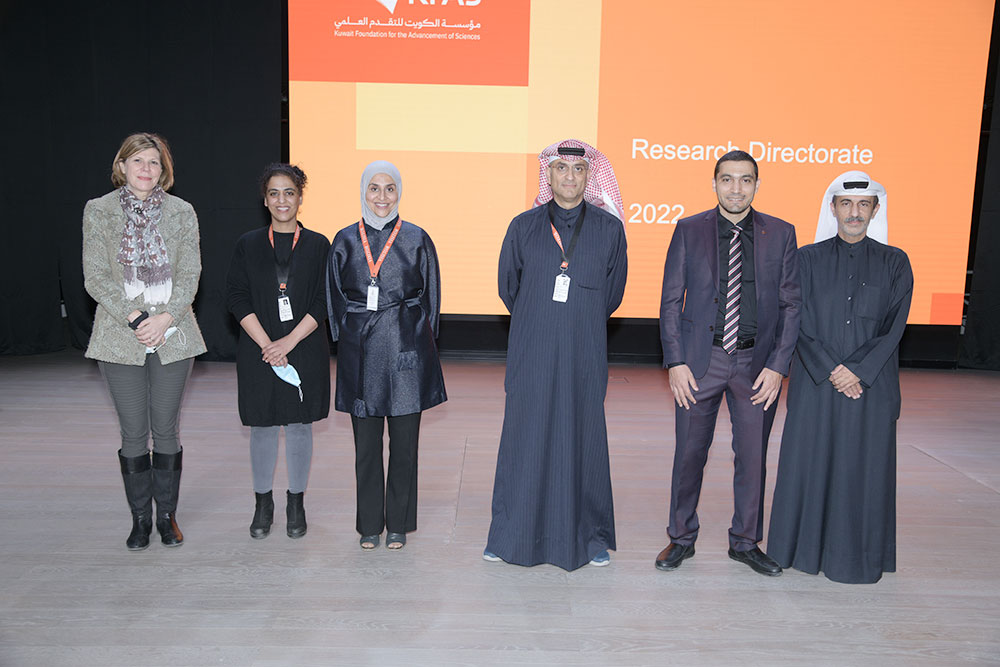
The Office of Research and Grants at AUK organized an event entitled, KFAS Programs for Research and Development. Held in the University’s campus, the event was presented by a team from the Kuwait Foundation for the Advancement of Sciences (KFAS) that included, Dr. Maitham Safar, consultant and acting manager for the Research Grant Program; Dr. Ibtisam Hassan, manager of the Research Capacity Building Program; and Khaled Alawadhi, manager of the Research Support Office. The event sought to introduce the campus community to the various research programs offered by KFAS.
AUK president, Dr. Rawda Awwad welcomed the KFAS team and thanked them for collaborating with AUK as this would encourage more faculty, staff, and students to apply for the offered research grants. The director of the Office of Research and Grants, Dr. Iyad Abu Doush began the event by emphasizing AUK’s support for faculty, staff, and students in conducting research.
The KFAS team then proceeded with a presentation that outlined the research development in the foundation and introduced the new call for research proposals. This included the call for basic and applied research proposals as well as the call for young researcher proposals. The strategic objectives were to generate high-quality research, support and foster sustainable solutions to issues of national priority, and facilitate best research practices at institutional levels.
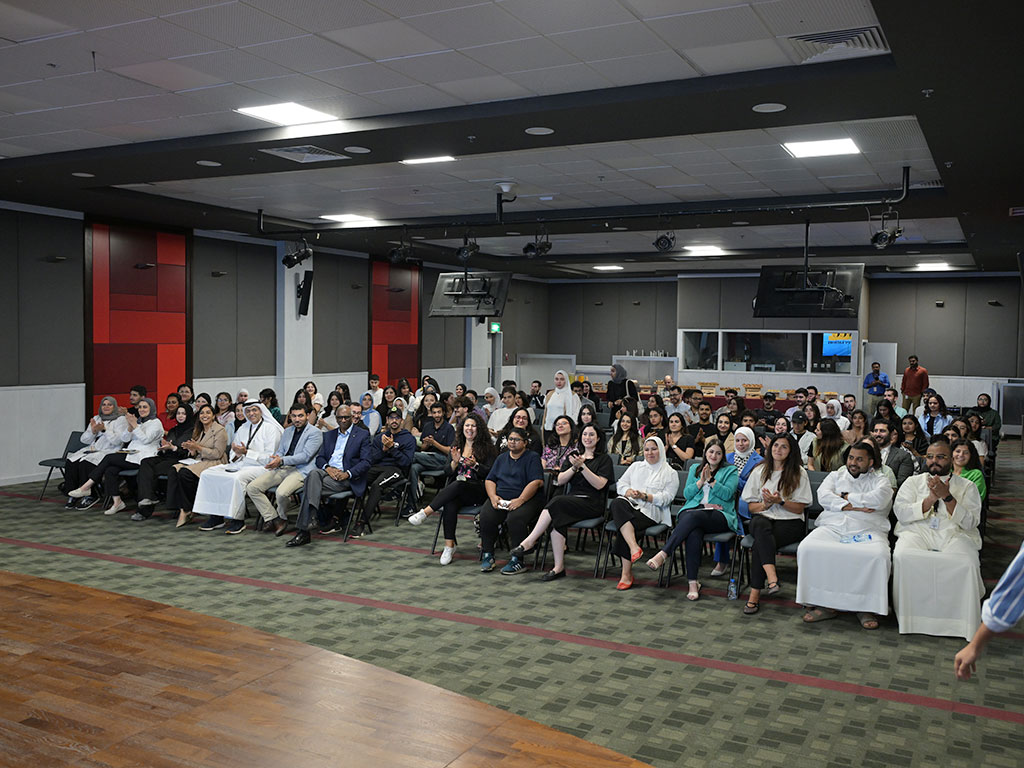
Concluding the event, Dr. Maitham Safar answered some questions about the KFAS research application and process asked by the faculty and staff who attended the event.
AUK president, Dr. Rawda Awwad welcomed the KFAS team and thanked them for collaborating with AUK as this would encourage more faculty, staff, and students to apply for the offered research grants. The director of the Office of Research and Grants, Dr. Iyad Abu Doush began the event by emphasizing AUK’s support for faculty, staff, and students in conducting research.
The KFAS team then proceeded with a presentation that outlined the research development in the foundation and introduced the new call for research proposals. This included the call for basic and applied research proposals as well as the call for young researcher proposals. The strategic objectives were to generate high-quality research, support and foster sustainable solutions to issues of national priority, and facilitate best research practices at institutional levels.
Concluding the event, Dr. Maitham Safar answered some questions about the KFAS research application and process asked by the faculty and staff who attended the event.
AUK president, Dr. Rawda Awwad; Director of the Office of Research and Grants, Dr. Iyad Abu Doush with KFAS representatives