

News
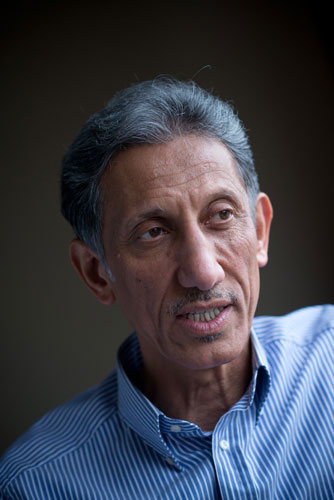
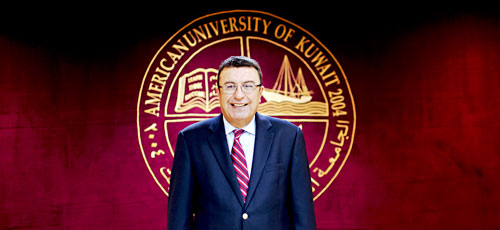
The American University of Kuwait's Board of Trustees has voted unanimously to appoint Interim President and Provost, Dr. Nizar Hamzeh, the 4th president of AUK, during an executive session of the board on Sunday, January 26, 2014.The unanimous board action signaled a strong and clear endorsement for Hamzeh, who has been instrumental in leading and advancing the mission of the university during his tenure as Interim President and Provost.
"This is an exciting time for the American University of Kuwait," said Dana Nasser Al-Sabah, Chair of AUK's Board of Trustees. "To take such a decision on the eve of our 10 year anniversary is a sign that we are embarking on our second decade of accomplishments in full force. Nizar Hamzeh brings an exceptional portfolio of scholarship and leadership to the University and, just as importantly, a tremendous commitment to AUK's mission and vision. He has done a great job in his post as Provost and Interim President and I am confident Nizar will lead the University into its next decade of academic excellence and public impact."
Hamzeh, who is a Professor of Political Science and International Law, joined AUK in 2005. He is an internationally recognized authority on the culture and politics of Lebanon, with special focus on the development of Hizbullah and Islamist movements across the Middle East.
Hamzeh has risen through the ranks of academic and administrative positions in higher education. Before joining AUK, he was a lecturer at the University of Southern California from 1987 to 1989, a member of the faculty at the American University of Beirut from 1989 to 2004, where he also served as the Political Science Department Chair from 1990 to 1999, member of AUB Senate from 1997-1999, and Dean of Student Affairs from 1999 to 2000.
"I am extremely grateful to the board of trustees for their vote of confidence and for giving me the opportunity to lead this extraordinary institution by working closely with them in the best interest of the university. As we celebrate AUK's 10 year anniversary, together we renew our commitment to continue providing AUK with excellence in teaching, research and service." Hamzeh said.
A 1979 graduate of the Lebanese University Faculty of Law, he pursued graduate studies at the University of Southern California, Los Angeles, receiving his M.A. and Ph.D. degrees in Political Science in 1982 and 1986, respectively.
Hamzeh is the author of "In the Path of Hizbullah", published by Syracuse University Press, December 2004, a work that received the U.S. Choice Magazine Outstanding Academic Book Award in 2005. He has co-authored two other volumes on Lebanese Politics, and his articles appeared in scholarly and internationally refereed journals such as International Journal of the Middle East (IJMES), Third World Quarterly, and Middle East Quarterly. His research work is also published by the Center for Strategic and International Studies (CSIS), Washington D.C. Hamzeh is a recipient of Senior Fulbright Scholar in 2001 and Fulbright Scholar Expert in 2003.
"Every day, I am inspired by the passion, dedication, and commitment of our faculty and by the accomplishments of our students and alumni and by the dedication of our staff, and the support of our friends; in Kuwait and around the globe. As I begin my new work and responsibility, I ask of each of you your help and support for taking AUK to the next level. It's not where we are today, but where we will reach tomorrow that matters." Hamzeh said.
Released by the Office of Public Affairs on the 6th February 2014
Photography by the Office of Public Affairs (C) 2014
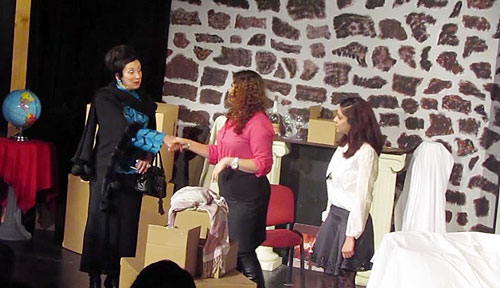
The Drama Program at the American University of Kuwait (AUK) staged its annual Fall theatre production, Paul Rudnick's I Hate Hamlet, at the Black Box Theatre, located on AUK's campus. The play was directed by Assistant Professor of Theatre and Drama, Dr. Kathleen R. Downs, under the auspice of the Music and Drama Department.
Rudnick's play centers on answering the question; "What is great Art?", and tells the story of a successful television actor, Andrew Rally, who was offered the role of a lifetime to play Hamlet, and his internal conflict with whether or not he should accept this role.
The production included performances by veteran AUK actors Khalid Ghaffar, Eamon Issa, and Alison Koushki, as well as newcomers to the University's theatre community Nada Helmy, Natasha Sharma and Samer Abou Zeid.
This play is set inside an apartment that was once owned by famed and deceased actor John Barrymore, whose ghost is a character within the play. As such, the production crew, which included veteran AUK thespians Dana Mann as Stage Manager, Rateb Shehadeh as Assistant Stage Manager and Understudy to Mr. Zeid, with the help of Ken Downs as Lighting Designer, relied on lighting, costumes, special effects, sounds and stage props to set the moods in the various scenes of the play. This was made possible with the help of some newcomers to the backstage crew, such as Mohammad Hazem, Sondos Al Kansby, Natalie Abu Nassar, Fadi Al Bouni, Abdulmajid El Kassem, Nasser Jadaxel, and Amr Abdulraheem.
The Department of Music and Drama offers a wide range of opportunities for both beginning and advanced students within the context of a liberal arts education. The Music and Drama faculty of talented professionals work closely with students to prepare them for campus concerts and plays, and to academically challenge them in courses on performing arts. The department fosters artistic proficiency, cultural appreciation, a sense of community, and a lifelong commitment to the arts.
The AUK community enjoyed entering the magical world of theatre and actors for four sold-out performances. They look forward to the next theatrical event, planned for this Spring semester.
Released by the Office of Public Affairs on the 3rd February 2014
Photography by the Office of Public Affairs (C) 2014
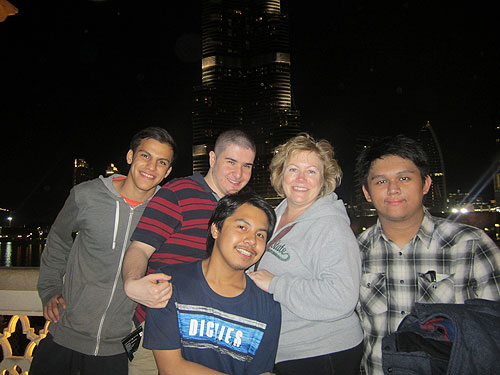
Students from the American University of Kuwait (AUK) recently participated in the 13th Regional Inter College Environmental Public Speaking Competition in Dubai. The Competition, which was sponsored by the Emirates Environmental Group (EEG), was held in Knowledge City, where the AUK team comprising of Vincent Puyat, Jad Saab, and Hussain Al-Sayegh, with Emannoel Cabildo on technical support, earned the Second Runner Up title for their presentation "Global Challenges - Local Solutions".
AUK was the only school to represent a university from Kuwait and the teams took great pride in representing their university, as well as the state of Kuwait. The students were accompanied to by their coach, Lisa WaiteTrago, Speech and faculty member of AUK's Intensive English Program (IEP). This year's AUK team was honored to receive coaching at home with former competition coach Don Prades, Speech and IEP faculty.
The students were chosen from the first round elimination after spending their summer months researching their assigned environmental topics. The final teams spent many hours last fall compiling research, writing, designing visuals and memorizing their speeches, while also working on their stage presence and speaking skills.
"This was a learning year for our teams," stated WaiteTrago. "I couldn't be more proud of these four AUK students. They worked countless hours in perfecting their environmental messages and all of them were well received at the competition."
WaiteTrago pointed out that many of the schools had 5-8 member teams who worked together on research, writing, visuals and stage presentations. In addition, other teams thanked the campus departments that assisted in the final presentation. In contrast, the AUK students were fully responsible for every single aspect of their speeches - a fact they are proud of.
Puyat's presentation included a heartfelt tribute to the victims of Typhoon Haiyan. Puyat and Cabildo, both Filipino nationals, dedicated their presentation to their country and the thousands of people who died in the disaster. They urged listeners to be mindful of the effects of Global Warming and the devastation inaction can cause for future generations.
Al-Sayegh presented his topic, "Who Left the Tap Open" where he explored the responsibility of water waste in the GCC region and solutions for reducing the waste. Meanwhile, Saab explored "Arts and Environments: How Art Can Help Our Environment." The students enjoyed interacting and competing against teams from Saudi Arabia, Bahrain, Qatar, Oman, and the Emirates.
The students and their coaches feel indebted to many people at AUK who funded and supported the team throughout the seven month preparation. Special thanks go to Dr. Craig Loomis, English Department Head and Dr. Carol Ross, Vice President of Student Affairs.
"Hopefully, next year we will be able to go to the competition and be even better prepared to represent AUK and help carry forth their inspirational environmental messages," stated WaiteTrago. "We were pleased to have the three teams from the American University of Kuwait at this year's competition," said Habiba Al Marashi, Chairperson EEG and Board Member of the UN Global Compact. She added, "I am sure it has raised the curtain effectively on the talents and capabilities of our youth and earned them a deserving place in the movement to protect and preserve our environment. We at EEG hope that the teams will keep up their pro-active involvement in environmental programs and continue to advocate for education for sustainable development in the region."
Released by the Office of Public Affairs on the 19th January 2014
Photography by the Office of Public Affairs (C) 2014
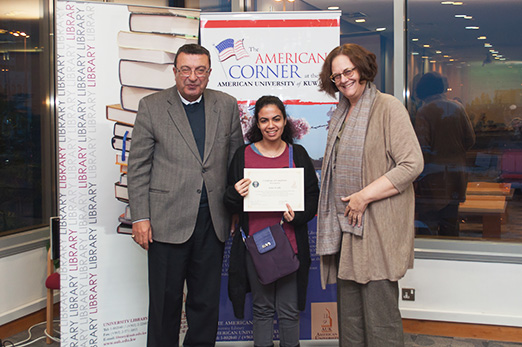
On January 9th, the American Corner at the American University of Kuwait (AUK) Library hosted a ceremony to honor the very first group to complete a Massive Open Online Course (MOOC). The course was entitled "21st Century American Foreign Policy" and was offered by Dr. Bruce Jentleson of Duke University. Dr. Nizar Hamzeh, AUK Interim President, Dr. Lisa Heilbronn, the Counselor for Public Affairs at the Embassy of the United States of America, and Dr. Gholamreza Vatandoust, an Associate Professor at the Department of International Relations, attended the ceremony.
Ms. Asma Al-Kanan, Library Director and the Coordinator of American Corner Activities, welcomed everyone and spoke of what has been achieved over the past few months, emphasizing the importance of continuing education and the potential MOOCs offer to revolutionize the world of academia. She then invited Farah Al-Shamali, one of the graduates who completed the online course and managed the group, to speak about the experience on behalf of herself and her colleagues. She explained that this was a rare opportunity - to be given a chance to create a new knowledge base instead of simply taking in information already accepted as such. Also, participating in discussion threads on varied issues with students around the world proved to be an enlightening experience.
The three AUK alumni; Radia Al-Afili, Dalal Marafie and Farah Al-Shamali, were presented with certificates to signify their successful accomplishment. President Nizar Hamzeh expressed his pride in the alumni who participated, and in AUK offering such opportunities that encourage critical thinking and urges other AUK students and graduates to follow in their footsteps.
Ms. May Katkhuda, Director of Information Resource Center
at the U.S. Embassy;
Ms. Asma Al-Kanan, Library Director and the Coordinator of American Corner Activities;
Dr. Nizar Hamzeh, AUK Interim President; AUK Alumna Radia Al-Afili;
AUK Alumna Farah Al-Shamali;
Dr. Lisa Heilbronn, Counselor for Public Affairs at the Embassy of USA;
Dr. Gholamreza Vatandoust, Associate Professor of International Relations.
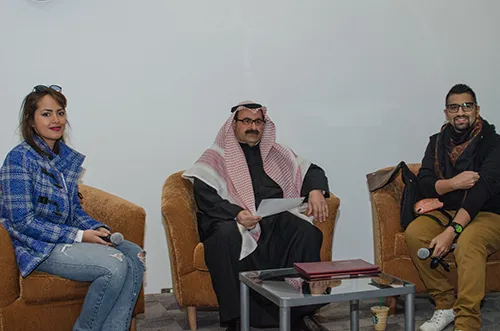
The Kuwait Media Club at the American University of Kuwait (AUK) invited Ali Najem, from Marina FM, and Nouf Al-Muthayan, from Kuwait Public Radio Station, to hold a discussion on life in the Communications and Media industry in an event entitled "Know Media". The event was open to members of the AUK community and the public. The event provided the attendees and the hosts with a forum to speak freely about media in Kuwait, giving all those present an opportunity to criticise or praise the current practices in the industry.
One of the issues raised was the difference between public and private media outlets in Kuwait, especially when it comes to freedom of expression and censorship. The guests shared their personal experiences within the private and public media, noting that private radio and TV in Kuwait offers more space for freedom of expression. According to Najem, cultural barriers play an important role in determining what can and cannot be said on air. Al- Muthayan recalled several situations when she was required to "filter" her sentences when she worked in public radio. The topic of censorship triggered a heated debate where students expressed their views on censorship in the media.
The discussion also shed light on necessary qualities and attributes required to become a successful media person. According to Al-Muthayan, a combination of factors contributes to success in the field of media, the most important of which is building specialized knowledge in specific area of interest. A media person should "find his niche", she advised; whether it is in science, sports, or social affairs. A media person should have a strong background knowledge about the area of interest he/she wishes to pursue as a TV/Radio journalist; "this is what builds talent" according to Al-Muthayan. The ability to engage one's listeners while speaking is an important skill to master when seeking a job in TV/Radio journalism. "Take every course you can find about public speaking," said Al-Muthayan addressing the communication students, this will build confidence and enhance self-expressivity needed for any media person who goes on air, according to Al-Muthayan.
The "Know Media" event is one of the Kuwait Media Club initiatives that aims to bridge the gap between the academic and professional practices of journalism. "It is very important to expose the COMM students to the professional life of Media in Kuwait. I repeatedly hear the students' questions on how the theories we study in class apply in real life. These talks by experts in the field answer many inquiries. In addition, they help undeclared students to finalize decisions on their academic paths," said Dr. Mohammed Akbar, Assistant Professor of Mass Communication and Media, and Advisor to the Kuwait Media Club.
The American University of Kuwait (AUK) is an independent, private, equal opportunity, and co-educational liberal arts institution of higher education. The educational, cultural and administrative structure, methods and standards of AUK are based on the American model of higher learning. The language of instruction is English. More information on the American University of Kuwait can be found at http://www.auk.edu.kw
Nouf Al-Muthayan
Ali Najem
Ahmed Al Refai, President of Kuwait Media Club
Dr. Mohammed Akbar, Assistant Professor of
Mass Communication and Media, and Advisor to the
Kuwait Media Club at AUK.
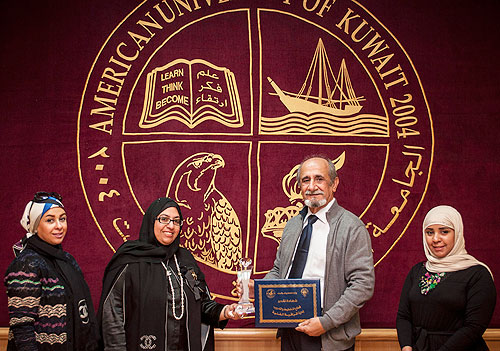
For the 6th consecutive year, the American University of Kuwait (AUK) received the Ministry of Electricity and Water (MEW) Award for Energy Conservation. AUK has been receiving MEW awards since 2008 on their collaborative efforts with the ministry on energy conservation.
Abolghasem Alavinejad, Director of Campus Services at AUK, commented on this achievement saying "We must think globally, and act locally to save energy and support the MEW energy conservation team".
The MEW relationship with AUK started when a team of ministry representatives visited the AUK campus in 2007 to inspect and provide advice on their energy conservation campaign. The visitors were impressed by how the Campus Services Department at AUK had already been applying energy conservation practices including, using light-emitting diodes, controlling the usage, and preventing energy loss. According to Alavinejad, this year AUK has taken further steps by replacing all campus outdoor lightings with low consumption LED lights, and changing all the air-conditioning systems filters with advanced foam filters.
In continuation of its energy conservation efforts, the campus services Department at AUK maintains collaboration with MEW by sharing experience, data, and information on energy conservation methods.
Released by the Office of Public Affairs on the 9th January 2014
Photography by the Office of Public Affairs (C) 2014
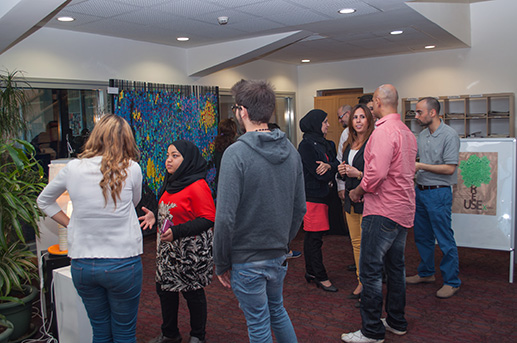
The American University of Kuwait (AUK) will be participating in the REUSE Recycled Art Competition held at the Avenues Mall between 9-11 January.
During the exhibition, twelve AUK students will showcase their artwork. The artworks are made of reused or re-purposed materials that promote environmental conservation. Most of the artwork has been created in Art and Graphic Design Department Professor George Bauer's courses, however any AUK student could enter work.
The participating artwork was selected based on a competition held last month at AUK. The finalists will compete against other local universities next week for the Kuwait grand prize, which will be awarded to the most creative and well produced exhibited work. The winner(s) will be determined through public voting at the exhibit.
The AUK delegation, led by Professor William Andersen of the Art and Graphic Design Department, will consist of the following 12 students:
- Jumana Al-Refei - Old is Gold
- Mohammed Al Hamad - Caffeinated Light
- Ahmed A Mohammed - Robot Attack Elite Force
- Maitha Al Jassmi - Thinking Silver
- Manal Adra - Pixelated Starry Night (currently on view at the AUK Library)
- Tamara Hamzah - Wire Tree
- Dalal Ali - Party Light
- Afnan Al Sendi - Clip it On
- Moustafa El Khashab - Metallic Stallion
- Fanar Al-Obaid - Carambar-ized Fortune Teller
- Farah Madi & Ahmad Hamzah - Cobra
REUSE is a program initiated by en.v - an initiative dedicated to promoting social responsibility in the Arab world, in partnership with Zain Telecommunications to promote environmental sustainability and community participation in Kuwait. The program includes activities such as educational roadshows and competitions, community events, online environmental campaigns and workshops that will take place throughout the year. The exhibit will be open at The Avenues Phase III (between Bath & Body Works and Puma, as well as between Faces and Perfumerie d'Exception)from 10AM to 10PM starting Thursday, January 9th and will continue until Saturday, January 11th of 2014.
Released by the Office of Public Affairs on the 9th January 2014
Photography by the Office of Public Affairs (C) 2014
The Scratches of Syria initiative, in cooperation with Syria Club at AUK held a short movie evening where they played movies reflecting the humanitarian situation in Syria. The movies shown were by Syrians directors, including Nader Makki (Death Time Story), Wessam Khwaji (Assi Alhawan), Kotaiba Al-Khoos (Love in a Hurry), Bassel Chehadeh (Saturday Morning), Taeem Henawe (Where are they?) and Abdulrahman Nahlawi (Darwash).
The movies carried different messages reflecting the life of Syrian children during the war, the new street language and war terminologies, and the life of refugees away from home. The evening ended with a movie rating by the audience.
For the second consecutive year, Scratches of Syria maintained its unbiased political stance, a practice it always emphasized since the launch of its first event last March. Supporting this position, Enas Al-Halawani, Scratches of Syria Coordinator stressed that "the Most Important matter right now is that Syrians get along together and forget about their political views because the existing fragmentation among Syrians is the main reason behind their weakness". Mohammad Naji, Scratches of Syria Coordinator, also agrees with the same argument confirming that "focusing on the armed solution makes us forget who are fighting and why we are fighting". Naji also added that "Scratches of Syria started and will keep following this trend of focusing entirely on the Syrian humanitarian situation". The event ended by announcing the upcoming Scratches of Syria event next March 2014.
Released by the Office of Public Affairs on the 7th January 2014
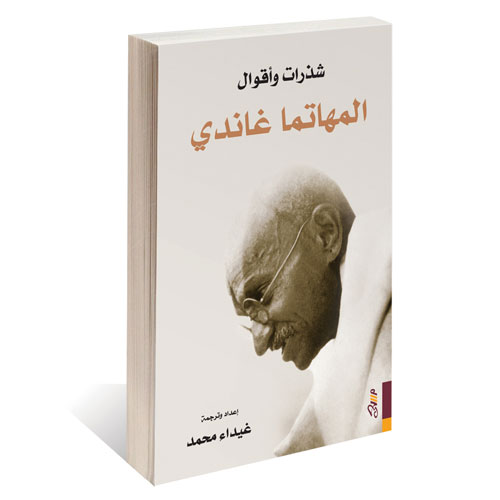
Excerpts and Sayings by Mahatma Gandhi, is newly published book by Ms. Ghaidaa Mohamad, Instructor for the Department of Arabic and Foreign Languages, that translates Gandhi's most famous sayings to Arabic. The book, which is published by Masaa Publishing, Bahrain, covers a variety of topics the assassinated leader came across during his intellectual and philosophical journey.
Excerpts and Sayings by Mahatma Gandhi summarizes many of Gandhi's ideas, whether related to education, economy, peaceful resistance, ethics, education, and industries, in addition to his views on relationships between cities and villages.
The 130 page book has excerpts selected by the author that reflect Gandhi's life philosophy in general, and contains images of Gandhi taken throughout his life. One chapter discusses his ideas on proper nutrition, while another chapter discusses his belief in God. "By reading this book we can live the deep Indian philosophy that believes in a different relationship with beings and things," says the author.
In one of the excerpts Gandhi says:
I am a part and parcel of the whole and I cannot find Him apart from the rest of humanity. My countrymen are my nearest neighbours. They have become so helpless, so resourceless, so inert that I must concentrate myself on serving them. If I could persuade myself that I could find Him in a Himalayan cave I would proceed there immediately. But I know that I cannot find Him apart from humanity.
Excerpts and Sayings by Mahatma Gandhi was released and sold by Masaa Publishing in the annual Book Fair in the Kuwait International Fair Grounds in Mishref earlier in November 2013.
Released by the Office of Public Affairs on the 7th January 2014
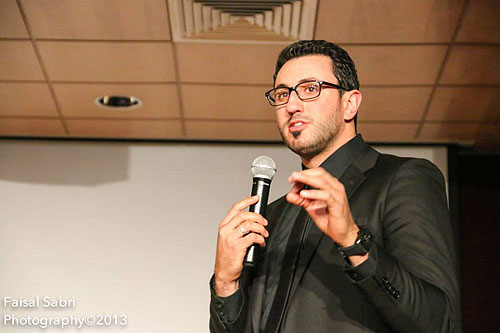
The Department of Arabic and Foreign Languages at AUK is releasing a new Arabic course in Creative Writing. The new course, which will be offered starting Spring 2014, introduces students to the skills of writing the genre of the short story and novel. The objective of the course is to help students develop critical appreciation of the social role of literature, as well as a comparative knowledge of outstanding examples of short story and novelistic writing from Kuwait, the Arab world, and the world at large.
For the first time, the course will be taught by the distinguished Kuwaiti author Taleb Al-Refai, whose novels and stories are known for their with contemporary analysis of social issues in Kuwait and the Gulf region, such as the situation of foreign laborers ("Shadow of the Sun," 1998), the independence of the writer and the necessity for artistic freedom ("The Garment," 2009), the rise of consumerism ("Minor Thefts," 2010), and the situation of women ("Kawthar," forthcoming 2014).
'We are very excited to offer this Arabic Creative Writing course to our students. The course will emphasize the process of creative writing. It will start with a review of the main elements of stories and novels, and then lead into a series of workshops, which will give the students the opportunity to write short stories and chapters of novels on their own. After receiving feedback from Mr. Al-Refai, students will be encouraged to seek publication for their writing. This is a unique opportunity for our students to learn about writing Arabic fiction from a master of the craft," said Dr. Raymond Farrin, Department Chair and Associate Professor of Arabic & Foreign Languages at AUK.
Released by the Office of Public Affairs on the 7th January 2014
Photography by the Office of Public Affairs (C) 2014