


News
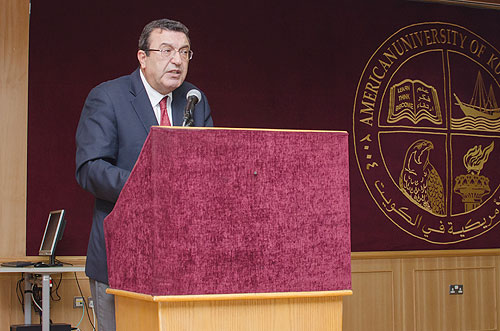
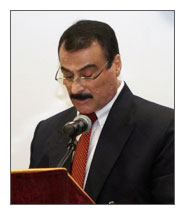
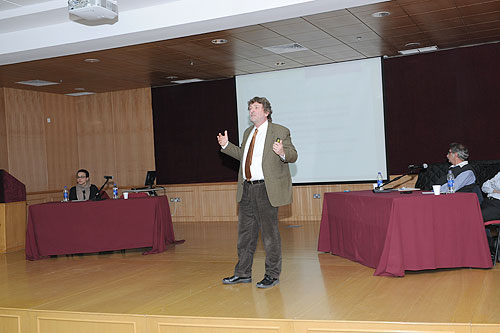
As part of the ongoing Faculty Speaker Series organized by the College of Arts and Sciences at the American University of Kuwait (AUK), Dr. Ghazi Nassir, Associate Professor of English, gave a talk to discuss how English literary figure Samuel Johnson's prejudices towards Arab and Islamic cultures are revealed through his various works. The talk was open to all members of the AUK community.
Dr. Nassir, who authored the book Samuel Johnson's Attitudes Toward Islam; A Study of His Oriental Readings and Writings, argued in his talk that Johnson's depictions and opinions of Islam and Muslim cultures in his works reflect prejudices he had towards the religion and its founder. "He, a Tory and an Anglican, was temperamentally hostile to Islamic culture, particularly to the Prophet Muhammad and Muslims; he never purposed to write a flattering tribute about Islam, Muslims, and their culture," explained Dr. Nassir.
However, Johnson's views were not only apparent in his writings; they were also clear from his conversations. Dr. Nassir stated that his conversations also provided an explicit indication of Johnson's tendency to be racially discriminating and display him as having an attitude of superiority. James Boswell wrote Life of Johnson, a biography of his personal acquaintance [Johnson]. In the biography, Johnson tells Boswell "There are two objects of curiosity-the Christian world and the Mahometan world".
According to Dr. Nassir, Johnson did not rate that world highly in either his conversations or his writings. "In fact his attitude toward Islam and Islamic culture stemmed more from his odious opinions of Islam and its followers than from his scholarly interest," he said.
The Faculty Speaker Series was initiated by, Dr. Rawda Awwad, Interim Dean of CAS, to commemorate AUK's 10th Anniversary. The program is coordinated by the CAS Faculty Speaker Series Committee, including Professors Maryam Hosseinnia, Mohamed Satti, and Raymond Farrin, who are also planning for a sequence of book presentations this semester, which will include talks by faculty members who recently published books. Signed copies of the authors' books will also be made available during the events.
Released by the Office of Public Affairs on the 27th March 2014
Photography by the Office of Public Affairs (C) 2014
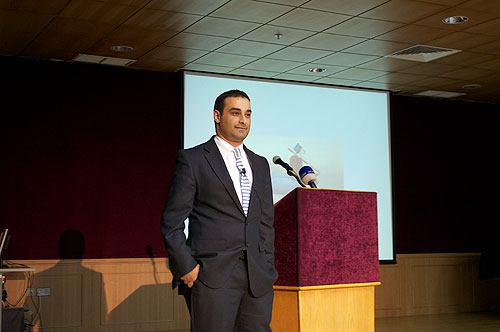
As part of the celebrations of International Week at the American University of Kuwait (AUK), the International Relations Club at AUK invited the Ambassador of Spain to Kuwait, His Excellency Mr. Angel Losada Fernandez, to give a talk about Spain's 50-year long standing relationship with Kuwait. The Ambassador's talk was attended the president of the University, Dr. Nizar Hamzeh, and was open to the members of the AUK community.
Ambassador Fernandez began his lecture by explaining the close historical ties shared between Spain and the Arab world. The 700 years of Arab presence in Spain left a significant impact culturally and linguistically, which has facilitated cross-cultural exchange over the years, and led to opportunities for joint projects. This paved the path for the existing relationship between Kuwait and Spain.
Over the past 50 years, Kuwait and Spain have collaborated in several areas. One of the recent joint projects the ambassador mentioned was the restoration of historical documents for the Spanish library. Kuwait has committed to fund the restoration of some of the historical documents of the Library, which include an old edition of the Holy Quran.
In addition to the existing areas of collaboration, Ambassador Fernandez shared his hopes for expanding Spanish language studies and student exchange programs between Kuwait and Spain in the future, confirming that his country is working towards facilitating procedures to visit to Spain.
Released by the Office of Public Affairs on the 25th March 2014
Photography by the Office of Public Affairs (C) 2014
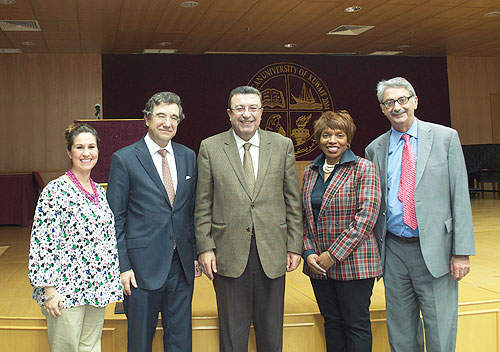
The Arabic Literature Club in collaboration with the Department of Arabic and Foreign Languages at the American University in Kuwait (AUK) organized a lecture on early Sufi poetry and music, delivered by professor of Arabic studies at the American University in Beirut, Dr. Bilal Orfali, author of several studies in the field of Arabic literature, with emphasis on the relationship between poetry & music and Sufism, known as "Sufi Sama'."
Dr. Orfali began his lecture with a musical piece from a Sufi group in Morocco, which embodies the poem 'Leila' by Qais bin Al-Mullawah combined with Ottoman Turkish music. Dr. Orfali explained the piece of music showing that Sufis used poetry and music to express their love of God, adding that they have turned courtly poetry into Sufi poetry, representing Leila, the beloved woman, as a sublime symbol.
Orfali also addressed the history of Sufism, explaining that "the Sufi movement became prominent during the 4th Islamic Century," to become one of the Islamic schools of thought after the death of Prophet Mohammed (PBUH)." Interpretations around the origin of the term 'Sufism' varied; some linked the name to wool (Suf in Arabic), others to wisdom and serenity. According to Orfali, Sufis did not stop at studying Islamic jurisprudence, but also expanded their studies to the basic doctrine, searching for "the great truth, God". Later on, Sufis branched into sects, some of which called for modesty in life and 'jihad' of the soul, while others resorted to reason, logic, and law. Other sects were known with the practice of spiritual drunkenness, while a number of them chose the principle of self-blame and concealment. It has also been documented that some Sufis were keen to master particular professions to avoid the social stigma of being perceived as taking their love of God as a source of income.
Orfali also put forward that Sufi poetry represents the intersection between literature and Islamic studies, explaining that Sufis also flourished as writers and poets, examples include Al-Hallaj, Al-Ghazali and Al-Rumi, who is well known in the West. Nevertheless, "the Sufi poetry has not received considerable attention, but has faced a state of negligence, because it is not considered as literature, but a science that does not fall within the confines of literature. This explains the lack of study of Sufi poetry, which has been classified out of the classical literary heritage."
The Arabic Literature Club at the American University of Kuwait is a student organization interested in different aspects of the Arabic language and culture such as Arabic poetry and literature. The main purpose of the Club is to reveal the Arab identity and practice Arabic language at AUK. Most of the club events currently focus on Arabic literature and poetry. The Arabic Club aims to host more cultural events that would include Arabic music and hosting of famous experts in the Arabic language to share their experience and thoughts with the students.
Released by the Office of Public Affairs on the 23rd March 2014
Photography by the Office of Public Affairs (C) 2014
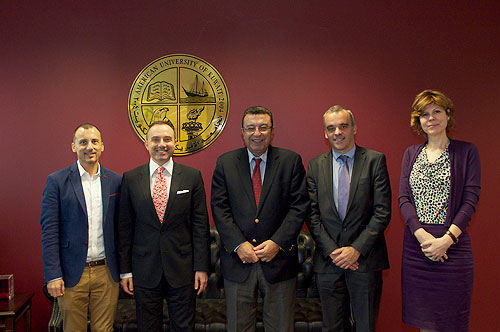
On the occasion of the International Week of La Francophonie, the Department of Arabic and Foreign Languages at the American University of Kuwait (AUK) invited His Excellency the French Ambassador to Kuwait, Mr. Christian Nakhlé, along with the embassy's Cultural Counselor, Mr. François Brossard to launch an exhibition of scrapbooks created by students from a French class of Professor Joseph Fiannaca, AUK Senior Instructor of French Language and Literature. The Exhibition took place at the AUK Library, and was attended by Dr. Rawda Awwad, Interim Dean of the College of Arts and Sciences, and Ms. Asma Al Kanan, Director of the AUK Library.
Upon their arrival to AUK, the Ambassador and Cultural Counselor met with AUK President Dr. Nizar Hamzeh, and Dr. Awwad, where they discussed possible collaboration opportunities, including the possibility of offering a French Minor at the University. During the meeting, the Embassy expressed it's commitment to provide support should the minor be created.
Following the meeting with the President, Dr. Awwad accompanied the visitors in a tour in the AUK Library where Ms. Al Kanan showed them the collection of French resources available to the AUK community prior to launching the students' exhibition.
The exhibition showcased scrapbooks created by students from Professor Fiannaca's Intermediate French class as a final class project. The project required the students to construct scrapbooks based on characters they created who spend one month in a French language institute in a city in France. Each student was required to select a different city and institute, conduct research on them, and create diary entries and postcards to family and friends, among other scrapbook staples.
"The purpose of this project and such assignments was to give our students the opportunity to express their personal and artistic skills, as well as their French reading and writing skills," said Professor Fiannaca.
As part of their visit, the Ambassador and Cultural Counselor were invited to attend one of Professor Fiannaca's classes. During the session, they interacted with the students and informed them about the variety of activities organized by the French Institute of Kuwait, and finally take some time to participate in a quiz on La Francophonie.
The International Organization of La Francophonie represents one of the biggest linguistic zones in the world which organizes political activities and actions of multilateral cooperation that benefit French-speaking populations. This year, the International Week of La Francophonie coincided with AUK's own annual International Week.
Released by the Office of Public Affairs on the 23rd March 2014
Photography by the Office of Public Affairs (C) 2014
To participate in the worldwide celebrations of International Women's Day, the Division of Student Affairs at the American University of Kuwait (aUK) organized activities and lectures to educate women on how to maintain their outer beauty, to embrace their inner beauty, and to celebrate successful women from the local community. The activities also included an opportunity for attendees to test their driving skills.
Sephora, one of the leading cosmetics stores in Kuwait, organized an event called Belle of the Ball. At the event, guests were introduced to products that will help them take care of how their outer beauty. Beauty experts discussed fragrances and make-up, as well as ways to maintain healthy hair and skin.
Eating habits and healthy lifestyle routines are important to manage and maintain healthy skin. Dr. Zainab Akbar Ashkanani, Dermatology Resident at the Asaad Al Hamad Center, was invited to share with the students the intricate details of skin care while focusing on the importance of healthy living and advised on the latest products on the market designed to minimize skin flaws. She stressed the importance of cleansing, moisturizing and using sunblock to prevent future skin damage.
In addition to educating women on maintaining their outer beauty, Ms. Joanne Hands, Clinical Director of Kuwait Counseling Center, was invited to speak with the guests about the importance of inner beauty. She explained how inner beauty is a positive trait which women should be proud to have attributed to their character. "Inner beauty doesn't really need makeup. It is so important to respect and like yourself before you ask others to do so," she added, indicating the vital role a woman has in identifying her own positive attributes.
The International Women's Day activities also included paying tribute to successful women in Kuwait, such as Bibi Al-Sabah, Founder of Kuwait Healthy Living, Zahra Taqi, Founder of Milestones Coaching, and Maryam Al-Nusif, Co-founder of Shakshooka Market. The list also included widely admired AUK graduates, like comedienne Shaikha Al-Khaldi, political researcher Wafiqa Al-Mulla, and founder of The Yard, Ala'a Ali Redha. "It was a great opportunity for AUK to recognize those great women and their positive impact on the young women," said Dr. Carol Ross, Vice President of Student Affairs.
Activities of the day also included an obstacle driving course for people to test their driving skills and understand the importance of driving responsibly.
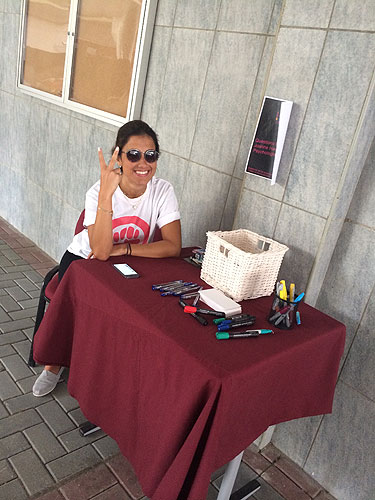
The entire campus community had an opportunity to participate in the activities of the day and take some time to acknowledge women they respected by inscribing names and dedications on the "Women We Admire" board.
Released by the Office of Public Affairs on the 16th March 2014
Photography by the Office of Public Affairs (C) 2014
The International Relations program (IR) at AUK hosted a two-session event designed to acquaint a group of 25 visiting students and faculty, from the American University of Paris (AUP), with Kuwait. The purpose of the visit was to investigate and compare the states of Kuwait and Qatar, to which the AUP group will travel next.
In the first session of the event, IR faculty comprised a panel discussion by Professors Farah Al-Nakib, Hesham Al-Awadi, Roman Kulchitsky and George Irani. Each made short presentations on different aspects of Kuwait, including history, politics, political economy, and regional politics. In his presentation, Dr. Al-Awadi referred to the Kuwait's unique constitution and young population, which, he suggested, can be reasons for people to feel optimistic, despite current problems in Kuwait and the region.
Building on that sentiment, the second session of the evening brought 25 of AUK's IR students together with those from AUP for a roundtable discussion about various aspects of life in Kuwait. The IR students represented AUK's diverse population and included Kuwaitis as well as foreign nationals, who could provide their own perspectives of Kuwait and the region. Topics discussed included the welfare state, Iraqi Invasion, the environment, expatriates, employment, the future of oil, and Gulf weather. AUP students also discussed the issue of religion and politics in France and specific restrictions that affect Muslims in the country, including laws regarding the wearing of religious items, such as the headscarf (veil).
Like AUK, the American University of Paris follows the best elements of the American university model-small, discussion-based classes; a collaborative relationship between students and faculty; a special emphasis on critical thinking and clear communication. This visiting group was under the direction of Dr. Hall Gardner, AUP Professor of International and Comparative Politics.
AUK's Department of IR boasts some of the highest program admission standards at AUK and produces articulate and well-rounded global citizens. It's faculty are dedicated to teaching skills in critical and perspectival thinking, problem solving, communication, research and teamwork. Information about AUK's IR Program can be found at www.auk.edu.kw/academics/cas/internation_relations_main.jsp.
Released by the Office of Public Affairs on the 6th March 2014
Photography by the Office of Public Affairs (C) 2014
The American University of Kuwait (AUK) took first-place in the REUSE Recycled Art Competition, an initiative launched by en.v, an organization dedicated to promoting social responsibility and environmental sustainability in the Arab world, in partnership with Zain Telecommunications, to promote environmental sustainability and community participation in Kuwait.
AUK submitted eleven pieces created by students as entries for the competition that promotes environmental conservation. The artworks were created from reused or repurposed materials, and were nominated to participate in REUSE based on a competition held at AUK in December.
286 entries were made for the REUSE competition by students from eight local schools and universities, but only the top 50 entries were invited to participate in the final stage of the competition, which was held at the Avenues Mall.
The AUK delegation, led by Professor William Andersen of the Art and Graphic Design Department, submitted eleven entries created by the following 12 students:
-
-
Jumana Al-Refei - Old is Gold
-
Mohammed Al Hamad - Caffeinated Light
-
Ahmed A Mohammed - Robot Attack Elite Force
-
Maitha Al Jassmi - Thinking Silver
-
Manal Adra - Pixelated Starry Night
-
Tamara Hamzah - Wire Tree
-
Dalal Ali - Party Light
-
Afnan Al Sendi - Clip it On
-
Moustafa Al Khashab - Metallic Stallion
-
Fanar Al-Obaid - Carambar-ized Fortune Teller
-
Farah Madi & Ahmad Hamzah - Cobra
-
Visitors to the exhibition were invited to participate by casting their votes for their favorite pieces. Almost 3000 of the visitors voted to determine the winner of the $1,000 USD cash prize. Moustafa El Khashab's entry, Metallic Stallion, was voted this year's winner. "This is the third year that AUK participates in our REUSE competition, and we have come to count on them as partners in our mission to promote environmental awareness and education in Kuwait," said Elisa Franceschinis, programs director at en.v. "We are always impressed by the creativity of AUK students as well as by the commitment of their professors. We are delighted that they won this year's REUSE Recycled Art Competition, as it seems a fitting way to celebrate this great university's 10th Anniversary, and we hope to continue our collaboration in the years to come," she added.
REUSE was established by en.v in 2007 as a yearly exposition. Last year, it was repositioned from an annual event to an ongoing social development program which includes activities such as art competitions and educational roadshows, workshops, online environmental campaigns and community events.
To celebrate AUK's victory, the Art and Graphic Design Department held a ceremony in the AUK Library, where they invited the sponsors and the participating students to meet with President Nizar Hamzeh and receive certificates for their participation.
The REUSE Grand Prize Winner, Moustafa El Khashab
From Left, Chair of the GDES Departnment, Professor Sharon Lawrence; en.v Programs Director; Elisa Franceschinis; AUK President, Nizar Hamzeh; and REUSE winner, Moustafa El Khashab
REUSE Participants with AUK President, GDES Faculty, and REUSE organizers
Photos from the Event

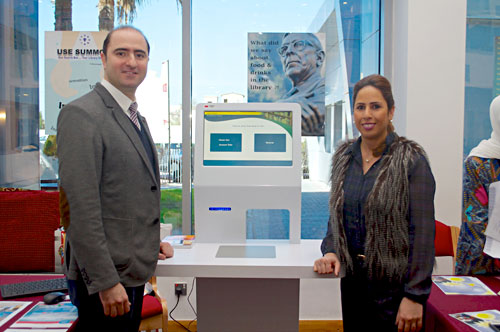
The Library at the American University of Kuwait (AUK) held its' second annual Open House on Thursday, February 13, for members of the AUK community. Such events provide the library with an opportunity to introduce new technological features and resources that enhance the library experience, as well as a chance to meet with members of the AUK community and increase student engagement with the library. At this Open House, the Library showcased a new system, the first of its' kind in Kuwait, that enables library patrons to serve themselves when checking out library items; the 3M SelfCheck kiosk.
Ms. Asma Al-Kanan, Library Director, explained that the idea behind holding an Open House is to create an opportunity for the Library to share new resources, showcase library-related technology, and educate users on ways to fully benefit from the library resources, on and off campus. "This year, we were pleased to unveil the 3M SelfCheck kiosk and were excited to show our visitors how easy the process of borrowing books has become. Our library is the first library in Kuwait to offer this self-service facility, and that is something we are proud of," said Al-Kanan.
The 3M SelfCheck kiosk will improve the customer service experience within the library. It will speed the circulation process, and allow users to borrow and return items when the circulation desk is closed or if the library staff is unavailable.
In addition to unveiling the SelfCheck kiosk, the AUK Library, in collaboration with academic publishers SAGE Journals and Emerald Database, held competitions during the Open House where visitors had the chance to win Kindle E-Readers, as well as vouchers. More than 200 people participated in the quiz contests to win the Kindle E-Readers.
Released by the Office of Public Affairs on the 20th February 2014
Photography by the Office of Public Affairs (C) 2014
American University of Kuwait (AUK) art students Fatemah Al-Shobbar and Zahraa Hamadi won first and third place, respectively, in the Universities Art Competition. The competition, which was co-sponsored by Argana Resorts & Hotels and the UNDP, is an intercollegiate art contest created to promote young artistic talents and support the United Nations Development Programme (UNDP) Millennium Development Goals. The awards ceremony and exhibition was held at the C-Club, Kuwait. More than 25 students from Universities around Kuwait submitted artwork to the Competition under the theme of "Power of Life".
During the opening ceremony, the top three winning artworks were announced, two of which were submissions made by AUK students Fatemah Al-Shobbar and Zahraa Hamadi, who won the first and third titles respectively.
The event was attended by the top management teams of participating universities and sponsors. In his opening remarks, AUK President Dr. Nizar Hamzeh emphasized the significance of this event in manifesting what he called "a perfect partnership between the corporate and educational sectors in Kuwait." Hamzeh also highlighted the liberal arts philosophy of AUK, which supports creativity and talent in all fields that "contribute to the development of the community and the world at large."
Fatemah Al Shobbar, the competition winner, expressed her thoughts about women empowerment through an image of a woman reading while sitting in the middle of a messy library, surrounded by books which were scattered everywhere around her. Fatemah explained that it resembled the tough path of women seeking education. "Finding our desired path as women is challenging, especially in this community. I have witnessed and lived up to some of it. We undo books on shelves, shuffle through them, and flip pages. This journey continues until we find what we truly desire and what is right for us after turning it into a messy journey," said Al Shobbar.
When the results were announced, Fatemah, who was not expecting the first place was surprised. "Winning that night definitely felt amazing and I would like to thank AUK, especially Professor Sharon Lawrence, for choosing me for this competition and all those who supported me through it," she said. Meanwhile, Zahraa Hamadi, the third place winner, expressed her wish to eradicate extreme hunger and poverty in the world through her submission of a painting that depicted a boy locked in a cycle of hunger and poverty while the world around him enjoyed luxury.
The Universities Art Competition was not the first victory for AUK art students this year. AUK was awarded first place in the REUSE competition, which was held at the Avenues Mall last January with Moustafa Al Khashab's dubbed "Metallic Stallion" art piece. Through its active participation in community wide activities, the Art and Graphic Design (GDES) Department at AUK continues to support the mission of AUK to enrich the society and create community involvement.
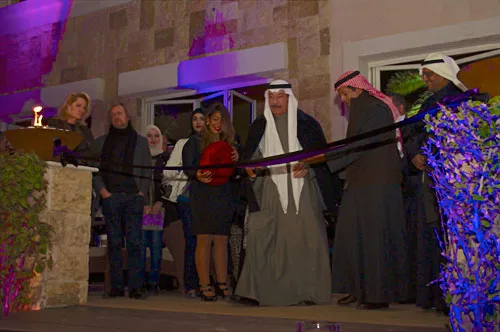
Argana Exhibition Opening Ceremony
Argana Exhibition Opening Ceremony - Left: Dr. Sleiman AlAskari, former Secretary General of the National Council for Culture, Arts, and Letters. Right: Eng Khaled Al Mashaan, Chairman-Managing Director of Alargan International Real Estate Company
President Nizar Hamzeh giving his opening remarks
Audience
The Artwork
General photos of the exhibition
General photos of the exhibition
General photos of the exhibition
The judges panel speaking to Fatemah Al Shobbar (1st Place Winner) before announcing the final results
Zahraa Hamadi (3rd Place Winner) with AUK President Nizar Hamzeh and Professor Sharon Lawrence, Chair Art and Graphic Design (GDES) Department
Zahraa Hamadi (3rd Place Winner) discussing her painting to the Judges Panel before announcing the winners
The Judges Panel Speaking to Alia AlQabandi before announcing the winners
Sara AlKhalaf (Gender Equality)
Sara AlKhalaf discussing her painting to the Judges Panel before announcing the winners
Iqra Riaz discussing her painting to the Judges Panel before announcing the winners
Announcement of the Winners
First place winner, Fatemah Al Shobbar
First place winner and her painting
Third place winner Zahraa Hamadi
Third place winner with her painting
Group photo of all participants
Group picture of the winners and the contest sponsors
AUK participants with President Nizar and Dean Awwad
President Nizar receiving award from Mr. Sherif Omara, CEO of Argana Resorts & Hotels
As the American University of Kuwait (AUK) continues to celebrate its Decade of Accomplishments, all newly enrolled students in the Intensive English Program (IEP) and AUK's Undergraduate program (UG) met before the beginning of the Spring semester, to attend the Student Orientation, a program created to familiarize the students with the AUK community and college life. The Orientation was attended by AUK President Dr. Nizar Hamzeh, who was accompanied by other university officials to welcome the new students.
"I urge you to devise a plan for yourself as a college student," advised President Hamzeh in his opening speech. "The new Student Orientation is designed around you, to help you uncover answers to the questions you have, and provide you with information about campus resources, programs and services. We are all here to support your successes and the completion of your degree requirements," he added. The President also reminded the students that there is a logical and empirical relationship between class attendance, class participation and scholastic performance.
In her welcome note, Dr Rawda Awwad, Interim Dean for the College of Arts & Sciences stimulated the students' desire for learning. "Learning is motivated by a sense of passion for knowledge and a desire to pursue that passion," she explained. Stressing on the importance of understanding academic material, rather than rely on memorizing it, Dr. John Russell, Interim Dean for the College of Business and Economics, encouraged the students to challenge themselves and question answers, and use their critical thinking skills to think of concepts and express their ideas.
Finally, Vice President for Student Affairs, Dr. Carol Ross, welcomed the students and introduced them to their orientation leaders, who were comprised of staff members from the Division of Student Affairs and IEP. To minimize anxiety of the first day of classes, the students engaged in specially designed group activities with their orientation leaders, which aimed to assist them in settling into this new phase of their lives by familiarizing them with all areas of the campus community and AUK's mission of lifelong learning.
As part of the orientation, the new students had the opportunity to personally meet with AUK officials to learn about the campus and the fundamentals of success. They also had a chance to socialize with their classmates, as well as the representatives of the student-body, Taiba Al-Ibrahim, Finance Club President, and Alaa Al-Chalabi, President of the Student Government Association (SGA). AUK aims to assist its newly registered students in transitioning to the Wolf Pack community.
Released by the Office of Public Affairs on the 16th February 2014
Photography by the Office of Public Affairs (C) 2014