

News
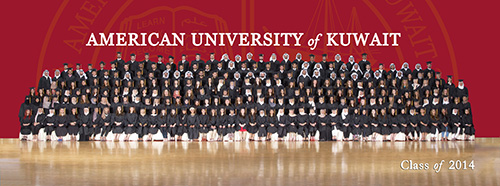
Under the patronage of His Highness the Amir Sheikh Sabah Al-Ahmad Al-Jaber Al-Sabah, represented by His Excellency the Deputy Prime Minister and Minister of Commerce and Industry and Acting Minister of Higher Education, Dr. Abdul Mohsen Al-Medej, the American University of Kuwait (AUK) held its graduation ceremony for the Class of 2014 at the Kuwait International Fairgrounds in Mishref, where 350 students officially became AUK graduates. The ceremony was attended by Shaikha Dana Nasser Sabah Al-Ahmed Al-Sabah, Founder and Chair of AUK, along with members of the AUK Board of Trustees, Dartmouth College representatives, diplomats, dignitaries, as well as the families and friends of this year's graduates.
Following Kuwait's national anthem and a recitation from the Holy Quran, the graduating class proceeded into the hall in the traditional ceremonial manner: the faculty processional led by the deans of the respective colleges, followed by the students' processional led by their faculty. The processional was ended with the march of the AUK President's party that included, for the first time, members of AUK's Board of Trustees.
Professor Dr. Nizar Hamzeh, President of AUK, addressed the graduates in his opening speech saying "you have passed the test and proved your readiness to embark toward the vision you hold of your future. We are proud and honored to have you as AUK alumni." Professor Dr. Hamzeh also emphasized the value and quality of education at AUK that "cannot be obtained with a simple point and click. It cannot be placed in a box, wrapped with paper and ribbon, and bestowed upon you. It is a quality education of high standards of learning that we must maintain as a university and you must earn as a student."
Dr. Abdul Mohsen Al-Medej gave a speech about the importance of private higher education in Kuwait, highlighting the important role played by AUK in Kuwait's higher education. He specifically highlighted the social engagement aspect of AUK's educational and research activities delivered through the different University research and outreach centers.
The Keynote Speaker of this year's commencement was Mr. Faisal Al-Ayyar, Vice Chairman of the Kuwait Projects Company (KIPCO), who shared with the graduates some words of wisdom, advising them to keep their youthful spirit while utilizing their education to the best of their abilities. "Raise the standard of work ethics. Have goals -personal and career- but also participate in the vision and goals of your country. I know you love your country but it should be a positive love that includes sincere contribution," he said.
Following Mr. Al-Ayyar's speech, Dr. Carol Ross, Vice President of Student Affairs, introduced the co-valedictorians of the Class of 2014; from the College of Arts & Sciences Noor Kassem, and from the College of Business & Economics Nasser Al-Rashoud. Dr. Ross invited Al-Rashoud to the stage to give his speech on behalf of the Class of 2014. In his speech, he thanked the families and faculty members for the support they provided the graduates throughout their university experience.
The event proceeded with the highlight of the ceremony, where the graduates receive their earned degrees. Dean of the College of Arts and Sciences, Dr. Rawda Awwad, recommended the conferral of degrees for the graduates of the College of Arts & Sciences, while Interim Dean of the College of Business and Economics, Dr. John Russell, recommended the conferral of degrees for the graduates of the College of Business and Economics, to President Hamzeh, who then conferred upon the graduates their respective degrees. The graduates were then awarded their , bachelor's degree diplomas by Dr. Hamzeh, Mr. Faisal Al-Ayyar, Dr. Rawda Awwad, and Dr. John Russell.
In keeping with the academic tradition, the graduates were then asked to move their tassels from right to left, thereby marking their official graduation from AUK. As the ceremony drew to a close, the graduating class celebrated the traditional cutting of the Class of 2014 cake, and took photos with their families and friends.
The AUK 2014 Commencement coincides with important milestones in the history of AUK as it overlaps with the 10th Anniversary of AUK.
About AUK
The American University of Kuwait is a liberal arts institution, founded in 2003, dedicated to teaching, learning, and scholarship. AUK offers programs that provide students with the knowledge and skills necessary for lifelong learning and professional success. AUK enriches society by fostering an environment encouraging critical thinking, effective communication, personal growth, service, and leadership.
About Dartmouth College
Founded in 1769, Dartmouth is a member of the Ivy League and consistently ranks among the world's greatest academic institutions. Dartmouth has forged a singular identity for combining its deep commitment to outstanding undergraduate liberal arts and graduate education with distinguished research and scholarship in the Arts & Sciences and its three leading professional graduate schools -the Geisel School of Medicine, Thayer School of Engineering, and the Tuck School of Business.
Released by the Office of Public Affairs on the 14th June 2014
Photography by the Office of Public Affairs (C) 2014
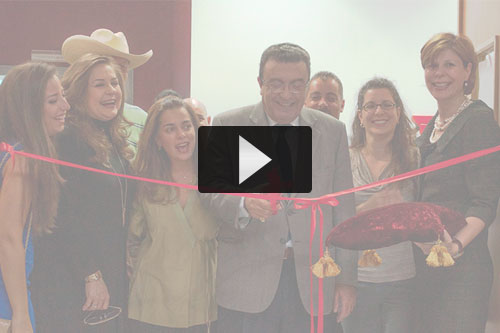
The Art & Graphic Design Program (GDES) at AUK held its 2014 Senior Capstone Exhibition from May 19th till 22nd . The opening reception for the exhibition which was held in the two main AUK halls was attended by the AUK President, Professor Dr. Nizar Hamzeh, AUK faculty and students, as well as a number of external visitors and advertising experts. The exhibition showcased the creative work of AUK students, reflecting their abilities to design concepts and develop themed campaigns on a wide variety of topics.
Under the supervision of AUK GDES professors, Maryam Hosseinnia and Rita Merheb Khair, the participating students were able to investigate a topic of their choice, research and analyze it, and come up with interesting communication tools, addressing their target audiences through the medium of Graphic Design. The exhibited projects reflected a culmination of semester-long, self-initiated, and largely self-directed ideas implemented through diverse applications. The students were graded based on their creativity and presentation, their ability to conduct and use graphic design research strategy effectively, and their ability to plan and implement a compelling graphic design exhibition.
Some of the top-scoring projects featured in the exhibition included:
Aisha Al Jiran's project is about a company specialized in custom-designed dessert tables for parties and special occasions. The exhibit included the corporate identity of the company, three themed tables, the company's catalogue showcasing this year's designs, and an app that contains company information, upcoming events, and a digital version of the catalog"
Jumana Al-Refaei's project involved the design of the identity and the communication materials for a contemporary dance company in Kuwait (LEAP). The overall design is consistent in rhythm and patterns that support the idea of infinite movement.
Mariam Mandani's project was 'kuwaitcom', an online guide to Kuwait city. It provides lists of places in the city organized in eight main in categories, such as: culture, art, design, landmarks music and entertainment.
Anam A. Rasheed created a packaging system to promote Pakistani herbal remedies (AFREYA) targeted to local market to reduce stress. She designed the identity system, brochures, packaging and a website.
Matrah Al-Dooseri created a superhero (SKELINA) based on her daily experience, reflecting women stereotyping. She created a comic book, posters, t-shirts and a website where you can get more information about the superhero and to purchase items.
Other projects included business rebranding ideas, like Confidental Dental Clinic, Dasman Model School, and Kuwait Riding Center, among others. A few more projects were themed around fashion and accessories, like projects Zodillary, Calssica, PRO Sport Tailoring, and Kfa; while another group of projects reflected the technology aspect, like Asturias guitar simulator, Anim8, and Jambuza board and computer game.
Held once a year in May, the Capstone exhibition brings together visitors from the field of graphic design, including experts from graphic design studios, publishing houses, film and video production companies, advertising, and multimedia firms.
As one of the final year courses, The AUK Graphic Design Capstone represents an opportunity for senior students to fully incorporate their design strengths and learning into a focused, extended process of research and visual expression.
The aim of AUK's Graphic Design major is to prepare students for meaningful careers in a wide range of fields and businesses, such as graphic design studios, publishing houses, corporations, non-profit institutions, film and video production companies, advertising and multimedia firms, and emerging areas of employment relative to visual communication.
Released by the Office of Public Affairs on the 27th May 2014
Photography by the Office of Public Affairs (C) 2014
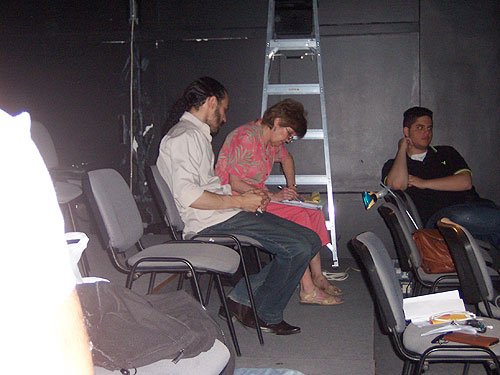
The Drama Program at the American University of Kuwait (AUK) presented its annual Spring theatre production, Long Ago and Not So Far Away, at the Black Box Theatre, located on AUK's campus. The play was adapted from Dr. Craig Loomis' short story collection, The Salmiya Collection, by Kendall F. Downs to create original theatre in Kuwait. The production was directed by Assistant Professor of Theatre/Drama, Dr. Kathleen R. Downs, under the auspice of the Music and Drama Department.
The production included performances by many veteran AUK actors: Omar Al-Farsi, Nada Helmy, Natasha Sharma, Maria Lambert, Ratab Shehadeh, Mohammed Al-Saeed, Alison Koushki, Tori Danner, Talal Faraj and Khaled Ghaffar. The show also included newcomers to the University's theatre community: Abdulmajid El-Kassem, Ali Kelkawi, Rabab Al-Shamaa and Abdullah AlGharabelly. Samer Abou Zeid, a veteran actor from last semester's play, accompanied the performers on drums. The production crew included Khaled Al Nuwaishri on lights, Abdullah AlGharabelly on sound, Myriam Qutop on makeup with Ken Downs completing the ensemble with set and poster design.
The theatrical ensemble was comprised of Dr. Downs' DRAM 360 production class, with the rest of the company being volunteers who met for six weeks during the semester, immersing themselves in the characters they portrayed.
Loomis' play centers around nine vignettes that portray everyday scenarios in Kuwaiti culture. In celebration of the 10th anniversary of AUK's inception, the play examines the world that we are engaged in at the American University of Kuwait. Dr. Loomis' stories were insightful and humorous observations of our antics in this world, conveyed to the audience by the talented group of performers. In addition to the acting, the stage was quickly transformed after each scene by the ensemble's use of lights, costumes, makeup, sound, and Props.
The AUK community seemed to enjoy entering the magical world of theatre and actors for four sold out performances. They look forward to the next theatrical event, planned for the Fall semester of 2014.
The Department of Music and Drama offers a wide range of opportunities for both beginning and advanced students within the context of a liberal arts education. The Music and Drama faculty of talented professionals work closely with students to prepare them for campus concerts and plays, and to academically challenge them in courses on performing arts. The department fosters artistic proficiency, cultural appreciation, a sense of community, and a lifelong commitment to the arts.
Released by the Office of Public Affairs on the 25th May 2014
Photography by the Office of Public Affairs (C) 2014
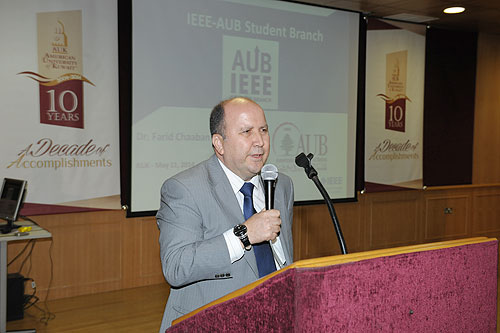
In a reception held last week at the AUK Auditorium, the Electrical and Computer Engineering Department at AUK announced the kick-off of the AUK-IEEE (The Institute of Electrical and Electronics Engineers) Student Branch. The evening also featured the launch of the Electrical and Computer Engineering Seminar Series 2014 (ECESS'14) held under the theme of Triple-Es: Energy, Ecology, and the Environment. The event was attended the AUK President, Deans of Colleges, AUK faculty, staff and students, as well as selected industry invitees. Keynote speech and presentation were given by Professor Farid B. Chaaban, Chair of the Electrical Engineering Department at the American University of Beirut (AUB).
The AUK-IEEE Student Branch is the second branch in Kuwait; it received its international affiliation on the 11th of March, 2014. "It is an added value to the academic and extra-curricular portfolio of our engineering students," said Dr. Issam Damaj, Chair of the Electrical and Computer Engineering Department, during his opening speech. "It is a high outpost for an effective recognition on the national and international levels, and a high outpost for a constructive community engagement," he added.
Kholod Al-Shmary, the first Chair of the AUK-IEEE Student Branch felt that before the establishment of the branch, there was no outlet for engineering students to "meet, share ideas, provide support, or solve problems." With the AUK IEEE Student Branch, "students will have the opportunity to meet and learn from their fellow students, as well as faculty members and professionals in the field."
Similar to its correspondent branches worldwide, the IEEE Student Branch at AUK is expected to offer a range of activities and advantages to students, including the IEEE membership, project exhibitions, meetings, training, and field trips. Through AUK-IEEE Student Branch, students can participate in regional conferences, workshops, and competitions as IEEE members. Professor Chaaban provided an overview of the IEEE student branch at AUB, emphasizing that its activities extend beyond engineering students to incorporate the whole student body and the wider local community.
Flowing from his talk about community engagement and social responsibility, the keynote speaker gave a presentation (A Century of Energy Conversion, Prospects for the 21st Century) reflecting the rising concerns of scientists and engineers about the impacts of energy systems on the environment. According to Professor Chaaban, throughout the 20th century, energy industries have been giving attention to the 'economic' factor of any operation, "the main objective was to achieve the most economically feasible operation". However, with the rising environmental concerts, "the environmental (ecological) factor has been added into this process and hence scientists and engineers are currently becoming more concerned with the 3 E's: Energy, Economy, and Ecology," said Professor Chaaban.
Following the keynote speech, the IEEE Student Branch presented the ECE seminar series as its inaugural educational activity this semester. Introduced by the master of ceremonies, Dr. Mohamed Al Abd, the first talk discussed e-Mobility in Kuwait and was presented by Dr. Detlef Hummes, Assistant Professor of Electrical Engineering at AUK. E-mobility (or electro mobility) is the concept of using the-state-of-art electro-vehicles to address environmental and economic concerns. According to Dr. Hummes, "sustainability is becoming a main goal in Kuwait, the region, and the world. With the advancement in e-mobility, the Kuwaiti society can play a pioneering role in the region if adopted such a growing technology." The talk investigated the impact of e-mobility on the Kuwaiti environment and economy, as well as its electrical infrastructure. It addressed issues, such as, expansions of current infrastructure to include quick charging stations and the national economic benefits of introducing e-mobility solutions.
The aim of the ECE seminar was to help students understand engineering ethical and professional responsibility, to understand the impact of engineering solutions in economic, environmental, and societal contexts, and to gain knowledge of contemporary issues surrounding the practice. Other anticipated events of the IEEE Student Branch include the Electrical and Computer Engineering Exhibition coming up in December 2014, the Student Professional IEEE Awareness Conference, and the establishment of a Student Branch Library for IEEE publications at AUK. The branch also plans to continue co-organizing the annual ECE seminar series.
Released by the Office of Public Affairs on the 19th May 2014
Photography by the Office of Public Affairs (C) 2014
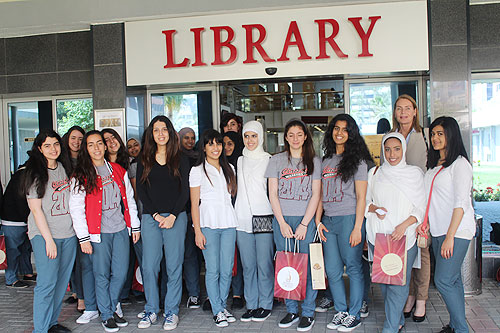
In preparation for the new academic year 2014-2015, the AUK Library has received a number of visits this semester from high schools students, aiming to explore the different facilities and services the Library offers to learners.
Students from the American International School, American Creativity Academy, Future Bilingual School and the American Academy for Girls were among those who visited AUK in guided campus tours coordinated collaboratively by the AUK Library and the Office of Admissions. The visitor groups were received by Library Director, Asma Al Kanan and Director of Admissions, Maher Dabouseh.
The campus and Library tours included orientation sessions by AUK Reference Librarian, Zainab Al Attabi, who provided demos introducing to the students the online resources and tools needed to conduct database searches, find academic materials, and support their essays with resources. Throughout the sessions students learnt new techniques on how the library can contribute to their academic life by facilitating information quests and knowledge acquisition. "Many of the senior students have found the tour and research demonstration very informative and helpful," Ms. Shannon Rooney, American Academy for Girls School Librarian "The University's main library is a refuge and a place they can seek for assistance with their academic research," she added. "What was most impressive was the graciousness, kindness and warm reception from the AUK staff".
Released by the Office of Public Affairs on the 19th May 2014
Photography by the Office of Public Affairs (C) 2014
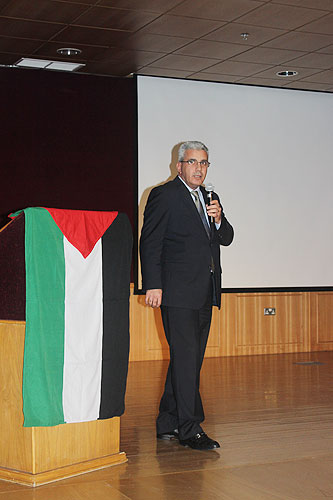
AUK students celebrated Palestinian Land Day "traditionally observed on March 30 every year." The celebration, which has seen over 250 people attendees, included national songs, poetry, drama and performance of Palestine folklore. The honoree of the celebration was His Excellency Ambassador of Palestine in Kuwait, Dr. Rami Tahboub, who was accompanied by his wife and a distinguished delegation from the embassy, including the Palestinian Consul Mr. Firas Al-Bala'awi; and Director of Public Relations, Mr. Thaer Nasser. The embassy delegation was received by Prof. Hanan Arnous, Prof. Maher Al-Tamimi, Dr. Raymond Farrin, Dr. Khetam Al-Kholi, in addition to AUK students and staff members.
The event began with Kuwaiti & Palestinian national anthems, followed by a statement by His Excellency the Palestinian Ambassador about the importance of the commemoration of special Palestinian occasions like the Land Day and Palestinian Prisoners Day.
In recognition of the efforts of the organizers and participants in putting together the Land Day event, His Excellency Ambassador Tahboub invited them to a dinner banquet hosted under the auspices of the Palestinian embassy for delegations participating at the Palestinian Industries Exhibition.
Arabs & Palestinians commemorate Land day, which dates back to 1976 when Israeli authorities illegally confiscated thousands of acres of land that provoked a Palestinian reaction, general strike and marches were organized in Arab towns from the Galilee to the Negev. In the ensuing confrontations with the Israeli army and police, six unarmed Arab citizens were killed, about a hundred were wounded, and hundreds of others arrested.
Released by the Office of Public Affairs on the 18th May 2014
Photography by the Office of Public Affairs (C) 2014
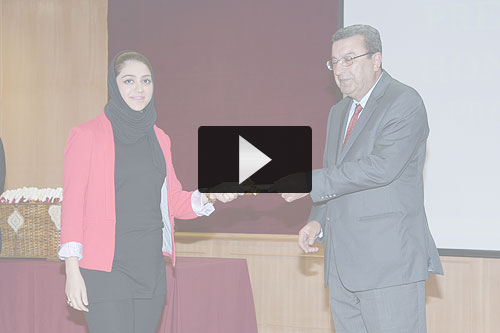
The American University of Kuwait held its semiannual President's Honor Roll / Dean's Honor List ceremony to award its top student academic achievers for the 2013 Fall Semester. The ceremony, which was held at the AUK Liberal Arts Auditorium, drew a large audience of students, parents, AUK faculty and staff, who took pleasure in seeing the students' hard work being recognized and rewarded.
During the event, AUK President, Professor Dr. Nizar Hamzeh, recognized the 22 students on the President's Honor Roll, a high distinction exclusively awarded to those few students who maintained a 4.0 GPA for the term. The Dean's Honor List, a distinction awarded by the college Deans to students who maintained a minimum GPA of 3.7, featured 124 recipients, 64 of whom belonged the College of Arts & Sciences, while 60 belonged to the College of Business & Economics.
The following students were recognized for their academic achievements:
Fall 2013 President's Honor Roll
| Laila Abdel Jaber | Fatemeh Ebrahimi |
| Afnan Al-Daqqaq | Abeer Imdoukh |
| Sara Al-Enezi | Jihan Kablaoui |
| Aisha Al-Hunaidi | Salli Khaddag |
| Dana AlMansouri | Stephanie Khalil |
| Abdulwahab Al-Meshari | Yasser Khalil |
| Maisaa Al-Musalam | Heba Khalil |
| Lamis Al-Nazer | Sara Lubbad |
| Nasser Al-Roshoud | Manar Mashal |
| Rania Al-Sabbagh | Batul Sadliwala |
| Aya Al-Touky | Connie Sahyoun |
Fall 2013 Dean's Honor List
College of Arts & Sciences
| Farah Abdel Salam | Rania Al-Sabbagh | Marina Karas |
| Jumanah Al Refaei | Jude Al-Saleh | Ali Kelkawi |
| Khaled Al-Abdulqader | Salem Al-Salem | Salli Khaddag |
| Farah Al-Ajeel | Abdulaziz Al-Shawaf | Stephanie Khalil |
| Geehan Al-Ansari | Abdulwahab Al-Sultan | Yasser Khalil |
| Hawraa Al-Awadh | Fares Al-Tawheed | Dana Maan |
| Alaa Eddin Al-Chalabi | Aya Al-Touky | Majd Makdessi |
| Sara Al-Enezi | Shaza Al-Wattar | Fatema AlZahra Marafi |
| Hala Al-Faisal | Sarah Behbehani | Manar Mashal |
| Munira Al-Farsi | Naser Behbehani | Hassan Mohieddine |
| Dalal Al-Jenaei | Farah Bossakhar | Omar Raad |
| Abrar Al-Kandary | Emannoel Cabildo | Ali Rady |
| Khaled Al-Karmi | Yassmin El-Torgoman | Dania Ragab |
| Hind Al-Khatrash | Rana El-Zoheiry | Sandra Saad |
| Huda Al-Kotob | Anwar Esmaeel | Batul Sadliwala |
| Dana AlMansouri | Ahmed Hassanein | Connie Sahyoun |
| Rawan Al-Mukhled | Mahmoud Imdoukh | Gaurav Srivastava |
| Amani Al-Murjan | Abeer Imdoukh | Shaima Thekerallah |
| Lamis Al-Nazer | Nay Issa | Maymoonah Toubeh |
| Rahaf Al-Otaibi | Reem Judah-Al-Maghari | Jessie Trago |
| Fouzan Al-Qahtani | Darin Kablaoui | |
| Dina Al-Qassar | Marwa Kandil |
College of Business & Economics
| Laila Abdel Jaber | Firas Al-Mobarek | Manit Kaur |
| Noha Abou Omar | Maisaa Al-Musalam | Heba Khalil |
| Mahmoud Abulburghul | Maryam Al-Nassar | DongYeon Koo |
| Mohammed Akbar | Abdullah Al-Otaibi | Sara Lubbad |
| Sawsan Al-Ajmi | Nasser Al-Roshoud | Abdullah Marhaba |
| Fajer Alali | Khaleefah Al-Sabah | Georges Massoud |
| Alaa Al-Barakat | Shehab Al-Shehab | Maryam Mofied |
| Bibi Al-Behbehani | Fatema Al-Thunayan | Ahmed Mohamed Tawfik |
| Salem Al-Beloushi | Alia Assaf | Munirah Mohammad |
| Shahad Al-Busairi | Khalid Baz | Eslam Moussa |
| Rawan Al-Dabt | Maria Bedrossian | Ayah Mowafi |
| Abdullah Al-Dahmali | Fatemeh Ebrahimi | Ghanima Najem |
| Afnan Al-Daqqaq | Noor Al-Huda Faisali | May Omran |
| Dalal Al-Dousari | Talal Faraj | Shaunak Parkhi |
| Rahaf Al-Ghazi | Shahad Farhanian | Vincent Puyat |
| Jumana Al-Halawani | Carol Ghali | Luke Rangel |
| Rataj Al-Hasawi | Amnah Hameed | Nathalie Saab |
| Aisha Al-Hunaidi | Masswo Issi | Lina Salout |
| Yousef Al-Jenai | Jihan Kablaoui | Farah Shimi |
| Abdulwahab Al-Meshari | Meeriam Kamel | Ahmed Yassin |
Released by the Office of Public Affairs on the 15th May 2014
Photography by the Office of Public Affairs (C) 2014
The American University of Kuwait held its 10th Annual Awards Night last week to celebrate students' academic achievements and extra-curricular involvement during the past academic year. The Awards Night is also the time when students recognize AUK faculty and staff for their support and encouragement throughout the year. The event was coordinated by the Division of Student Affairs-Department of Student Life, College of Arts and Sciences and College of Business and Economics, and hosted by faculty member, Dr. Chris Ohan.
The event commenced with a welcome note from AUK President, Nizar Hamzeh, who acknowleged the awardees not only for their "excellent scholastic records but also for their willingness to seek a balance between their academic and co-curricular and extra-curricular activities." He also stressed that competing at a high level, or volunteering time in a club or athletic capacity, while also undertaking university study can present its own challenges. "This is not always easy to strike," said President Hamzeh "But, the students receiving awards tonight have proven that with balance comes great success both on and off the field, on and off the classroom."
The Awards Night honors students, faculty and staff in different categories of performance. The top three University awards, which are considered the highlights of the event, are the Student Affairs' Award, the Founders' Award and the President's Award. They are intended to recognize students who stand out in the crowd and embody the values and expectations of citizens of the AUK community. Students in these categories are nominated by peers, faculty and staff, interviewed by committee and recommended to the Vice President for Student Affairs and President for final selection. The recipients of these awards were students who have shown exceptional academic achievement and involvement in activities outside of the classroom among other criteria.
Other award categories include;
University Service Awards which honor student employees, students involved in service and student athletes for their hard work and dedication.
Academic Achievement Awards awarded by the College Deans, with support from Department Chairs, for outstanding academic performance for the academic year were
Student Life Awards which honors students and student organizations who made significant contributions to life at AUK. Members of the Student Life department and Professor Hala Al Najjar, Coordinator of the Education Program presented awards to students this year.
Student Government Association Awards, presented to faculty and staff members nominated by students as the most innovative, supportive, and humorous as well as best mentors.
The Vice-President of Student Affairs Dr. Carol Ross-Scott commented on the ceremony saying, "AUK Student Awards night celebrates the engagement of students in activities outside the classroom," emphasizing that student programs and activities such as student media, athletics, curriculum related organizations, service clubs, and leadership bring the university experience to life. "Involvement compels our students to push the boundaries of excellence, academically, and in extra-curricular activities. We want our students to be better prepared to serve the competitive, global society and awards night is where we highlight their achievements of the academic year," said Dr. Ross-Scott
For the past decade, AUK has been arming its students with the most powerful and effective tool, the liberal arts education. One of the fundamental tenants of such an education is not only one's intellectual development but also personal growth and development, traits which are often enhanced when students are engaged in college life outside the classroom. Whether in leadership positions, participating in academic societies, athletics or in volunteer service, extra- and co-curricular engagement propels student readiness for life after college. This Awards' night celebrates this principle of excellence by recognizing our students ability to excel inside and outside of the classroom
Award Categories and Recipients
Founders' Award: May Omran
President's Award: Sally Zaghloul
Student Affairs' Award: May Omran
University Service Awards
| Founders' Award: | May Omran |
| President's Award: | Sally Zaghloul |
| Student Affairs’ Award: | May Omran |
University Service Awards
| Sabeekah Al Jasem | |
| Mohammed Al-Faqan | |
| Fay Al Rasheed | |
| Nathalie Matta | |
| Ali H. Kamal |
Student Employee Awards
| Alumni Affairs | Fatemah Al-Ali |
| College of Business & Economics | Alia Assaf |
| Department of Arabic & Foreign Languages | Hana Khalaf |
| Department of Communication & Media | Hana Khalaf |
| Department of Electrical & Computer Engineering | Ali Nawab |
| Department of International Relations | Abdulmajid El-Kassem |
| Department of Social Sciences | Rana El-Zoheiry |
| Department of Student Life | Nour Jaber |
| Department of Student Life | Abdurrahman Chowdhury |
| Department of Student Life | Carol Ghali |
| Department of Student Life | Rawan Esmael |
| Office of Admissions | Dana Maan |
| Office of Public Affairs | Muneera Al-Khulaifi |
| Office of the Dean CAS | Farah T. Madi |
| Tutoring Center | Sara Abdel Baki |
| Tutoring Center | Ajab Ali Hussain |
| Tutoring Center | Fatemeh Ebrahimi |
| Tutoring Center | Manit Kaur |
| Writing Center | Stephanie Khalil |
| Writing Center | Maria Bedrossian |
| Writing Center | Maymoonah Toubeh |
| Registrar | Haya Al-Jouda |
| Library | Marina Matta |
| IEP | Rana Youssef |
| IEP | Sara A. Mohamed |
| IEP | Yasmin Abou Zeid |
| IEP | Fatemah Al-Attar |
| IT | Yousef Hamadah |
Outstanding Athlete Award
Sarah Al-Qenaei
IEP Academic Achievement Award
Shafeeqah Hussain
Abdelaziz Al-Mesbah
Aref Froutan
Elisa Verrazzo
Academic Achievement Awards
College of Arts and Sciences
| Department of Social & Behavioral Sciences | Nourah K Al-Omar |
| Department of International Relations | Jessie Trago |
| Department of Music & Drama | Faisal G Al-Bahairi |
| Department of Arabic & Foreign Languages | Fatma Al-Adwani |
| Department of Communication & Media | Noor Kassem |
| Department of Graphic Design & Art | Jumana Al-Refaie |
| Department of English | Reem Al Hasawi |
| Department of Math & Natural Sciences | Hala R. Al Faisal |
| Department of Computer Sciences & Information Systems | Maitha Al-Jassmi |
| Department of Electrical & Computer Engineering | Maymoonah I Toubeh |
College of Business and Economics
| Department of Accounting | Aisha Al-Hunaidi |
| Department of Economics | Yousef Al-Jenai |
| Deparment of Finance | Sally Zaghloul |
| Department of Management | Farah Shimi |
| Department of Marketing | May Omran |
SGA Student Body Awards
| Innovative Lecturer Award | Dr. Amir Zeid |
| Most Supportive Faculty Award | Dr. Mohammed EL Abd |
| Most Supportive Faculty Award | Dr. Christopher Ohan |
| Most Supportive Staff Award | Shoug Al-Othman |
| Most Supportive Staff Award | Hala Al Abdulrazzaq |
| Faculty Mentorship Award | Dr. Issam Damaj |
| Staff Mentorship Award | Heba Mansour |
| Most Humorous Faculty Award | Dr. Ahmad Rabaa'i |
| Most Humorous Staff Award | Hussein Diab |
Student Life Awards
| Advisor of the Year | Dr. Kathy Nixon |
| Rising Star of the Year | Ali Kelkawi |
| Exceptional Organization Member of the Year | Aisha Al-Hunaidi |
| Exceptional Organization Member of the Year | Fajer Ben Naser |
| Student Leader of the Year | Khaled Al-Rubaian |
| Student Leader of the Year | Samarth Puri |
| Program of the Year | Liberation Village |
| Most Improved Organisation | International Relations Club of AUK |
| Organization of the Year | Finance Club of AUK |
Released by the Office of Public Affairs on the 14th May 2014
Photography by the Office of Public Affairs (C) 2014
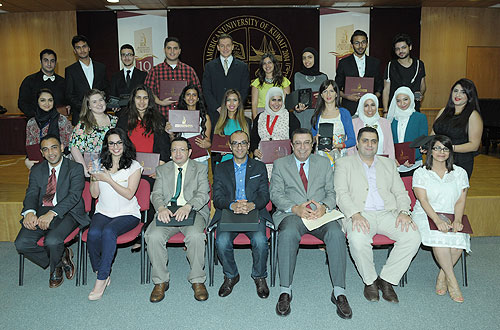
In an official ceremony held on the 8th of May, 2014, the President of American University of Kuwait (AUK), Professor Dr. Nizar Hamzeh, officially announced the inauguration of AUK's first research and development center f in informatics, sciences and engineering (RISE). The event, which took place at the AUK Auditorium, featured remarks by the event honoree and keynote speaker, Professor Dr. Adnan Shihab-Eldin, General Director of the Kuwait Foundation for the Advancement of Sciences (KFAS).
The event started with opening remarks by President Hamzeh who officially announced the inauguration of RISE, emphasizing that "The new center reflects our goal and commitment to excellence in research. I am confident that the center will lead our future research efforts in the area of informatics, sciences, technology and engineering into the future."
Professor Dr. Shihab-Eldin acknowledged AUK for taking forward such a project which he said will be another step towards the advancement of scientific research within Kuwait and the Arab World at large. He specifically emphasized the importance of establishing research centers within private universities, which will support national research and development efforts.
Dr. Rawda Awwad, Dean of the College of Arts and Sciences at AUK, pointed out that "RISE strategically supports the values that guide AUK in areas of research and scholarship, and provides an important venue that enables both faculty and students to partake in an essential ingredient that informs progress and positive change, namely the production of knowledge-the hallmark of the liberal arts."
Situated within the lively Salmiya campus of Kuwait's first liberal arts institute, RISE will serve as the University's primary source for research and development in the various areas of sciences and technology. "The center holds unique opportunities for multidisciplinary research in Kuwait," said Dr. Amir Zeid, RISE Director and Associate Professor of Computer Science and Information Systems. "In the early Golden Age of this region, our strength lied in the multidisciplinary knowledge of our scientists. Today, with its strong commitment to liberal arts, RISE aims to revive the old trends."
RISE is a collaborative effort between the different AUK science and engineering departments. It adapts an integrative model by forging connections between academic disciplines, local & international innovators, academia & industry, as well as technology & society.
The main objectives of RISE include:
- Expanding the innovative research and development environment within Kuwait
- Hosting collaborative research and development projects with selected local industries
- Establishing research collaboration and joint research projects with world-class institutes
- Hosting scholars and initiating original research projects of international interest
- Organizing international conferences and workshops
The inauguration event, which took place at AUK, saw a significant number of attendees who included AUK faculty and staff members, AUK students and alumni, as well as selected invitees from the business sector.
Released by the Office of Public Affairs on the 12th May 2014
Photography by the Office of Public Affairs (C) 2014
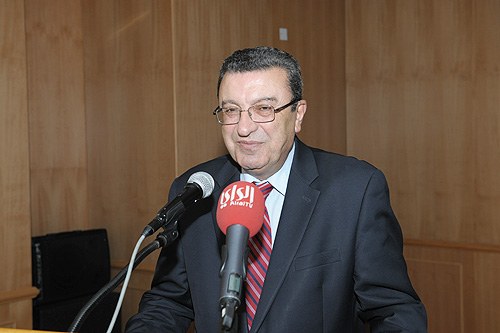
For the 11th consecutive year, the American University of Kuwait (AUK) has participated as the exclusive Diamond Sponsor in the education section of EDUCAREER 2014, the annual Education & Training Exhibition held at Kuwait International Fairgrounds (KIF) from April 27th until April 30th. This year, EDUCAREER coincides with the 10th anniversary of AUK and its celebration of a decade of contributions to Kuwait's higher education sector.
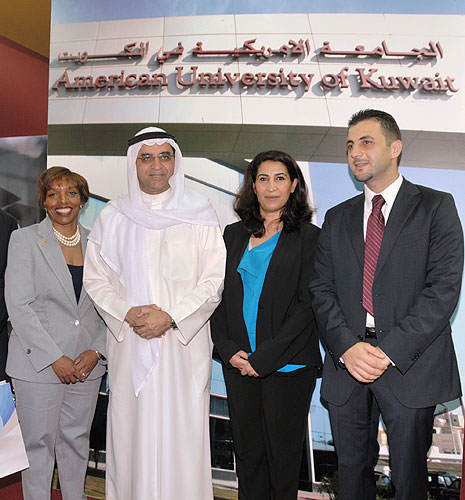
AUK Vice President for Admissions and Public Affairs, Amal Al-Binali; and the Vice President for Student Affairs, Dr. Carol Ross, were present at the opening ceremony to meet the Minister of Education & Higher Education, Mr. Ahmed Al-Mulaifi, who inaugurated the exhibition with ceremonial ribbon cutting, followed by a tour around the participating booths
The AUK Admissions team was also present to meet with prospective students and visitors and respond to inquiries about the admissions process, the different academic programs offered at AUK, the IEP program, government Scholarships, and campus life. Prospect students were also offered the opportunity to start their application process and schedule campus tours.
During the exhibition, representatives from the Center for Continuing Education (CCE) at AUK played an active role in promoting their services, training programs and workshops to both youth and adult learners.
EDUCAREER has always been a major annual admissions and marketing activity for AUK. The AUK booth at EDUCAREER has historically drawn a wide range of visitors including public and private high school students, parents, young professionals, and local media. This year AUK is expecting to see a higher footfall, especially that it had introduced the widely demanded Electric Engineering and Human Resources majors.
Currently, the American University of Kuwait offers 15 distinct degree programs in the following academic disciplines:
- Bachelor of Business Administration (BBA) in: Accounting, Finance, Marketing, Economics, Management, and Human Resources
- Bachelor of Arts (BA) in: Communication and Media, English, Graphic Design
- International Studies, and Social and Behavioral Sciences
- Bachelor of Science (BS) in: Computer Science, Information Systems
- Bachelor of Engineering (BE) in: Computer Engineering, Electrical Engineering
AUK is accredited institutionally by the Private Universities Council (PUC) in Kuwait. Its business programs are accredited by the Accreditation Council for Business Schools and Programs (ACBSP); its social sciences, arts and humanities programs are accredited by The American Academy for Liberal Education's (AALE); and its Intensive English program is accredited by the Commission for Intensive English Program Accreditation (CEA).
Released by the Office of Public Affairs on the 1st May 2014
Photography by the Office of Public Affairs (C) 2014