



News
19, Feb 2019
AUK Library Hosts Its 7th Annual Open House
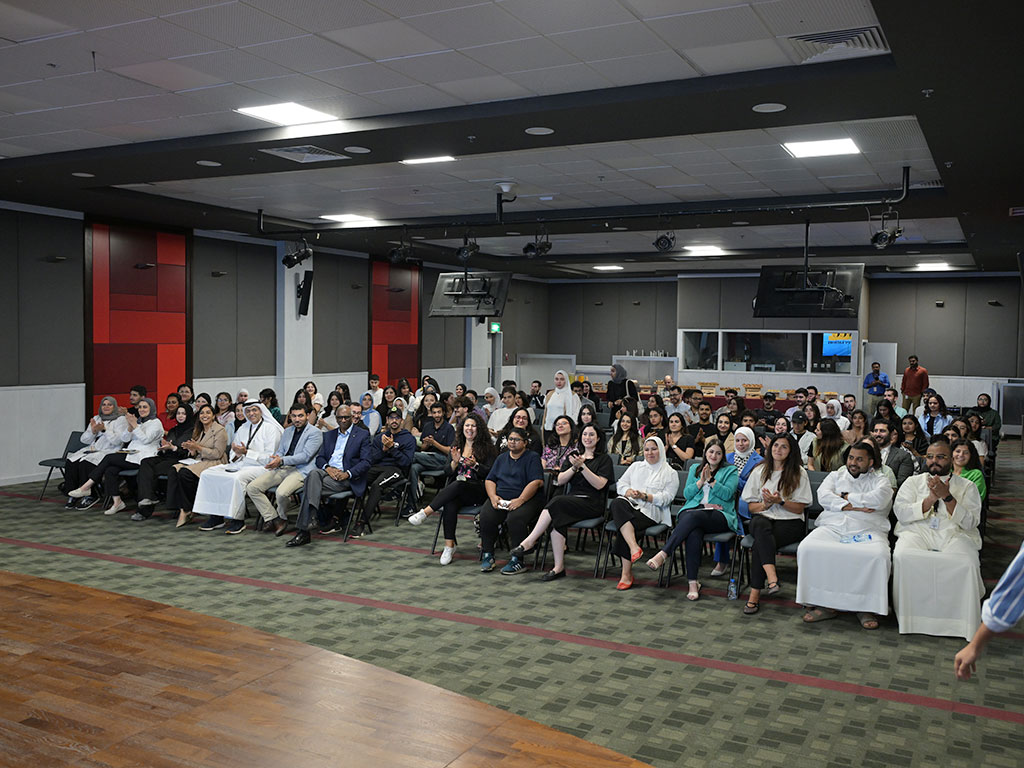
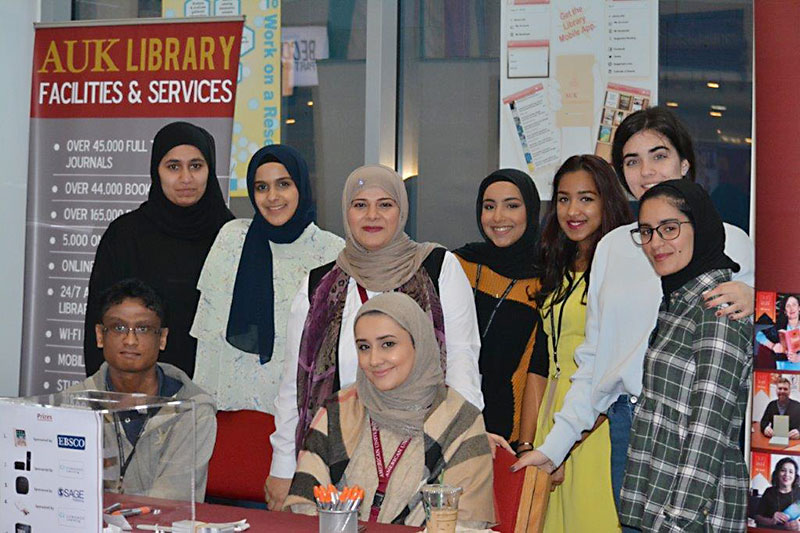
The Library at AUK held its 7th annual Open House event on Tuesday, February 12. At the event, the Library showcased its latest resources, services and interactive technologies to all members of the AUK community, and engaged with the visitors through a variety of activities and contests.
The Library’s partners and international publishers were present as academic resource vendors through their local agents in Kuwait, where they were able to provide promotional materials and short demos for online databases that are available at the AUK Library. Participating publishers included Naseej, Springer Nature, Virtus National, Emerald group Publishing, EBSCO and Cengage Learning. The Intensive English Program (IEP) also participated by setting a reading corner inside the library.
The event program also included educational games, such as the “Spinning Wheel” and the “Keys Swap Challenge”, both of which tested the participants’ library and general knowledge. All attendees had the chance to enter the raffle draw for a chance to win an iPad mini, Apple TV, HP photo printer or wireless speaker. Prizes were sponsored by EBSCO, Cengage Learning, SAGE and Emerald Group Publishing. The attendees were also invited to capture moments in a photo booth, have caricatures of themselves created, and explore the augmented reality display. The Open House concluded with a musical performance by a Saxophone player.
“The turnout this year was great! Library staff were thrilled to have been able to interact with a great number of students during this one-day event. I think it was a wonderful opportunity to learn about one another as a community – about our needs, expectations, what we know, and what we don’t know so that we bridge the gabs, if any.”
General photos from the event
View More
The Library’s partners and international publishers were present as academic resource vendors through their local agents in Kuwait, where they were able to provide promotional materials and short demos for online databases that are available at the AUK Library. Participating publishers included Naseej, Springer Nature, Virtus National, Emerald group Publishing, EBSCO and Cengage Learning. The Intensive English Program (IEP) also participated by setting a reading corner inside the library.
The event program also included educational games, such as the “Spinning Wheel” and the “Keys Swap Challenge”, both of which tested the participants’ library and general knowledge. All attendees had the chance to enter the raffle draw for a chance to win an iPad mini, Apple TV, HP photo printer or wireless speaker. Prizes were sponsored by EBSCO, Cengage Learning, SAGE and Emerald Group Publishing. The attendees were also invited to capture moments in a photo booth, have caricatures of themselves created, and explore the augmented reality display. The Open House concluded with a musical performance by a Saxophone player.
“The turnout this year was great! Library staff were thrilled to have been able to interact with a great number of students during this one-day event. I think it was a wonderful opportunity to learn about one another as a community – about our needs, expectations, what we know, and what we don’t know so that we bridge the gabs, if any.”
General photos from the event
07, Feb 2019
AUK and GSSCPD Completed an Applied Course on Behavioral Economics, Public Policy, and Nudge for Sustainability
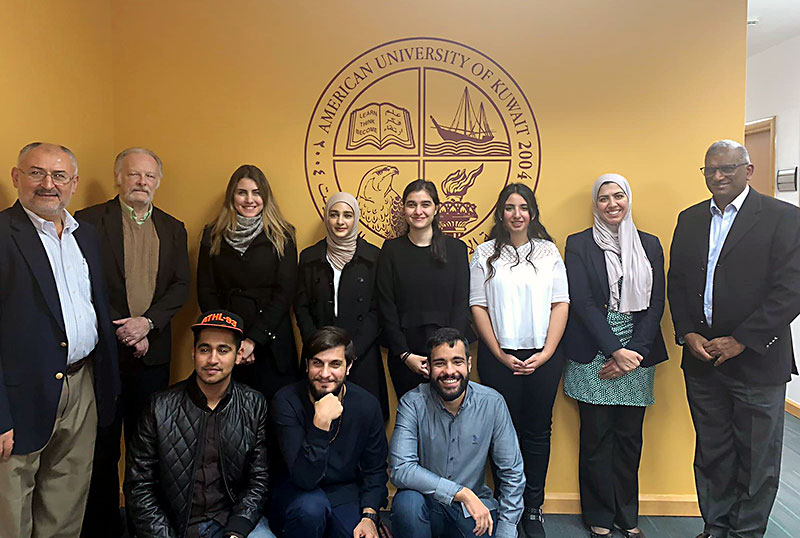
The College of Business and Economics (CBE) at the American University of Kuwait (AUK) jointly offered a new Interdisciplinary Honor Seminar that focused on behavioral economics, public policy, and nudge for sustainability. The BUS 489, entitled “Behavioral Public Policy for Sustainability and the Environment” was jointly taught in collaboration with the newly set-up behavioral insights unit Kuwait Policy Appraisal Lab (KPAL) under the Kuwait Public Policy Center (KPPC) at the General Secretariat of the Supreme Council for Planning and Development (GSSCPD), and the United Nations Development Programme (UNDP) in Kuwait. The course, which was designed as a joint offering between the national nudge units and universities, is a recent innovation in the Middle East. It provided a unique platform for AUK students to apply behavioral economics to design and implement experiments related to challenges with roots at the heart of KNDP 2035, with a focus on the energy and environment pillar.
The course combines collaboration with practitioners working from the field with academics from AUK. It was jointly taught by professors in the College of Business and Economics, Mark Speece, and Ali Aljamal, and a team from KPAL, which, was led by Dr. Fadi Makki and included Dr. Fatemah Al-Moussawi and Ms. Fatima Keaik. Dr Makki is the Head of the Qatar Behavioural Insights Unit (QBIU) and Founder of Nudge Lebanon—a pioneering group in the application of behavioral sciences to public policy issues in the MENA region. A similar course was developed by the QBIU and was offered at the Hamad Bin Khalifa University’s Juris Doctor (JD) Program in 2017-18. The course was then replicated at the American University of Beirut and at the American University of Kuwait.
CBE students implemented two field experiments, one to reduce littering in movie theatres, and the second to increase the use of recycling bins. The course provided an opportunity for students to engage with stakeholders, draw a behavioural map of the challenge, collect data, and analyze the findings. Both experiments were hailed as a success with strong implications for public policy. The field experiments were supported by the UNDP-KPPC project team, KPAL, QBIU, and Nudge Lebanon teams who coached students and helped them in the design, implementation, and analysis of their projects. Students successfully designed and implemented experiments to assess policy challenges and propose behavioral interventions which can guide decision-making in the pursuit of optimum public policy.
This collaboration provides a forum for policy makers, experts in behavioral sciences and academics to jointly tackle some of the sustainability challenges Kuwait is facing. H.E. Dr. Khaled Mahdi, Secretary General of GSSCPD, said, “By training students and exposing them to behavioral sciences and their applications to real-life policy challenges, we are bringing a new innovation, some form of experiential learning which few universities have done recently.” Dr. Ralph Palliam, the Dean of AUK’s College of Business and Economics, noted that the objectives of the course characterize AUK’s DNA and tradition to provide students an education that is humanistic, global, integrative, and distinctively liberal arts. “Courses of this nature fit well with the ongoing efforts to integrate real-world application into the program,” noted Dean Palliam.
Dr. Fadi Maki, Head of the QBIU and Founder of Nudge Lebanon, said that Behavioural Economics is now mainstream and teaching it is a must going forward. Dr. Makki stressed that the practical applications of Behavioral Economics bring a new skillset to future leaders, namely in policy experimentation. The awareness around behavioral sciences have been growing steadily over the last few years and has started with the set-up of nudge units in the Arab world led by QBIU and Nudge Lebanon.
View More
The course combines collaboration with practitioners working from the field with academics from AUK. It was jointly taught by professors in the College of Business and Economics, Mark Speece, and Ali Aljamal, and a team from KPAL, which, was led by Dr. Fadi Makki and included Dr. Fatemah Al-Moussawi and Ms. Fatima Keaik. Dr Makki is the Head of the Qatar Behavioural Insights Unit (QBIU) and Founder of Nudge Lebanon—a pioneering group in the application of behavioral sciences to public policy issues in the MENA region. A similar course was developed by the QBIU and was offered at the Hamad Bin Khalifa University’s Juris Doctor (JD) Program in 2017-18. The course was then replicated at the American University of Beirut and at the American University of Kuwait.
CBE students implemented two field experiments, one to reduce littering in movie theatres, and the second to increase the use of recycling bins. The course provided an opportunity for students to engage with stakeholders, draw a behavioural map of the challenge, collect data, and analyze the findings. Both experiments were hailed as a success with strong implications for public policy. The field experiments were supported by the UNDP-KPPC project team, KPAL, QBIU, and Nudge Lebanon teams who coached students and helped them in the design, implementation, and analysis of their projects. Students successfully designed and implemented experiments to assess policy challenges and propose behavioral interventions which can guide decision-making in the pursuit of optimum public policy.
This collaboration provides a forum for policy makers, experts in behavioral sciences and academics to jointly tackle some of the sustainability challenges Kuwait is facing. H.E. Dr. Khaled Mahdi, Secretary General of GSSCPD, said, “By training students and exposing them to behavioral sciences and their applications to real-life policy challenges, we are bringing a new innovation, some form of experiential learning which few universities have done recently.” Dr. Ralph Palliam, the Dean of AUK’s College of Business and Economics, noted that the objectives of the course characterize AUK’s DNA and tradition to provide students an education that is humanistic, global, integrative, and distinctively liberal arts. “Courses of this nature fit well with the ongoing efforts to integrate real-world application into the program,” noted Dean Palliam.
Dr. Fadi Maki, Head of the QBIU and Founder of Nudge Lebanon, said that Behavioural Economics is now mainstream and teaching it is a must going forward. Dr. Makki stressed that the practical applications of Behavioral Economics bring a new skillset to future leaders, namely in policy experimentation. The awareness around behavioral sciences have been growing steadily over the last few years and has started with the set-up of nudge units in the Arab world led by QBIU and Nudge Lebanon.
AUK and GSSCPD team group photo
Showing
10 Articles
of 1528
04, Feb 2019
AUK Board of Trustees Appoints Dr. Rawda Awwad as AUK’s Sixth President
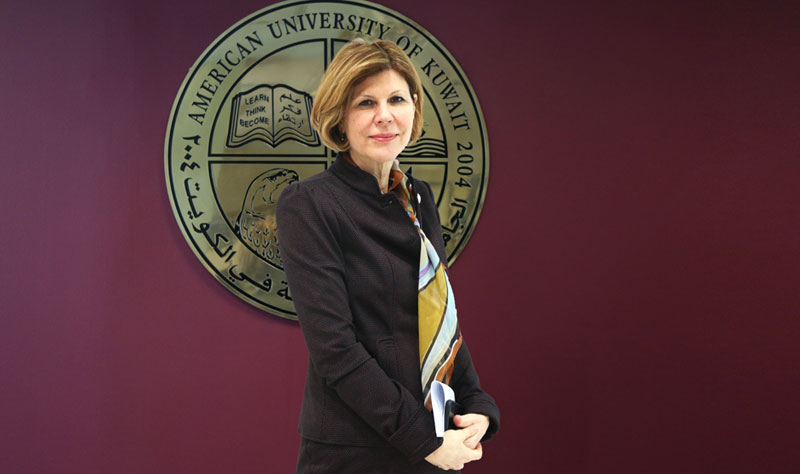
Chair of the Board of Trustees of the American University of Kuwait, Sheikha Dana Nasser Al-Sabah, announced today, that on Sunday, January 13, 2019, AUK’s Board of Trustees has voted unanimously to appoint Professor Rawda Hildegard Awwad as the sixth AUK president effective January 27, 2019. President-Elect Awwad will succeed President Tim “Earl” Sullivan who is leaving AUK to pursue other professional and personal interests.
“We are delighted to announce Professor Awwad as the new AUK President. Professor Awwad has genuine appreciation and understanding for liberal arts education which has been consistently reflected in her work since she joined AUK in 2004. Professor Awwad brings a wealth of experience in curriculum development, assessment, and accreditation. As we welcome Professor Awwad to her new post, I would like to thank President Sullivan for his contributions and servicesto AUK, and I look forward to continued success as the new president transitions to office,” said Al-Sabah.
Originally a faculty of English and Literature since 1995, Professor Awwad¬ has turned her career into a personal vocation: she has been a consummate teacher, mentor, scholar, administrator, and educational visionary throughout her professional life. Before joining AUK, she held a number of academic and/or administrative leadership positions at Duquesne University, Allegheny College, and the Pittsburgh Technical Institute.
“It is an honor to continue to serve the American University of Kuwait (AUK): its students, faculty, staff, parents and its broader constituents. We will maintain our distinctiveness and remain at the forefront of education in Kuwait by creating a sustainable impact that is visionary, constructive and forward looking,” said Professor Awwad.
Professor Awwad joined AUK in 2004 as a member of the university start-up team and member of the English department. In 2008, she was awarded a teaching/research grant by the U.S. State Department’s Strategic Engagement Initiative to develop and implement a series of courses addressing the rhetoric of terrorism and counter-terrorism. In 2009, Awwad was appointed Assistant Dean of the College of Arts and Sciences (CAS) and successfully oversaw a range of assessment and program accreditation initiatives. In 2013, she served as Interim CAS Dean prior to her appointment as Dean in 2014. In December 2016, Awwad was appointed University Provost, during which she focused on strengthening academic affairs and actively led a range of assessment and accreditation initiatives. Under her leadership, the university secured ABET accreditation for Computer Engineering, Electrical Engineering, and Computer Science.
Professor Awwad received her Bachelor of Sciences in Business and Administration in Marketing from Duquesne University, Pittsburgh, PA (1988); her M.A. in English from Duquesne (1992); and her Ph.D. in English from Duquesne University, Pittsburgh, PA (1997), with a specialization in nineteenth century British Literature, and Literary Theory and Criticism.
“We are delighted to announce Professor Awwad as the new AUK President. Professor Awwad has genuine appreciation and understanding for liberal arts education which has been consistently reflected in her work since she joined AUK in 2004. Professor Awwad brings a wealth of experience in curriculum development, assessment, and accreditation. As we welcome Professor Awwad to her new post, I would like to thank President Sullivan for his contributions and servicesto AUK, and I look forward to continued success as the new president transitions to office,” said Al-Sabah.
Originally a faculty of English and Literature since 1995, Professor Awwad¬ has turned her career into a personal vocation: she has been a consummate teacher, mentor, scholar, administrator, and educational visionary throughout her professional life. Before joining AUK, she held a number of academic and/or administrative leadership positions at Duquesne University, Allegheny College, and the Pittsburgh Technical Institute.
“It is an honor to continue to serve the American University of Kuwait (AUK): its students, faculty, staff, parents and its broader constituents. We will maintain our distinctiveness and remain at the forefront of education in Kuwait by creating a sustainable impact that is visionary, constructive and forward looking,” said Professor Awwad.
Professor Awwad joined AUK in 2004 as a member of the university start-up team and member of the English department. In 2008, she was awarded a teaching/research grant by the U.S. State Department’s Strategic Engagement Initiative to develop and implement a series of courses addressing the rhetoric of terrorism and counter-terrorism. In 2009, Awwad was appointed Assistant Dean of the College of Arts and Sciences (CAS) and successfully oversaw a range of assessment and program accreditation initiatives. In 2013, she served as Interim CAS Dean prior to her appointment as Dean in 2014. In December 2016, Awwad was appointed University Provost, during which she focused on strengthening academic affairs and actively led a range of assessment and accreditation initiatives. Under her leadership, the university secured ABET accreditation for Computer Engineering, Electrical Engineering, and Computer Science.
Professor Awwad received her Bachelor of Sciences in Business and Administration in Marketing from Duquesne University, Pittsburgh, PA (1988); her M.A. in English from Duquesne (1992); and her Ph.D. in English from Duquesne University, Pittsburgh, PA (1997), with a specialization in nineteenth century British Literature, and Literary Theory and Criticism.
AUK President, Dr. Rawda Awwad
04, Feb 2019
The Center for Gulf Studies at AUK Hosts Dr. Haneen Al-Ghabra
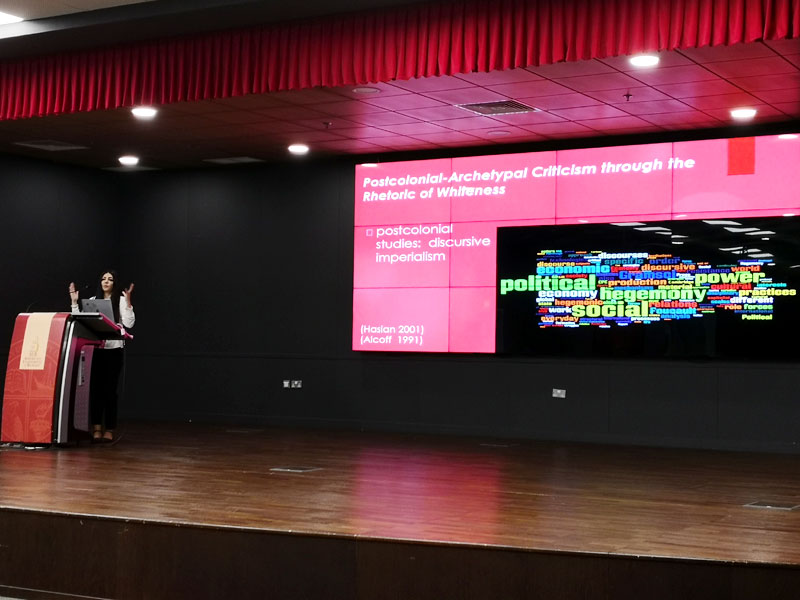
The Center for Gulf Studies (CGS) at AUK hosted a lecture by Dr. Haneen Al-Ghabra, Assistant Professor in the Department of Mass Communication in Kuwait University. The talk entitled, Muslim Women and White Femininity: Reenactment and Resistance, discussed the main findings of her book of the same title,where she focused on the portrayal of Muslim women in western media and their embodiment of white feminism.
In her talk, Dr. Al-Ghabrashed light on the hegemonic representation of feminism in an attempt tointroduce a transition towards the more inclusive intersectional feminist ethics, whichwould allow for anaccount ofthe multiple layers of thediverse ethnic, social, and religiousidentities of women of color. In studying this, she demonstrated the utilityof archetypal criticism, a form of criticism that analyzesrecurring archetypes, as a tool to deconstruct dominant discourses in the media. She suggested that there were archetypes of Muslim women circulated by western media outlets for further political and economic agendas, emphasizing,“It is important to know that Muslim women are always at the forefront of western media whenever the West wants to come into the region, politically, economically, and strategically.”
In particular, the speakerexaminedthree predominant archetypes carried through by Muslim womenwithin western media discourse and imagery.The first archetype she listed is‘The Oppressed’ which frames Muslim women as beings lacking access to basic rights. She offers the case of Malala Yousafzai, a Pakistani activist for female education, of being framed by the western media as someone who belongs in this category. Dr. Al-Ghabra’s second archetype was ‘The Advocate’ which she explains as a type that completely disengages with their own society, culture, and identity. The final archetype she introduced was ‘The Humanitarian’ such as philanthropist Queen Rania of Jordan. In this category, she notes the difference between the ways in which humanitarian efforts may be reported by western media.
In noting the significance of this lecture, Dr. Shareefa Al-Adwani, Director of CGS, said, “Dr. Al-Ghabra’s presentation allows us to reflect on our privileges and our oppressions, and how the two are both exogenous and internalized by all people. In this way, her research challenges us to interrogate institutions, ideas, and our identities as denizens of the Gulf.”
Dr. Haneen Al-Ghabra is an Assistant Professor at the Department of Mass Communications at Kuwait University. She recently was the recipient for the Outstanding Article Award, at the National Communication Association’s (NCA) Feminist Division in the United States (November, 2018). She is the author of Muslim Women and White Femininity: Reenactment and Resistance (November 2018) and specializes in Rhetoric and Cultural Studies with a focus on Intersectionality. Dr. Haneen’s methodological research is conducted through rhetorical criticism, ethnography, and autoethnography. She has been featured on more than six top panels and has won top awards four times. Dr. Haneen also has eight years of work experience both in the government and private sector in Kuwait in public relations and campaign planning.
In her talk, Dr. Al-Ghabrashed light on the hegemonic representation of feminism in an attempt tointroduce a transition towards the more inclusive intersectional feminist ethics, whichwould allow for anaccount ofthe multiple layers of thediverse ethnic, social, and religiousidentities of women of color. In studying this, she demonstrated the utilityof archetypal criticism, a form of criticism that analyzesrecurring archetypes, as a tool to deconstruct dominant discourses in the media. She suggested that there were archetypes of Muslim women circulated by western media outlets for further political and economic agendas, emphasizing,“It is important to know that Muslim women are always at the forefront of western media whenever the West wants to come into the region, politically, economically, and strategically.”
In particular, the speakerexaminedthree predominant archetypes carried through by Muslim womenwithin western media discourse and imagery.The first archetype she listed is‘The Oppressed’ which frames Muslim women as beings lacking access to basic rights. She offers the case of Malala Yousafzai, a Pakistani activist for female education, of being framed by the western media as someone who belongs in this category. Dr. Al-Ghabra’s second archetype was ‘The Advocate’ which she explains as a type that completely disengages with their own society, culture, and identity. The final archetype she introduced was ‘The Humanitarian’ such as philanthropist Queen Rania of Jordan. In this category, she notes the difference between the ways in which humanitarian efforts may be reported by western media.
In noting the significance of this lecture, Dr. Shareefa Al-Adwani, Director of CGS, said, “Dr. Al-Ghabra’s presentation allows us to reflect on our privileges and our oppressions, and how the two are both exogenous and internalized by all people. In this way, her research challenges us to interrogate institutions, ideas, and our identities as denizens of the Gulf.”
Dr. Haneen Al-Ghabra is an Assistant Professor at the Department of Mass Communications at Kuwait University. She recently was the recipient for the Outstanding Article Award, at the National Communication Association’s (NCA) Feminist Division in the United States (November, 2018). She is the author of Muslim Women and White Femininity: Reenactment and Resistance (November 2018) and specializes in Rhetoric and Cultural Studies with a focus on Intersectionality. Dr. Haneen’s methodological research is conducted through rhetorical criticism, ethnography, and autoethnography. She has been featured on more than six top panels and has won top awards four times. Dr. Haneen also has eight years of work experience both in the government and private sector in Kuwait in public relations and campaign planning.
Dr. Haneen Al-Ghabra during the lecture
03, Feb 2019
Abolish153 Campaign Shares National Survey Findings with AUK Community
In recognition of the International Day for the Elimination of Violence Against Women, the Center for Gulf Studies (CGS) at AUK hosted the campaign to Abolish Article 153. In a lecture entitled, Attitudes on Violence in Kuwait, the speakers shared their findings from the Abolish 153’s national surveyon violenceto the AUK community, members of the public,and special guests such as His Excellency US Ambassador Lawrence Silverman.
Dr. Alanoud Al-Sharekh, Chairperson of Abolish 153 and Director of Ibtkar Strategic Consultancy, introduced the campaign’s primary objective —to abolish Article 153 from Kuwait’s penal code. In particular domestic situations, the law downgrades the severity of husband-initiated homicides to a misdemeanor. In this case, the punishment is a maximum of 3 years in prison and/or a 3,000 rupee (KD 14) fine. Dr. Al-Sharekh also discussed how other articles, such as Article 29 that allows for greater permissiveness regarding violence, may collectively reduce the ability for survivors of abuse to find and receive resources that would alleviate threats to themselves and their loved ones.
The campaign focuses on lobbying policymakers and advocating policies that present alternatives to Kuwait’s current legal framework on this issue, such as encouraging the State to intervene on behalf of survivors. This intervention may take the form of the provision of necessary crisis centers, legal assistance, medical aid, and functional shelters for survivors. Without these resources in place, the members of Abolish 153 have taken it upon themselves to provide some resources to survivors, all while aligning with the current laws and regulations of Kuwait. So far, eighty-six women have been assisted in various capacities.
In May 2017, the campaign’s greatest milestone was achieved when Members of Parliament signed a bill to end Article 153. Since then, the campaign’s advocacy and awareness efforts have expanded, such as providing support for the establishment of the first independent women’s shelter in Kuwait.
Dr. Al-Sharekh further discussed the general lack of availability of comprehensive and reflective national statistics on domestic violence. Due to this lack of data, Abolish153 funded the national survey that was discussed at the panel. In surveying over 700 people proportionally representing Kuwait’s community, they found disparities between respondents’ perception of domestic violence and actual case studies and experiences found in interviews. The study found that while violence against children and violence against the elderly were perceived by both sexes as important issues, violence against women was perceived as less important of an issue by men. Up to 50% of respondents indicated that this was due to the culturally embedded nature of guardianship and the value of traditional sex-gender roles. Similarly, the perpetrators were prominently perceived to be significant others, perhaps due to promotion of the stereotype by the media, whereas in discussions with survivors, the perpetrators were most likely direct relatives. In either case, scholars suggested that the results illustrate the need for government interventionand assistance.
Most notably, Al-Sharekh revealed that 53% of respondents —both men and women— have been subjected to violence. The real figure may be higher, as there is a tendency to under-report domestic violence. In spear heading the research, Dr. Fatma Al-Salem, Assistant Professor of Mass Communications at Kuwait University, shared anonymous stories from her in-depth interviews from the study. She indicated that each story indicated the need for women to be financially empowered, and the possibility for change has to begin with the immediate family. She implored the audience to discuss ongoing violence against women and to bring awareness to the campaign, to resources, and to ask for greater public assistance in the journey to eliminate domestic violence. Indeed, the scholars reminded the audience that the perpetuation of the violence was a threat to Kuwait’s values of peace and humanity.
The audience found the results striking and continued to engage in dialogue after the presentation of the statistics. One question asked about the possibility of greater involvement in the process of helping survivors. The scholars revealed that the campaign hosts an annual fundraising exhibition, which displays and sells creations by various local and international artists. The proceeds of the exhibition go to assist survivors of violence. When asked about the fates of the anonymous survivors, after hearing their stories, Dr. Al-Sharekh indicated that not all survivors remain in touch with the campaign. She continued, however, by noting that passing legislation for the protection of survivors of domestic violence would be the greatest contribution of all members of our society and the most positive legacy to leave future generations.
Dr. Shareefa Al-Adwani, Director of the Center for Gulf Studies, emphasized that bringing studies about societal difficulties, while perhaps tough to listen to, is the first step to addressing the issues, “The discussions promote greater understanding of ourselves, our society, and our culture, and offers direction in how we may begin to improve our private and public lives.” She continued, “We appreciate Drs. Al-Sharekh and Al-Salem for conducting such a far-reaching study and discussing the results with all sectors of society in order to understand where we currently stand on this issue and to understand where we want to be on this issue.”
Dr. Alanoud Al-Sharekh, Chairperson of Abolish 153 and Director of Ibtkar Strategic Consultancy, introduced the campaign’s primary objective —to abolish Article 153 from Kuwait’s penal code. In particular domestic situations, the law downgrades the severity of husband-initiated homicides to a misdemeanor. In this case, the punishment is a maximum of 3 years in prison and/or a 3,000 rupee (KD 14) fine. Dr. Al-Sharekh also discussed how other articles, such as Article 29 that allows for greater permissiveness regarding violence, may collectively reduce the ability for survivors of abuse to find and receive resources that would alleviate threats to themselves and their loved ones.
The campaign focuses on lobbying policymakers and advocating policies that present alternatives to Kuwait’s current legal framework on this issue, such as encouraging the State to intervene on behalf of survivors. This intervention may take the form of the provision of necessary crisis centers, legal assistance, medical aid, and functional shelters for survivors. Without these resources in place, the members of Abolish 153 have taken it upon themselves to provide some resources to survivors, all while aligning with the current laws and regulations of Kuwait. So far, eighty-six women have been assisted in various capacities.
In May 2017, the campaign’s greatest milestone was achieved when Members of Parliament signed a bill to end Article 153. Since then, the campaign’s advocacy and awareness efforts have expanded, such as providing support for the establishment of the first independent women’s shelter in Kuwait.
Dr. Al-Sharekh further discussed the general lack of availability of comprehensive and reflective national statistics on domestic violence. Due to this lack of data, Abolish153 funded the national survey that was discussed at the panel. In surveying over 700 people proportionally representing Kuwait’s community, they found disparities between respondents’ perception of domestic violence and actual case studies and experiences found in interviews. The study found that while violence against children and violence against the elderly were perceived by both sexes as important issues, violence against women was perceived as less important of an issue by men. Up to 50% of respondents indicated that this was due to the culturally embedded nature of guardianship and the value of traditional sex-gender roles. Similarly, the perpetrators were prominently perceived to be significant others, perhaps due to promotion of the stereotype by the media, whereas in discussions with survivors, the perpetrators were most likely direct relatives. In either case, scholars suggested that the results illustrate the need for government interventionand assistance.
Most notably, Al-Sharekh revealed that 53% of respondents —both men and women— have been subjected to violence. The real figure may be higher, as there is a tendency to under-report domestic violence. In spear heading the research, Dr. Fatma Al-Salem, Assistant Professor of Mass Communications at Kuwait University, shared anonymous stories from her in-depth interviews from the study. She indicated that each story indicated the need for women to be financially empowered, and the possibility for change has to begin with the immediate family. She implored the audience to discuss ongoing violence against women and to bring awareness to the campaign, to resources, and to ask for greater public assistance in the journey to eliminate domestic violence. Indeed, the scholars reminded the audience that the perpetuation of the violence was a threat to Kuwait’s values of peace and humanity.
The audience found the results striking and continued to engage in dialogue after the presentation of the statistics. One question asked about the possibility of greater involvement in the process of helping survivors. The scholars revealed that the campaign hosts an annual fundraising exhibition, which displays and sells creations by various local and international artists. The proceeds of the exhibition go to assist survivors of violence. When asked about the fates of the anonymous survivors, after hearing their stories, Dr. Al-Sharekh indicated that not all survivors remain in touch with the campaign. She continued, however, by noting that passing legislation for the protection of survivors of domestic violence would be the greatest contribution of all members of our society and the most positive legacy to leave future generations.
Dr. Shareefa Al-Adwani, Director of the Center for Gulf Studies, emphasized that bringing studies about societal difficulties, while perhaps tough to listen to, is the first step to addressing the issues, “The discussions promote greater understanding of ourselves, our society, and our culture, and offers direction in how we may begin to improve our private and public lives.” She continued, “We appreciate Drs. Al-Sharekh and Al-Salem for conducting such a far-reaching study and discussing the results with all sectors of society in order to understand where we currently stand on this issue and to understand where we want to be on this issue.”
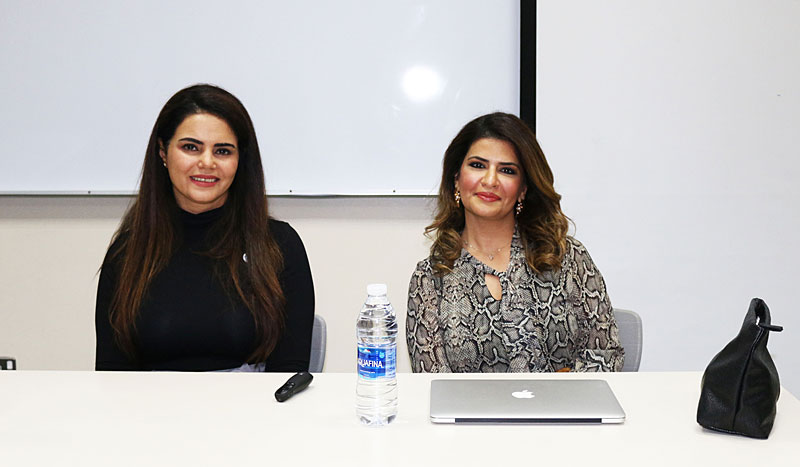
Lecture speakers, Dr. Alanoud Al-Sharekh, and Dr. Fatma Al-Salem
Dr. Alanoud Al-Sharekh during the lecture
Member of the audience asking a question during the Q&A session
Audience members attending the lecture
29, Jan 2019
AUK’s RISE Center Explores Vehicle-Based Information Services
The Center for Research in Informatics, Sciences and Engineering (RISE) at the American University of Kuwait (AUK) hosted a lecture titled “Towards Provisioning Vehicle-Based Information Services.” The lecture was presented by Professor Hossam Hassanein, Director of the School of Computing at Queen’s University in Canada; his lecture focused on introducing the research trends in the field of IOT and smart vehicles.
In his talk, Dr. Hassanein introduced the concept of the Vehicle as a Resource (VaaR), where he explored the role of intelligent vehicles in the development of intelligent transportation systems. He anticipated that smart vehicles could be a significant service provider in a variety of situations—including emergency scenarios. Whether the vehicles are on the road or parked, the service can be utilized to serve the interests of both the vehicle occupants and third-party recipients. To illustrate, he discussed how the integration of the vehicles’ sensor technologies available in the vehicles and drivers’ smartphones could be used to provide advanced, robust localization and accurate road information services. This could contribute to reporting road conditions, traffic flow, and weather updates. Such data can be collected and stored using cloud computing for further use in planning and policy recommendations.
Following his lecture, Dr. Hassanein received questions from the audience related to privacy concerns in data collection and misuse, as well as alternative suggestions of making roads smarter to simplify the process.
Dr. Amir Zeid, Director of RISE, expressed RISE’s privilege in hosting Dr. Hassanein saying, “As a platform for community engagement, we welcome international experts from a wide variety of disciplines—not only to share their expertise with us, but to inspire and empower our students and local community.” He noted the significance of this lecture in relating advancements in the IOT (internet of things) and the future of smart vehicles, to further innovations in both the industry and academia.
Dr. Hossam Hassanein is a leading authority in the areas of broadband, wireless and mobile networks architecture, protocols, control and performance evaluation. His record spans more than 500 publications in journals, conferences and book chapters, in addition to numerous keynotes and plenary talks in flagship venues. Dr. Hassanein has received several recognitions and best papers awards at top international conferences. He is also the Founder and Director of the Telecommunications Research Lab (TRL) at Queen’s University School of Computing, with extensive international academic and industrial collaborations. He is the former Chair of the IEEE Communication Society Technical Committee on Ad hoc and Sensor Networks (TC AHSN). Dr. Hassanein is an IEEE Communications Society Distinguished Speaker, and a fellow of the IEEE.
About RISE:
The AUK Center for Research in Informatics, Sciences, and Engineering (RISE) serves as AUK's primary source for multidisciplinary research and development (R&D) activities. The Center employs a holistic approach to R&D by integrating academic disciplines, and forging connections between local & international innovators, academia & industry, and technology & society.
In his talk, Dr. Hassanein introduced the concept of the Vehicle as a Resource (VaaR), where he explored the role of intelligent vehicles in the development of intelligent transportation systems. He anticipated that smart vehicles could be a significant service provider in a variety of situations—including emergency scenarios. Whether the vehicles are on the road or parked, the service can be utilized to serve the interests of both the vehicle occupants and third-party recipients. To illustrate, he discussed how the integration of the vehicles’ sensor technologies available in the vehicles and drivers’ smartphones could be used to provide advanced, robust localization and accurate road information services. This could contribute to reporting road conditions, traffic flow, and weather updates. Such data can be collected and stored using cloud computing for further use in planning and policy recommendations.
Following his lecture, Dr. Hassanein received questions from the audience related to privacy concerns in data collection and misuse, as well as alternative suggestions of making roads smarter to simplify the process.
Dr. Amir Zeid, Director of RISE, expressed RISE’s privilege in hosting Dr. Hassanein saying, “As a platform for community engagement, we welcome international experts from a wide variety of disciplines—not only to share their expertise with us, but to inspire and empower our students and local community.” He noted the significance of this lecture in relating advancements in the IOT (internet of things) and the future of smart vehicles, to further innovations in both the industry and academia.
Dr. Hossam Hassanein is a leading authority in the areas of broadband, wireless and mobile networks architecture, protocols, control and performance evaluation. His record spans more than 500 publications in journals, conferences and book chapters, in addition to numerous keynotes and plenary talks in flagship venues. Dr. Hassanein has received several recognitions and best papers awards at top international conferences. He is also the Founder and Director of the Telecommunications Research Lab (TRL) at Queen’s University School of Computing, with extensive international academic and industrial collaborations. He is the former Chair of the IEEE Communication Society Technical Committee on Ad hoc and Sensor Networks (TC AHSN). Dr. Hassanein is an IEEE Communications Society Distinguished Speaker, and a fellow of the IEEE.
About RISE:
The AUK Center for Research in Informatics, Sciences, and Engineering (RISE) serves as AUK's primary source for multidisciplinary research and development (R&D) activities. The Center employs a holistic approach to R&D by integrating academic disciplines, and forging connections between local & international innovators, academia & industry, and technology & society.
Dr. Amir Zeid, Director of RISE Center
Dr. Hossam Hassanein during his lecture
23, Jan 2019
AUK Psychology Students Visit the Kuwait Psychiatric Hospital
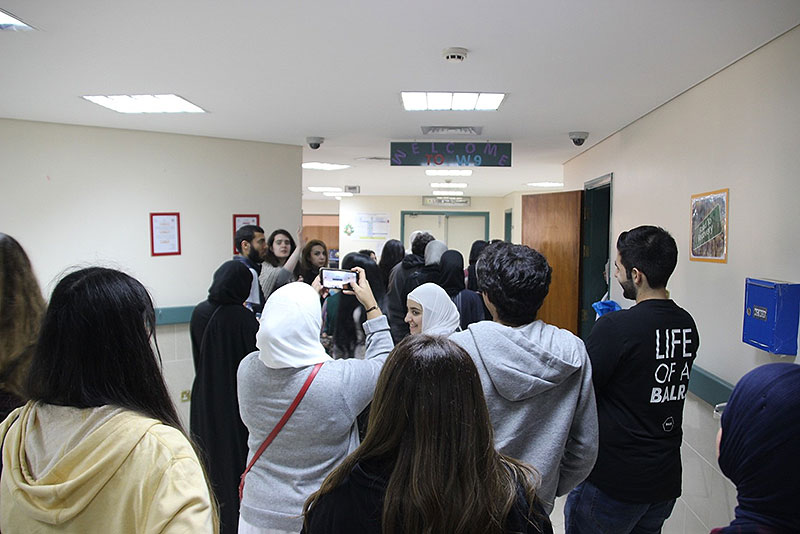
Students from the psychology classes at AUK took a trip with their professor, Dr. Juliet Dinkha to the Kuwait Psychiatric Hospital. Upon arriving at the hospital, it became apparent how crucial this trip was in understanding abnormal psychology, especially when living in a culture where mental abnormalities are far from being accepted.
The tour began in the auditorium of the Psychiatric Rehabilitation Unit where the students and faculty were greeted by the Director of the unit, Dr. Adel Al Zayed. They were introduced to the idea of a ‘therapeutic community’ and how the patients relied on each other for support during their times of recovery.
The next part of the tour was led by Ms. Abeer, a social worker who works closely with Dr. Adel in helping recovering patients achieve their goals of a drug-free lifestyle. She guided AUK students to the inpatient unit which ranged from the lecture hall to the personal rooms of the patients. Going through the female ward of the drug and substance abuse was a raw feeling of honesty. It served as a realization that substance abuse does happen and there are those who seek recovery with success stories to follow. The most interesting place of the ward was the halfway house which is where the women or men would slowly integrate back into the larger Kuwaiti society. They would look for jobs or attend university during the day but return home at night. Residents of the halfway house would usually stay for about a year to a year and a half.
After visiting the center of drug and substance abuse, the group visited the General Psychiatric Hospital. Their guide, Dr. Ibrahim took them to visit the wards; it became apparent that residents, particularly those who experience psychosis, could easily be disturbed by additional noises when they are trying to relax. While going through the wards the group got to meet one of the nurses. She explained that she oversaw the female patients who suffered from low IQs.
The tour concluded at the forensic unit. This unit was primarily responsible for observing the patients for psychopathy and helping those with recover and reintegrating with society. This experience allowed the students to change their views of mental institutions and the different kinds of cases that are being treated there.
The tour began in the auditorium of the Psychiatric Rehabilitation Unit where the students and faculty were greeted by the Director of the unit, Dr. Adel Al Zayed. They were introduced to the idea of a ‘therapeutic community’ and how the patients relied on each other for support during their times of recovery.
The next part of the tour was led by Ms. Abeer, a social worker who works closely with Dr. Adel in helping recovering patients achieve their goals of a drug-free lifestyle. She guided AUK students to the inpatient unit which ranged from the lecture hall to the personal rooms of the patients. Going through the female ward of the drug and substance abuse was a raw feeling of honesty. It served as a realization that substance abuse does happen and there are those who seek recovery with success stories to follow. The most interesting place of the ward was the halfway house which is where the women or men would slowly integrate back into the larger Kuwaiti society. They would look for jobs or attend university during the day but return home at night. Residents of the halfway house would usually stay for about a year to a year and a half.
After visiting the center of drug and substance abuse, the group visited the General Psychiatric Hospital. Their guide, Dr. Ibrahim took them to visit the wards; it became apparent that residents, particularly those who experience psychosis, could easily be disturbed by additional noises when they are trying to relax. While going through the wards the group got to meet one of the nurses. She explained that she oversaw the female patients who suffered from low IQs.
The tour concluded at the forensic unit. This unit was primarily responsible for observing the patients for psychopathy and helping those with recover and reintegrating with society. This experience allowed the students to change their views of mental institutions and the different kinds of cases that are being treated there.
AUK students during their tour of the facilities
Group photo of the students with their professor outside the hospital
19, Dec 2018
AUK Hosts Leadership Workshops for Student Clubs and Organizations in Collaboration with EN.V
AUK recently hosted a series of leadership workshops organized by the Clubs and Organizations Coordinator from the Office of Student of Life, Division of Students Affairs at AUK in collaboration with EN.V. T
The workshops which took place in the University’s student lounge, were tailored for AUK by EN.V, and were designed to help students gain an added cooperative and results-based approach towards teamwork, while enhancing the synchronicity and harmony between the clubs and organizations at AUK.
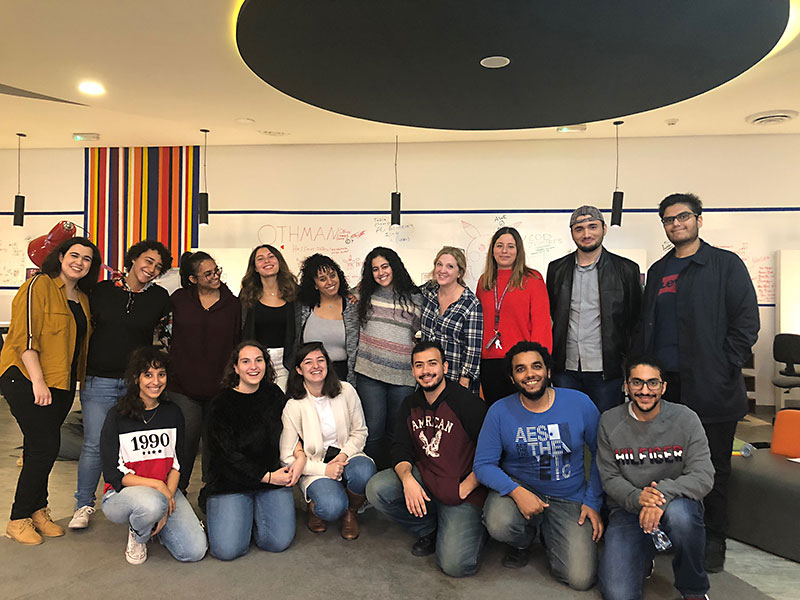
Facilitated by the management team from EN.V, Eleanor Burton and AUK Alumni Layan Al Dabt, the workshops were attended by presidents and treasurers of each of the 25 university student clubs and two student organizations. The students walked through various informative tactics and collaborative projects to assist them in defining their values, realizing and expanding their communication styles and skills to instill a deeper sense of community between the student clubs & organizations and the rest of the AUK community.
The workshop series titled, Building Collaborative Process, Teamwork, Leadership and Results-Based Activity Planning, consisted of three intense sessions which commenced with a three-hour orientation, followed by four and a half-hour sessions: Leadership and Communication Styles, and concluded with a five and a half-hour closing session: Planning for Impact.
Commenting on the workshop series, Dean of Student Affairs at the American University of Kuwait, Dr. Hanan Muzaffar, expressed her delight, “Everything was professionally planned and tailored precisely to match our AUK community’s character and what our student clubs and organizations strive to accomplish. We have received positive feedback from the workshop attendees and look forward to more inspirational and informative activities which enrich our student body and their overall holistic experience at AUK. Congratulations to the students who completed the workshops, and thank you to EN.V for tailoring the workshops to suit AUK’s vision, for their time and effort, and most importantly and for their admirable mentorship and motivational workshops,” she said.
Student clubs and organizations’ leaders during the Building Collaborative Process, Teamwork, Leadership and Results-Based Activity Planning workshop
The workshops which took place in the University’s student lounge, were tailored for AUK by EN.V, and were designed to help students gain an added cooperative and results-based approach towards teamwork, while enhancing the synchronicity and harmony between the clubs and organizations at AUK.
Facilitated by the management team from EN.V, Eleanor Burton and AUK Alumni Layan Al Dabt, the workshops were attended by presidents and treasurers of each of the 25 university student clubs and two student organizations. The students walked through various informative tactics and collaborative projects to assist them in defining their values, realizing and expanding their communication styles and skills to instill a deeper sense of community between the student clubs & organizations and the rest of the AUK community.
The workshop series titled, Building Collaborative Process, Teamwork, Leadership and Results-Based Activity Planning, consisted of three intense sessions which commenced with a three-hour orientation, followed by four and a half-hour sessions: Leadership and Communication Styles, and concluded with a five and a half-hour closing session: Planning for Impact.
Commenting on the workshop series, Dean of Student Affairs at the American University of Kuwait, Dr. Hanan Muzaffar, expressed her delight, “Everything was professionally planned and tailored precisely to match our AUK community’s character and what our student clubs and organizations strive to accomplish. We have received positive feedback from the workshop attendees and look forward to more inspirational and informative activities which enrich our student body and their overall holistic experience at AUK. Congratulations to the students who completed the workshops, and thank you to EN.V for tailoring the workshops to suit AUK’s vision, for their time and effort, and most importantly and for their admirable mentorship and motivational workshops,” she said.
Student clubs and organizations’ leaders during the Building Collaborative Process, Teamwork, Leadership and Results-Based Activity Planning workshop
19, Dec 2018
CCE Celebrates The Completion of Al-Amiri Hospital Employees Leadership Training Programs For The Year
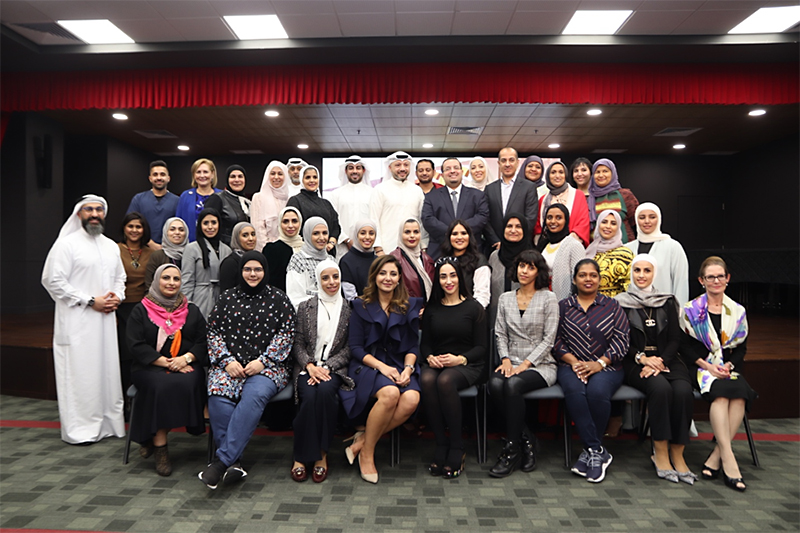
The Center of Continuing Education (CCE) at AUK celebrated the graduation of the final class of the iCARE Development Programs—a series of 6 program launched in April in collaboration with Al Amiri Hospital focusing on 125 executives and staff from the hospital. The integrated training programs were designed for senior management and their medical staff in an effort to improve the hospital’s working culture. The ceremony was held at AUK’s Auditorium and was attended by the the Director of Al Amiri Hospital, Dr. Ali Alalanda; Assistant Undersecretary of the Kuwaiti Ministry of Health for Supporting Medical Services, Dr. Fawaz Al-Rifai; and Director of CCE Mrs. Buthaina Al-Khubaizi, who presented the graduates with their certificates.
Al-Khubazi explained, “The iCARE Development Programs have been designed with change and leadership skills in mind, inspired by the combined vision of Al-Amiri Hospital and the Center for Continuing Education at AUK. The program will help contribute to the creation of the iCARE culture throughout the hospital. This journey of learning will continue through the Al-Amiri Hospital management team leading by example - what you do is so much more important than what you say.”
The Leadership Development Certificate Program aimed to train 25 executives on how to analyze and develop their personal leadership styles to become leaders who support, challenge, and inspire commitment to the organization’s vision of excellence. This was accomplished through 2 customised leadership modules: The Leader Within, which focused on helping leaders analyze and strategize their personal leadership styles to motivate and inspire their teams to maximum performance; and Leading Change, which developed a mindset of growth in leading and managing change, from strategy to implementing changes in a work system. The program relied on collaborative exercises and guided discussions to help participants relate to the challenges they face at work. One of the participants recognised the successful outcome of the program, saying, “This program changed my perception about leadership and has helped me to think and lead in a new and more inspiring way!”
The iCARE Program provided over 100 medical and non-medical professionals with the opportunity to enhance their principles of social and self-awareness required to effectively communicate with people, and provide patients and visitors with the best healthcare service. After exploring topics such as emotional intelligence, self-awareness and communication styles, the participants planned an post-course work-based project that will facilitate continuing work on interpersonal skills, and iCARE service excellence.
In recognizing the significance of the program, Dr. Alalanda said, “Education and staff development is our number one priority and we always seek development and self-improvment. Our main goal is to be a better version of ourselves in delivering the best healthcare services possible. ”
Al-Khubazi explained, “The iCARE Development Programs have been designed with change and leadership skills in mind, inspired by the combined vision of Al-Amiri Hospital and the Center for Continuing Education at AUK. The program will help contribute to the creation of the iCARE culture throughout the hospital. This journey of learning will continue through the Al-Amiri Hospital management team leading by example - what you do is so much more important than what you say.”
The Leadership Development Certificate Program aimed to train 25 executives on how to analyze and develop their personal leadership styles to become leaders who support, challenge, and inspire commitment to the organization’s vision of excellence. This was accomplished through 2 customised leadership modules: The Leader Within, which focused on helping leaders analyze and strategize their personal leadership styles to motivate and inspire their teams to maximum performance; and Leading Change, which developed a mindset of growth in leading and managing change, from strategy to implementing changes in a work system. The program relied on collaborative exercises and guided discussions to help participants relate to the challenges they face at work. One of the participants recognised the successful outcome of the program, saying, “This program changed my perception about leadership and has helped me to think and lead in a new and more inspiring way!”
The iCARE Program provided over 100 medical and non-medical professionals with the opportunity to enhance their principles of social and self-awareness required to effectively communicate with people, and provide patients and visitors with the best healthcare service. After exploring topics such as emotional intelligence, self-awareness and communication styles, the participants planned an post-course work-based project that will facilitate continuing work on interpersonal skills, and iCARE service excellence.
In recognizing the significance of the program, Dr. Alalanda said, “Education and staff development is our number one priority and we always seek development and self-improvment. Our main goal is to be a better version of ourselves in delivering the best healthcare services possible. ”
Graduation picture of the last batch of Al-Amiri Hospital participents
From the right: Assistant Undersecretary of the Kuwaiti Ministry of Health for Supporting Medical Services, Dr. Fawaz Al-Rifai ; Director of Al Amiri Hospital, Dr. Ali Alalanda; and Director of CCE Mrs. Buthaina Al-Khubaizi
Class photo of Al Amiri Hospital participants, including the Director of Al Amiri Hospital, Dr. Ali Alaland
17, Dec 2018
AUK Launches LEAD Program
The American University of Kuwait (AUK) launched its leadership program—LEAD@AUK, Fall 2018, with Level 1–Foundations of Leadership, through a set of workshops by AUK faculty serving a total of 26 students.
Level 1 of LEAD@AUK–Foundations of Leadership has been tailored to inspire students, instill leadership qualities, and provide them with helpful knowledge of how to lead effectively in the workplace and in their everyday life.
The month-long sessions covered four main areas that were tailored for the program by AUK faculty experts in the following fields: Developing Identity Through Performance with Dr. Yasmine Jahanmir; Leadership Skills for Life with Dr. Salime Mehtap (Smadi); Leading with Emotional Intelligence with Dr. Stavros P. Hadjisolomou; and Effective Communication: Using Your Voice to Change the World with Dr. Candace Dominique.
LEAD is a collaborative program initiated by the Division of Student Affairs and designed to enhance leadership traits. It is comprised of multiple levels which will be introduced throughout the academic year, and will include workshops, trainings, discussions, and much more. The program is part of AUK’s Holistic Student Engagement initiative and reflects the University’s ongoing commitments to its slogan— LEARN. THINK. BECOME.
Commenting on the program, Dean of Student Affairs, Dr. Hanan Muzaffar said, “It has been a rewarding and profound launch and experience, I commend all our participating students for their eagerness to develop themselves and grow their leadership skills. We look forward to the continuation of LEAD@AUK, as we continue to enrich the students’ experience at AUK. Congratulations to those who have completed Level 1, and thank you to our faculty members for sharing their expertise and for their graceful mentorship and inspirational workshops.”
Level 1 of LEAD@AUK–Foundations of Leadership has been tailored to inspire students, instill leadership qualities, and provide them with helpful knowledge of how to lead effectively in the workplace and in their everyday life.
The month-long sessions covered four main areas that were tailored for the program by AUK faculty experts in the following fields: Developing Identity Through Performance with Dr. Yasmine Jahanmir; Leadership Skills for Life with Dr. Salime Mehtap (Smadi); Leading with Emotional Intelligence with Dr. Stavros P. Hadjisolomou; and Effective Communication: Using Your Voice to Change the World with Dr. Candace Dominique.
LEAD is a collaborative program initiated by the Division of Student Affairs and designed to enhance leadership traits. It is comprised of multiple levels which will be introduced throughout the academic year, and will include workshops, trainings, discussions, and much more. The program is part of AUK’s Holistic Student Engagement initiative and reflects the University’s ongoing commitments to its slogan— LEARN. THINK. BECOME.
Commenting on the program, Dean of Student Affairs, Dr. Hanan Muzaffar said, “It has been a rewarding and profound launch and experience, I commend all our participating students for their eagerness to develop themselves and grow their leadership skills. We look forward to the continuation of LEAD@AUK, as we continue to enrich the students’ experience at AUK. Congratulations to those who have completed Level 1, and thank you to our faculty members for sharing their expertise and for their graceful mentorship and inspirational workshops.”
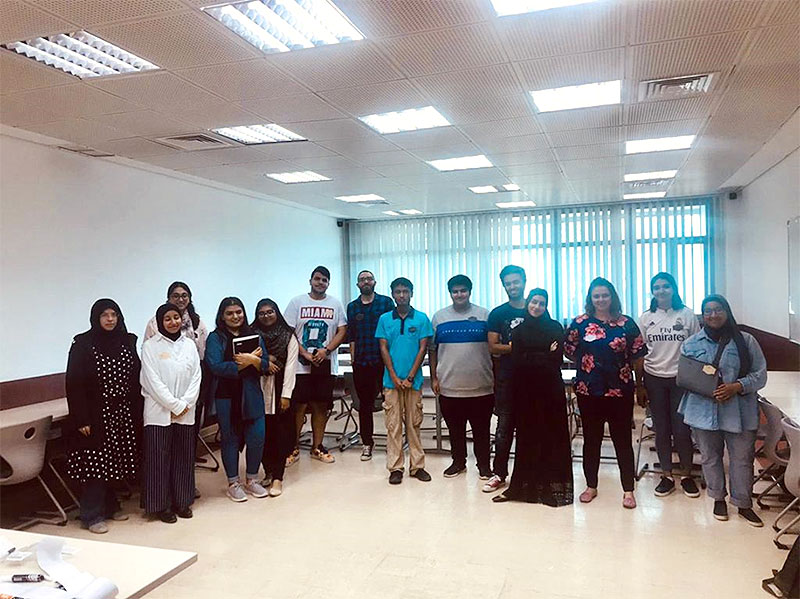
Group picture of the student attendees and professor from the opening session of Foundations of Leadership: Developing Identity through Performance with Dr. Yasmine Jahanmir
Student attendees and professor during the opening session of Foundations of Leadership: Developing Identity through Performance with Dr. Yasmine Jahanmir