

News
Each student's objective was to conceptualize and design a poster for the Sadu lecture and workshop which was held at AUK in November 2009 under the direction and guidance of Dr. Lisa Urkevich, Director of the Arabian Heritage Project.
This class met once a week for 2.45 hours. Students had four weeks to research, process and take their ideas through competition. Each explored with variety of mediums to investigate the notion of Sadu weaving such as: photography, drawing, making letters out of threads and created a setup to capture the essence of Sadu. Students expressed with their craft through juxtaposition of image and text, exploring with design elements, texture, color, grid, composition, hierarchy.
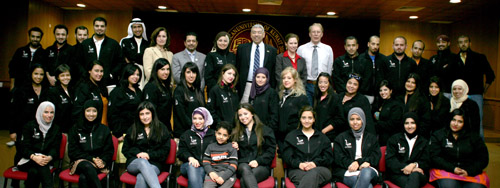
There are two major sponsors for the trip. MENA Holding Company who paid for all Airfares to the United States, and provided academic supplies to the group. ZAIN who will be covering all the costs of the two-day intensive training programs in Washington DC. The US Embassy in Kuwait will offer an orientation Seminar for the participants.
MRKT 389 is the 3rd study abroad trip organized by the Business and Economics Division during the Spring 2010. The first was to Mexico (FINC 389), and the Second was to Milan, Italy (FINC 389). Such Study Abroad trips will enrich the global business educational experience of AUK students, and provide them with a competitive edge in the job market.
Faisal G. Al-Bahairi, an AUK sophomore majoring in English, won first prize at the inaugural Gulf International Chopin Piano Competition on March 20, 2010. Al-Bahairi competed against more than eighty talented participants from around the world, including those from the Gulf and other Middle Eastern countries, Poland, Armenia, and several Asian nations.
Al-Bahairi said, "I am so happy to have won. The competition was steep and everyone was intense. My one concern was half of the participants were my friends, all excellent pianists. We were all afraid that one of us would win and the others would be upset. But we agreed beforehand, that no matter what, nothing would change. We would stay friends and support each other."
Along with taking first prize in the over 12 competition, Al-Bahairi also won the Sheikh Nasser Sabah Al Ahmad Al-Sabah Special Prize, the Hungarian Embassy Prize for best performance of a Liszt piece, and best Kuwaiti participant prize. Al-Bahairi said, "I am especially proud that I was able to represent my country. I decided for the performance to wear a dishdasha, my national dress. I think it is important to let people know, you can be very interested in international culture, but still be proud of your own country and people."
Al-Bahairi is a piano student of Dr. Elena Tsenkova, and he would "like to thank her greatly for all of her help and support."

The program was executed in association with AUK clubs and organizations such as the Diplomatic Club, MUN-AUK, Al Akhdar Environmental Club, and the Entrepreneurship and Business Club. A number of volunteer students joined forces with The Office of Student Life to ensure the smooth running of the diverse events that the week offered.
Each day of the week was dedicated to a region of the world. The first day, Africa and the Arab World Day, saw representatives from a variety of African and Arab embassies in Kuwait participate in the Country Recourses Fair. The Participating countries include Niger, Sudan, Morocco, Egypt, Jordan, Syria, UAE and Saudi Arabia. Other countries represented by AUK students included Qatar and Lebanon.
The second day was designated as Europe day. This day saw a variety of European countries' embassies partake in the Country Resource Fair. Representatives from countries like France, Germany, the Netherlands, Czech Republic, Poland and Azerbaijan were all present on campus. Other countries represented by AUK students included Belgium, Spain, Italy and Armenia.
The third day, North and South America Day, witnessed representatives from the embassies of the United States of America, Canada and Argentina take part in the Country Resource Fair. In addition to these countries, Amideast Organization was also present on campus.
The same day was host to The Global Warming Forum. This event involved a fruitful discussion presented by Dr. Lulwa Ali an Environmental Research Scientist from Kuwait Institute for Scientific Research, Ms. Sandra Al-Saleh Managing Partner of Equilibrium, Prof. Ralph Palliam AUK's Associate Professor of Business Administration, AUK's Prof. Ahlam Alaki -Assistant Professor of English and MUNAUK and Al Akhdar Environmental Club representatives. The discussion panel oversaw the effects of global warming and climate change from a scientific, social and economic stand point.
Asia Day, saw representatives from a variety of countries embassies in Kuwait partake in the Country Resources Fair; countries included Russia, Pakistan, Malaysia, and Japan. During the Country Resources Fair, countries had the opportunity to represent themselves to a diverse body of AUK students, faculty and staff. This AUK body had the opportunity to ask the representatives from the various embassies a large array of questions related to the countries people, their history, culture and tourism. Representatives also offered informational presentations.
On the last day, The Global Village Day, students were encouraged to celebrate cultural diversity. Students represented their culture through traditionally rich elements, such as food, music, and art. A competition was held for the best country representation where the best three student-run groups were awarded prizes. The Global Village Day activities also included a traditional dress competition where three winners were awarded prizes.
The 5th Annual International Week provided various opportunities for students to interact and engage in meaningful experiential learning activities. This allowed them to deepen their understanding and appreciation of cultural differences. It also cultivated a sense of social responsibility to others, fostered cultural collaboration, and communication, as well as offered civic, personal, and organizational leadership.
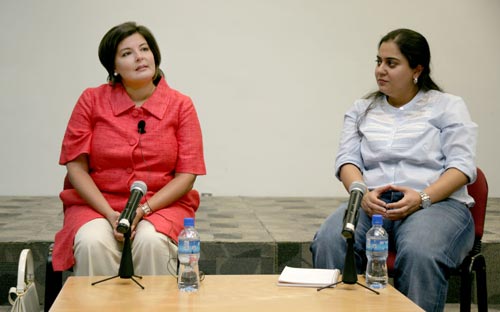
MP Al-Awadhi took questions from the crowd regarding some of the challenges she faces as a female in Parliament, the future of education in Kuwait and the current state of politics and policy making in the country. In the spirit of International Women's Day, MP Al-Awadhi advised young females to have confidence in themselves and in their abilities and to be persistent in whatever it is they try to attain in life. She encouraged them to raise society's standards of women and to formulate their own identity.
MP Al-Awadhi ended the lively discussion by thanking the audience and AUK for inviting her and for creating a venue whereby such discussions can take place.
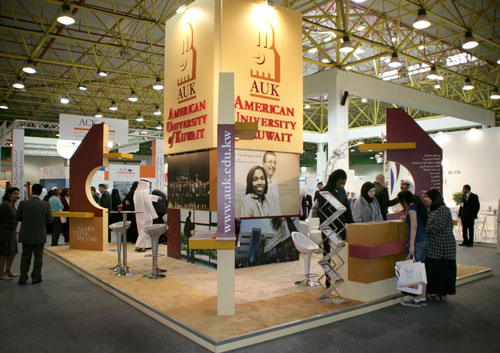
The AUK Admissions team will be available at the exhibition to offer information and answer questions about the admissions process, campus life, and the different academic programs available at the University. Currently, the University offers the following degree programs:
Bachelor of Business Administration (BBA) in: Accounting, Finance, Marketing, Economics, and Management.
Bachelor of Arts (BA) in: Communication and Media, English, Graphic Design, International Studies, and Social and Behavioral Sciences.
Bachelor of Science (BS) in: Computer Science, Information Systems.
Bachelor of Engineering (BE) in: Computer Engineering
In addition, the Intensive English Program (IEP) at AUK offers courses that are designed to prepare non-native English speakers for the academic tasks required of them in their first and successive years of university education.
Representatives from the Center for Continuing Education (CCE) at AUK will also be available at the exhibition to inform visitors about the extensive catalog of courses and programs the Center has to offer.
The American University of Kuwait is a liberal arts institution, based on the American model of higher education, fully accredited by the Private Universities Council. AUK has a memorandum of cooperation and understanding with Dartmouth College, an Ivy League institution established in 1769, in New Hampshire (USA).
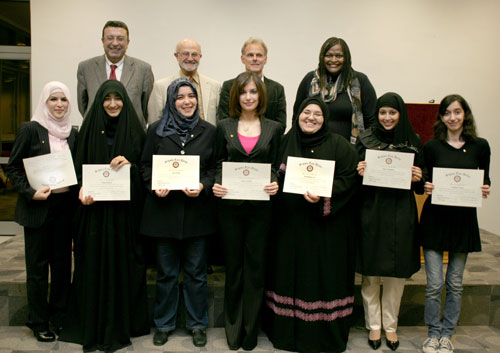
The induction welcomed family members of the eight students receiving their membership pins and certificates from Sigma Tau Delta and words of encouragement, congratulations and guidance from the AUK administration and faculty. During the course of the ceremony Dr. Tim Sullivan, AUK's Interim President, Dr. Nizar Hamzeh, Dean of the College of Arts & Sciences and Dr. Craig Loomis, Division Head of Humanities & Arts offered brief remarks. After the traditional distribution of pins and certificates, Nuha Al-Fadli, Sigma Tau Delta President, concluded the night by thanking families and instructors for their support and dedication, and for fostering an environment of free critical, cultural, and intellectual exchange. It is through this combined effort that the inductees are prepared to uphold the Sigma Tau Delta's motto of "sincerity, truth and design."
To become honor society members, AUK students had to earn above a 3.1 GPA in upper level courses in English literature and be recommended by their professors as students who represent the best in scholarship and honor at AUK.
As one of the newest chapters in Sigma Tau Delta, the Alpha Rho Eta chapter at AUK is committed to excellence in the discipline of English and takes its responsibility of being a "first" in the Middle East seriously. Seeking to embrace that responsibility, the members plan to host an event that celebrates literature at AUK and to deliver a panel presentation in the United States.
In March, some of the AUK English honor society will present a panel at the 2010 Sigma Tau Delta convention in St. Louis, Missouri. Entitled Sand, Camels, Oil and Shakespeare: Reconciling our Arabian Gulf Identity with Studying English Literature, AUK's panel will take a comparative, intercultural, interdisciplinary approach to our experience as literature majors in the Middle East. In weaving literary theory, anthropological research, and cultural studies, members will demonstrate the breadth of knowledge and leadership skills AUK students manage to acquire while remaining sensitive to regional and cultural restrictions. Through this exciting academic experience, the presenters wish to shatter some of the misconceptions that enshroud Gulf countries and raise greater awareness to the unique position their citizens occupy as both members of the Muslim society and larger global community. Hence, they will seek to modify current academic and political discourse that centers on the Middle East.
In addition to educating convention attendees, the participants will also have the opportunity to meet internationally renowned writers such as Chris Abani, author of Song for Night and Graceland, Judith Ortiz Cofer, author of The Meaning of Consuelo and Li-Young Lee, author of The Winged Seed: A Rememberance and The City in Which I Love You.
Before traveling to the United States, the Sigma Tau Delta members will share their passion for literature and the arts with the larger AUK community by hosting a read-in in an Arabic setting. They will invite AUK students, faculty and staff to read from Chris Abani, author of Song for Night in a simple tribute to the magical quality of the written word.
While Sigma Tau Delta is a new organization at AUK, it holds great potential for its members and the larger AUK community. When asked about her experience, Nuha Al-Fadli stated, "It is truly a privilege to belong to such a prestigious and intellectually stimulating organization. We all have great hopes for Sigma Tau Delta. I am sure our chapter will bring unique ideas and exciting events to both AUK and Sigma Tau Delta."
Sigma Tau Delta Faculty Advisor
Dr. Kathy Nixon
Sigma Tau Delta Officers:
President: Nuha Al-Fadli
Vice President: Fatema Al-Haji
Secretary: Alia Aref
Treasurer: Amnah Ibraheem
Sigma Tau Delta Members:
Nur Soliman
Kawther Sadeq
Dana Al-Failakawi
Mohammed Hassan
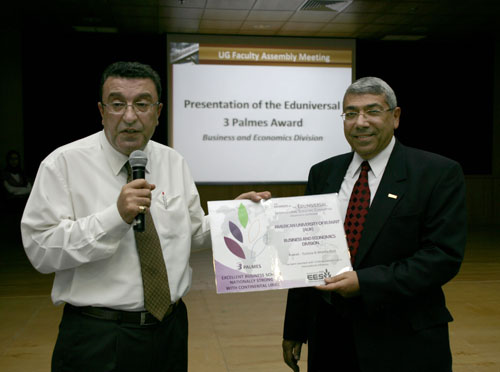
Eduniversal is the first international organization to offer a truly universal perspective on higher education. Eduniversal offers a unique service providing students, professionals, HR executives and academic officers with a global panorama of the best educational opportunities.
Eduniversal spent a tremendous amount of time researching and compiling a comprehensive study of over 4000 websites to select the best 1000 business schools and then to award a selection of those universities with a 3 Palms Award.
Eduniversal's International Scientific Committee is responsible for the official selection of business schools and is composed of 12 members. It has established a global mapping system meeting the criteria of universality and the international reputation of each academic institution. Each country and each continent is represented according to a quota method. The number per country is weighted by quantitative and qualitative criteria.
Courtesy of UN HABITAT
The United Nations Human Settlements Programme Office for Arab Cities in Kuwait announced the winners for the 2010 Writing Competition entitled "Cities, Climate Change and Youth" organized in cooperation with the Lothan Youth Achievement Center (LOYAC). First place went to Ms. Shaha Bader Al-Munaifi of the American University of Kuwait, second place went to Ms. Samah Muhammad Khalid at Box Hill College Kuwait and third place went to Mr. Nasser Sharaf Al-Ajmi at the American University of Kuwait.
Dr. Tarek El Sheikh Chief of UN HABITAT Kuwait Office confirmed that the judging of the submitted essays was conducted with full transparency and neutrality. This expert panel was comprised of the following personalities: Dr. Manaf Behbehani of the Department of Biological Sciences in the Faculty of Science at Kuwait University, Dr. Omar Khattab, Associate Professor in the Department of Architecture in the College of Engineering and Petroleum at Kuwait University, Dr. Ali Khuraibet, General Manager of ECO Environmental Consultant, Ms. Faten Al-Mussalam, Director of the Environmental Strategy Office in the Environment Public Authority for the State of Kuwait, Sandra Al-Saleh, Managing Partner of Equilibrium, Mr. Abdulatif Al-Mishari and Ms. Alya Al-Hamad who served as youth representatives for LOYAC youth organization, UN HABITAT's organizing partner for the event panel, and Dr. Samira Omar Asem, Division Director of the Food Resources and Marine Sciences Division at the Kuwait Institute for Scientific Research. Dr. Tarek El-Sheikh and Ms. Fareah Al-Saqqaf, Vice Chairperson and Managing Director of LOYAC served as observers to the event.
The office announced the competition in mid-November and received many contributions from young people studying at universities in Arab countries regardless of their nationality and this indicates a high level of awareness among youth in Arab universities and an eagerness to participate in the human development and urban development of cities. The impact of climate change takes place in cities, towns and villages. They in turn have the greatest impact on climate change. At the same time, cities present a great potential for implementation of innovative climate change measures.
Dr. Tarek El Sheikh, Chief of the UN HABITAT Office, acknowledged the role and efforts of the expert panel and thanked them for their contributions in the deliberation talks, noting their neutrality, professionalism and transparency.
Victoria Wisniewski Otero, contest coordinator of the program, stated "the United Nations Human Settlements Programme recognizes young people as key stakeholders and active participants in the future of human settlements in order to ensure a brighter urban future for our planet. We must have local solutions to offset global disasters. The youth are some of the people who will be most affected by climate change. At the same time, it's been demonstrated that young individuals can serve as influential change agents in their communities, something that has been verified by the results of this contest."
Dr. Tarek El Sheikh said "It is wonderful to see two Kuwaitis among the top three winners."
The first place winner, Shaha Bader Al Munaifi, will attend the United Nations World Urban Youth Assembly in Rio de Janeiro from March 19-20, 2010 as a guest of the UNITED NATIONS and will get the opportunity to discuss with youth from all over the world the existing urban challenges as well as being received by the Executive Director of UN HABITAT. The runner-ups will receive a certificate of achievement from the UN HABITAT Office, with the possibility to publish their research on our website.
Dr. Tarek El Sheikh appealed to young people in Arab cities to get involved in the events and activities organized by the UN Programme for Human Settlements and said "young people are key to their society and on their shoulders rests a great responsibility for the development and progress of all nations. This can be achieved only through full awareness of issues concerning their city in order to be fully prepared to address the challenges associated with urbanization through scientific research to offer realistic solutions."